 Indietro
General Chemistry Study Guide: Reactions in Aqueous Solutions, Thermochemistry, and Gases
Guida di studio - Note intelligenti
 Appunti personalizzati basati sui tuoi materiali, ampliati con definizioni chiave, esempi e contesto.
Chapter 4: Reactions in Aqueous Solutions
Solubility Rules and Precipitation Reactions
Understanding solubility rules is essential for predicting whether a compound will dissolve in water and whether a precipitation reaction will occur. Solubility guidelines help classify ionic compounds as soluble or insoluble, which is crucial for writing balanced chemical equations and net ionic equations.
Soluble Ionic Compounds: Compounds containing NO3-, CH3COO-, and most halides (Cl-, Br-, I-) are generally soluble, except when paired with Ag+, Hg22+, or Pb2+.
Insoluble Ionic Compounds: Compounds containing S2-, CO32-, PO43-, and OH- are generally insoluble, except with NH4+ and alkali metal cations.
Precipitation Reaction: Occurs when two soluble salts are mixed and form an insoluble product (precipitate).
Net Ionic Equation: Shows only the species that participate in the reaction, omitting spectator ions.
Example: Mixing aqueous solutions of calcium chloride and sodium carbonate forms a precipitate of calcium carbonate.
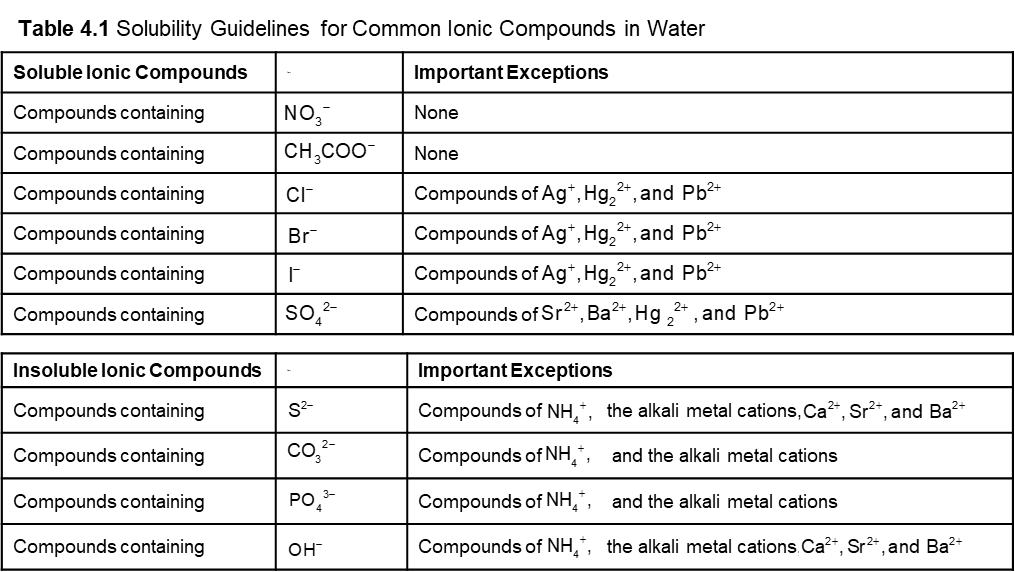
Table Purpose: The table provides solubility guidelines for common ionic compounds in water, listing exceptions for each rule.
Soluble Ionic Compounds | Important Exceptions |
|---|---|
Compounds containing NO3- | None |
Compounds containing CH3COO- | None |
Compounds containing Cl- | Ag+, Hg22+, Pb2+ |
Compounds containing Br- | Ag+, Hg22+, Pb2+ |
Compounds containing I- | Ag+, Hg22+, Pb2+ |
Compounds containing SO42- | Sr2+, Ba2+, Hg22+, Pb2+ |
Insoluble Ionic Compounds | Important Exceptions |
|---|---|
Compounds containing S2- | NH4+, alkali metal cations, Ca2+, Sr2+, Ba2+ |
Compounds containing CO32- | NH4+, alkali metal cations |
Compounds containing PO43- | NH4+, alkali metal cations |
Compounds containing OH- | NH4+, alkali metal cations, Ca2+, Sr2+, Ba2+ |
Oxidation Numbers and Redox Reactions
Oxidation numbers are assigned to atoms in compounds to track electron transfer in redox reactions. The sum of oxidation numbers in a neutral molecule is zero, and in an ion equals the ion's charge.
Rules: Hydrogen is +1 when bonded to nonmetals; oxygen is usually -2; alkali metals are always +1.
Redox Reaction: Involves the transfer of electrons; one species is oxidized (loses electrons), another is reduced (gains electrons).
Example: Aluminum reacts with hydrobromic acid; aluminum is oxidized, bromine is reduced.
Molarity and Solution Calculations
Molarity (M) is a measure of concentration, defined as moles of solute per liter of solution. Calculations involving molarity are fundamental for preparing solutions and determining the amount of solute required.
Formula:
Example: To prepare 0.425 L of 0.300 M CaCl2 solution, calculate the required grams using molar mass.
Chapter 5: Thermochemistry
Pressure–Volume Work
Work is done by a system when it expands or contracts against an external pressure. The pressure–volume work is calculated using the change in volume and the constant pressure.
Formula:
Unit Conversion: 1 L·atm = 101.3 J
Example: If a piston expands from 0.250 L to 0.980 L against 1.35 atm, calculate the work in joules.
Enthalpy and Heat Transfer
Enthalpy change (ΔH) represents the heat absorbed or released at constant pressure. The relationship between heat, temperature change, and heat capacity is used to calculate energy changes in substances.
Formula:
Molar Heat Capacity: The heat capacity of one mole of a substance.
Example: Calculate the heat needed to warm 250 g of water from room temperature to near boiling.
Chapter 10: Gases
The Ideal Gas Law
The ideal gas law relates pressure, volume, temperature, and number of moles of a gas. It is fundamental for calculations involving gases under various conditions.
Formula:
Variables: P = pressure (atm), V = volume (L), n = moles, R = gas constant (0.0821 L·atm·mol-1·K-1), T = temperature (K)
Gas Density and Molar Mass
Gas density and molar mass can be determined using the ideal gas law and measurements of mass, volume, pressure, and temperature.
Density Formula:
Molar Mass Calculation: Use mass and volume of gas, along with pressure and temperature, to find molar mass.
Example: Calculate the density of carbon tetrachloride vapor at 714 torr and 398 K.
Example: To determine the molar mass of an unknown gas, measure the mass of the gas-filled flask, subtract the mass of the evacuated flask, and use the ideal gas law.
