 Indietro
Integrated Rate Laws, Reaction Kinetics, and Mechanisms in General Chemistry
Guida di studio - Note intelligenti
 Appunti personalizzati basati sui tuoi materiali, ampliati con definizioni chiave, esempi e contesto.
Change in Concentration with Time: Integrated Rate Laws
First-Order Reactions
First-order reactions are characterized by a rate law where the rate is directly proportional to the concentration of a single reactant. The integrated rate law allows calculation of reactant concentration at any time.
Rate Law:
Integrated Rate Law: or
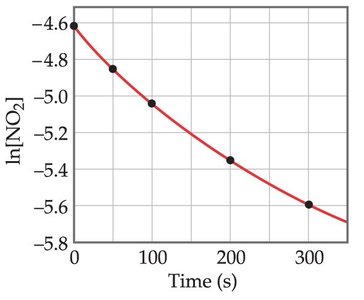
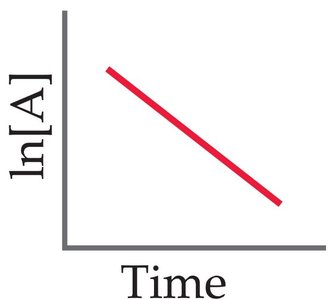
Graphical Representation: A plot of vs. time yields a straight line with slope .
Application to Gases: Partial pressure can substitute for concentration in rate laws due to the ideal gas law.
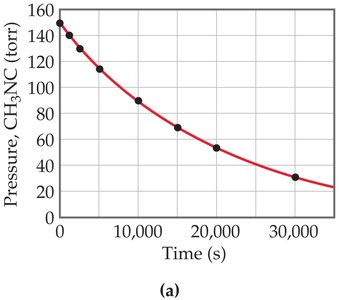
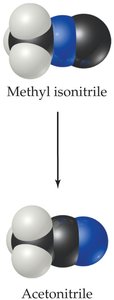
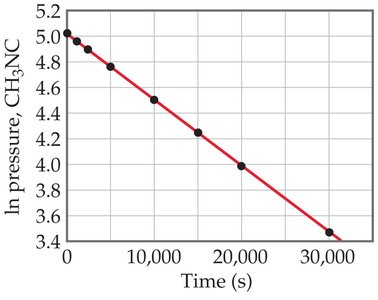
Second-Order Reactions
Second-order reactions involve either two molecules of the same reactant or two different reactants. The integrated rate law for second-order reactions is distinct from first-order.
Rate Law:
Integrated Rate Law: or
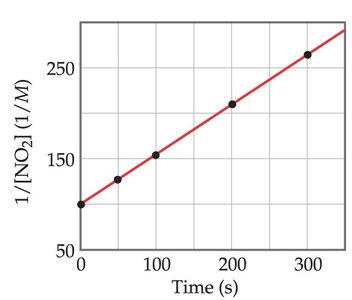
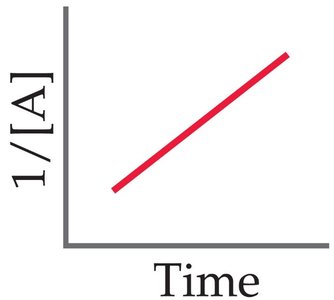
Graphical Representation: A plot of vs. time yields a straight line with slope .
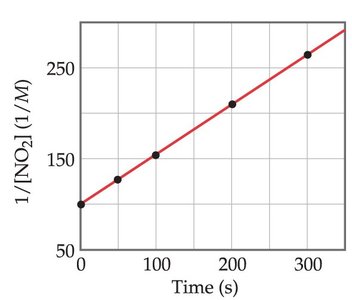
Example: Decomposition of Nitrogen Dioxide
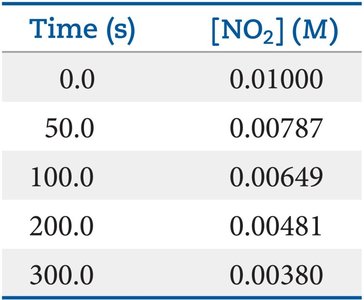
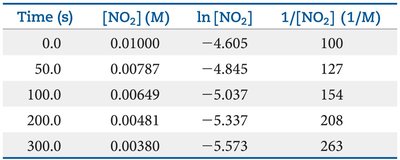
The decomposition of NO2 was analyzed to determine its reaction order. Data for concentration over time were collected and transformed for both first- and second-order plots.
Time (s) | [NO2] (M) |
|---|---|
0.0 | 0.01000 |
50.0 | 0.00787 |
100.0 | 0.00649 |
200.0 | 0.00481 |
300.0 | 0.00380 |
Time (s) | [NO2] (M) | ln [NO2] | 1/[NO2] (1/M) |
|---|---|---|---|
0.0 | 0.01000 | -4.605 | 100 |
50.0 | 0.00787 | -4.845 | 127 |
100.0 | 0.00649 | -5.037 | 154 |
200.0 | 0.00481 | -5.337 | 208 |
300.0 | 0.00380 | -5.573 | 263 |
Zero-Order Reactions
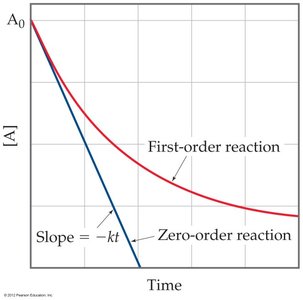
Zero-order reactions have a rate independent of reactant concentration. These are often observed in catalytic reactions where the catalyst surface is saturated.
Rate Law:
Integrated Rate Law:
Graphical Representation: A plot of vs. time yields a straight line with slope .
Summary of Integrated Rate Laws
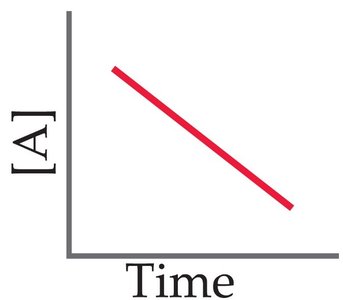
The order of a reaction determines the form of the integrated rate law and the type of plot that yields a straight line.
Order | Linear Plot |
|---|---|
0th | [A] vs t |
1st | ln[A] vs t |
2nd | 1/[A] vs t |
Half-Life of Reactions
Definition and Calculation
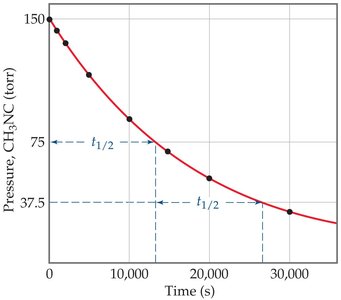
The half-life () is the time required for the concentration of a reactant to decrease to half its initial value. The formula for half-life depends on the reaction order.
First-Order: (independent of initial concentration)
Second-Order:
Zero-Order:
Reaction Rate and Temperature
Collision Model and Activation Energy
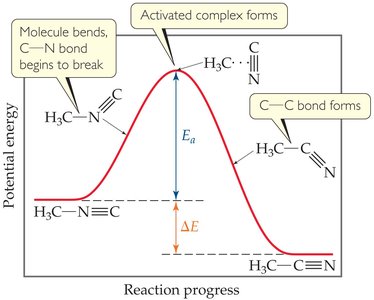
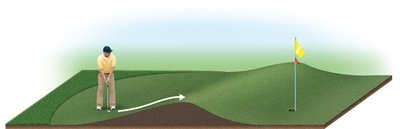
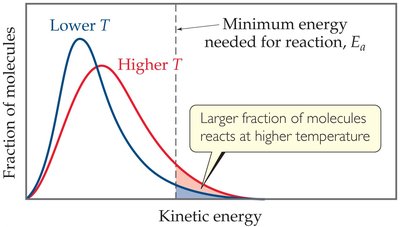
Reaction rates depend on the frequency and orientation of molecular collisions, as well as the activation energy () required to initiate the reaction.
Collision Theory: Molecules must collide with proper orientation and sufficient energy.
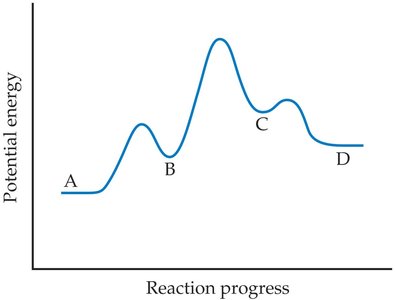
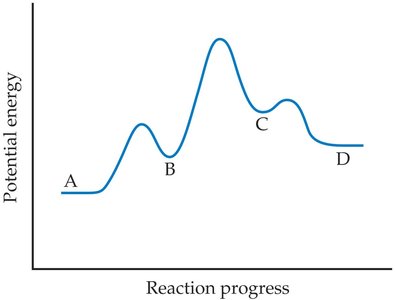
Energy Profile Diagram: Shows the energy changes during a reaction, including and .
Temperature Dependence of Rate Constant
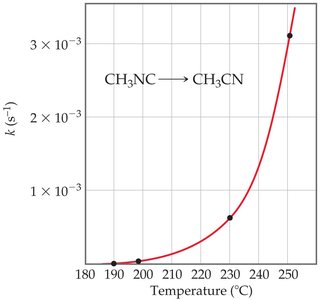
The rate constant () increases with temperature, as more molecules have energy greater than .
Arrhenius Equation
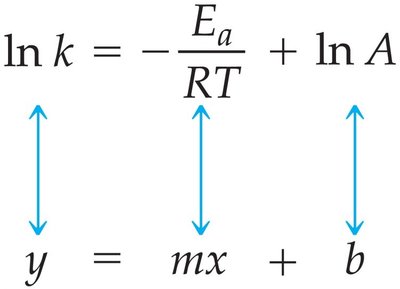
The Arrhenius equation relates the rate constant to temperature and activation energy:
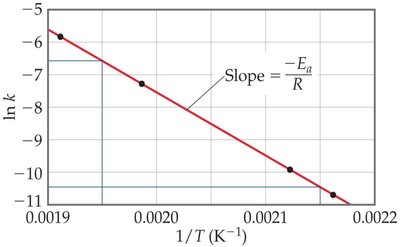
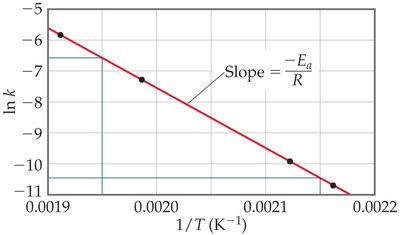
Linearized:
Graphical: Plotting vs yields a straight line with slope .
Reaction Mechanisms
Elementary Reactions and Molecularity
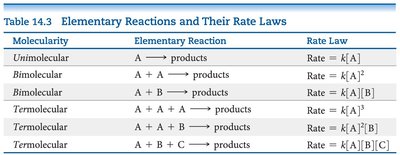
Elementary reactions occur in a single step and are classified by the number of reactant molecules involved (molecularity).
Molecularity | Elementary Reaction | Rate Law |
|---|---|---|
Unimolecular | A → products | Rate = k[A] |
Bimolecular | A + A → products | Rate = k[A]^2 |
Bimolecular | A + B → products | Rate = k[A][B] |
Termolecular | A + A + A → products | Rate = k[A]^3 |
Termolecular | A + A + B → products | Rate = k[A]^2[B] |
Termolecular | A + B + C → products | Rate = k[A][B][C] |
Multistep Reactions and Rate-Determining Step
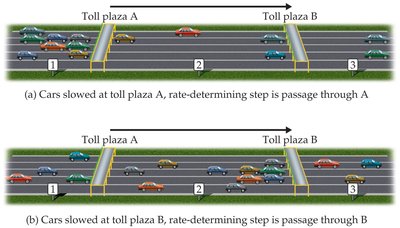
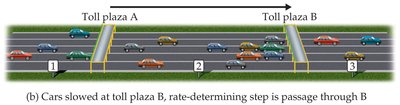
Complex reactions often proceed through multiple steps. The slowest step, known as the rate-determining step, controls the overall reaction rate.
Intermediates: Species formed in one step and consumed in another.
Mechanism Analysis: The rate law is deduced from the slowest elementary step.
Summary Table: Integrated Rate Laws and Half-Lives
Order | Integrated Rate Law | Linear Plot | Half-Life Formula |
|---|---|---|---|
Zero | [A] vs t | ||
First | ln[A] vs t | ||
Second | 1/[A] vs t |
Additional info: These notes expand on the original content by providing definitions, formulas, and context for each reaction order, as well as a summary table for quick reference.
