 Indietro
Intermolecular Forces and Their Effects on Physical Properties
Guida di studio - Note intelligenti
 Appunti personalizzati basati sui tuoi materiali, ampliati con definizioni chiave, esempi e contesto.
Intermolecular Forces: An Overview
Introduction to Intermolecular Forces
Intermolecular forces are the attractive forces that exist between molecules and are responsible for many physical properties of substances, such as boiling point, melting point, viscosity, and solubility. Understanding these forces allows us to explain why substances behave differently under various conditions.
Boiling Point: The temperature at which a liquid changes to a gas. At the molecular level, boiling occurs when intermolecular forces are overcome by thermal energy, allowing molecules to escape into the gas phase.
Types of Intermolecular Forces: These include London dispersion forces, dipole-dipole interactions, hydrogen bonds, and ion-dipole interactions.
London Dispersion Forces (LDF)
Origin and Nature of London Dispersion Forces
London dispersion forces are the weakest type of intermolecular force and are present in all atoms and molecules, especially nonpolar ones. They arise due to temporary fluctuations in electron distribution, creating instantaneous dipoles that induce dipoles in neighboring atoms or molecules.
Temporary Dipoles: Even nonpolar molecules can have momentary uneven electron distributions, leading to weak attractions.
Polarizability: The ease with which the electron cloud of an atom or molecule can be distorted to form a dipole. Larger atoms/molecules are more polarizable, leading to stronger dispersion forces.
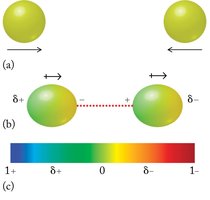
Trends in Boiling Points and Polarizability
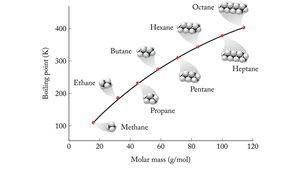
The strength of London dispersion forces increases with the size and molar mass of the molecule, which is reflected in higher boiling points for larger molecules.
Hydrocarbons: As the size of alkanes increases, so does their boiling point due to increased polarizability.
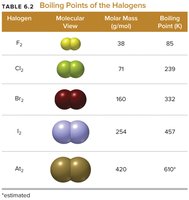
Halogens: The boiling points of halogens increase with molar mass, reflecting stronger dispersion forces.
Halogen | Molecular View | Molar Mass (g/mol) | Boiling Point (K) |
|---|---|---|---|
F2 | ... | 38 | 85 |
Cl2 | ... | 71 | 239 |
Br2 | ... | 160 | 332 |
I2 | ... | 254 | 457 |
At2 | ... | 420 | 690* |
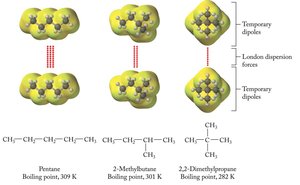
Effect of Molecular Shape on Dispersion Forces
The surface area of a molecule affects the strength of London dispersion forces. Isomers with greater surface area have higher boiling points due to increased contact area for intermolecular attractions.
Structural Isomers: Pentane, 2-methylbutane, and 2,2-dimethylpropane have the same formula but different shapes, leading to different boiling points.
Viscosity and Molecular Size
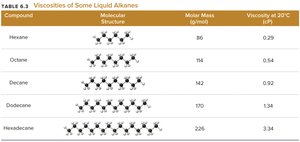
Viscosity, the resistance of a liquid to flow, increases with molecular size due to stronger intermolecular forces.
Compound | Molecular Structure | Molar Mass (g/mol) | Viscosity at 20°C (cP) |
|---|---|---|---|
Hexane | ... | 86 | 0.29 |
Octane | ... | 114 | 0.54 |
Decane | ... | 142 | 0.92 |
Dodecane | ... | 170 | 1.34 |
Hexadecane | ... | 226 | 3.34 |
Dipole-Dipole Interactions
Nature of Dipole-Dipole Forces
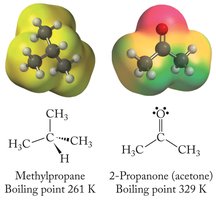
Dipole-dipole interactions occur between polar molecules, where the positive end of one molecule is attracted to the negative end of another. The strength of these interactions depends on the magnitude of the dipole moment and molecular geometry.
Polarity: Molecules with permanent dipoles interact more strongly than nonpolar molecules.
Example: Acetone (2-propanone) has a higher boiling point than methylpropane due to dipole-dipole interactions in addition to London dispersion forces.
Hydrogen Bonding
Definition and Requirements
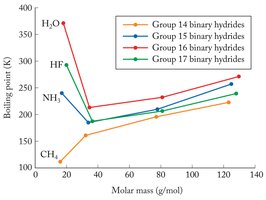
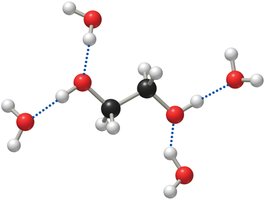
Hydrogen bonding is a special, strong type of dipole-dipole interaction that occurs when hydrogen is bonded to highly electronegative atoms (N, O, or F). These bonds are much stronger than regular dipole-dipole interactions.
Boiling Point Anomalies: Compounds like H2O, HF, and NH3 have unusually high boiling points due to hydrogen bonding.
Hydrogen Bond Donors and Acceptors: The hydrogen atom must be bonded to N, O, or F, and the acceptor must have a lone pair on N, O, or F.
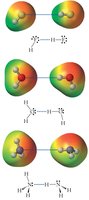
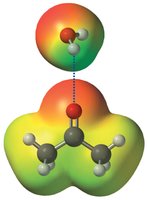
Hydrogen Bonding with Other Molecules: For example, acetone cannot hydrogen bond with itself but can form hydrogen bonds with water.
Comparing Boiling Points and Dipole Moments
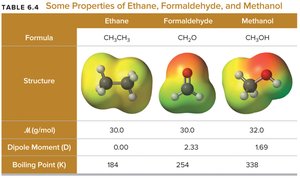
Hydrogen bonding can lead to higher boiling points even when dipole moments do not directly correlate.
Formula | Structure | M (g/mol) | Dipole Moment (D) | Boiling Point (K) |
|---|---|---|---|---|
CH3CH3 | ... | 30.0 | 0 | 184 |
CH2O | ... | 30.0 | 2.33 | 254 |
CH3OH | ... | 32.0 | 1.69 | 338 |
Biological Importance of Hydrogen Bonding
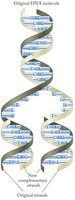
Hydrogen bonding is critical for the structure of proteins and nucleic acids (DNA). Proper and improper hydrogen bonding determines the fidelity of DNA replication. 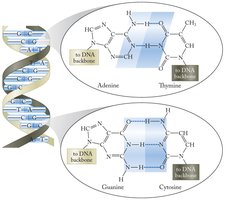
Ion-Dipole Interactions and Solubility
Ion-Dipole Interactions
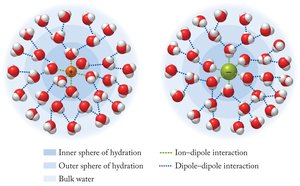
Ion-dipole interactions occur when ionic compounds dissolve in polar solvents like water. The ions are stabilized by the partial charges of the solvent molecules, forming spheres of hydration (solvation).
Example: When NaCl dissolves in water, ion-ion interactions are replaced by ion-dipole interactions.
Solubility and Factors Affecting It
Solubility is the maximum amount of solute that can dissolve in a given solvent at a specific temperature. It depends on the balance of solute-solute, solvent-solvent, and solute-solvent interactions.
Like Dissolves Like: Polar solvents dissolve polar solutes; nonpolar solvents dissolve nonpolar solutes.
Hydrogen Bonding: Substances capable of hydrogen bonding with water are generally more soluble.
Dipole-Induced Dipole Interactions
Polar molecules can induce dipoles in nonpolar molecules, leading to weak attractions and limited solubility. 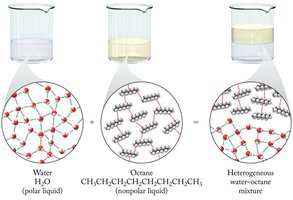
Solubility of Ketones in Water
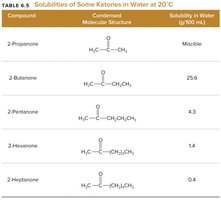
As the nonpolar region of a molecule increases, its solubility in water decreases, even if it contains a polar group.
Compound | Condensed Structure | Solubility in Water (g/100 mL) |
|---|---|---|
2-Propanone | CH3COCH3 | Miscible |
2-Butanone | CH3COC2H5 | 25.6 |
2-Pentanone | CH3COC3H7 | 4.3 |
2-Hexanone | CH3COC4H9 | 1.4 |
2-Heptanone | CH3COC5H11 | 0.4 |
Phase Diagrams and Unusual Properties of Water
Phase Diagrams
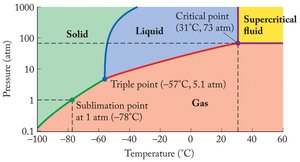
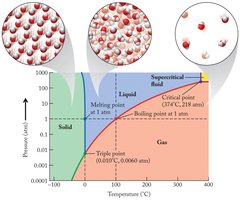
Phase diagrams show the physical state of a substance as a function of temperature and pressure. They illustrate the conditions for solid, liquid, and gas phases, as well as the triple point and critical point.
CO2 Phase Diagram: Shows typical behavior with solid, liquid, and gas regions, and a supercritical fluid above the critical point.
H2O Phase Diagram: Water has unusual behavior; its solid-liquid boundary has a negative slope, indicating that ice melts under pressure.
Surface Tension and Meniscus
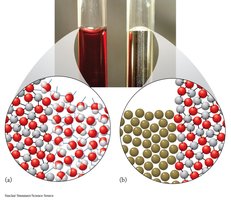
Water has high surface tension due to strong hydrogen bonding. The meniscus shape depends on the balance between adhesive and cohesive forces.
Water: Concave meniscus due to strong adhesion to glass.
Mercury: Convex meniscus due to stronger cohesion among Hg atoms.
Capillary Action and Density of Ice
Capillary action occurs when adhesive forces between water and a surface draw water upward in narrow tubes. Water expands upon freezing due to the open, extended structure of ice formed by hydrogen bonding, making ice less dense than liquid water.
Biological Implications: The lower density of ice allows it to float, insulating aquatic life in cold climates.
