 Indietro
Intermolecular Forces, Properties of Liquids and Solids, and Phase Changes
Guida di studio - Note intelligenti
 Appunti personalizzati basati sui tuoi materiali, ampliati con definizioni chiave, esempi e contesto.
Intermolecular Forces, Properties of Liquids and Solids, and Phase Changes
Properties of Gases, Liquids, and Solids
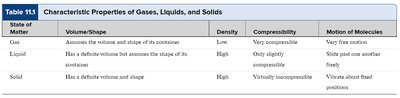
Understanding the properties of the three main states of matter—gases, liquids, and solids—is fundamental in chemistry. Each state is characterized by distinct physical properties due to the nature and strength of intermolecular forces present.
Gases: Assume the volume and shape of their containers, are easily compressible, form homogeneous mixtures, and have low density.
Liquids: Have a definite volume but assume the shape of their container, are only slightly compressible, and have higher density than gases.
Solids: Have a definite volume and shape, are virtually incompressible, and have the highest density among the three states.
State of Matter | Volume/Shape | Density | Compressibility | Motion of Molecules |
|---|---|---|---|---|
Gas | Assumes the volume and shape of its container | Low | Very compressible | Very free motion |
Liquid | Has a definite volume but assumes the shape of its container | High | Only slightly compressible | Slide past one another freely |
Solid | Has a definite volume and shape | High | Virtually incompressible | Vibrate about fixed positions |
Phases and Phase Changes
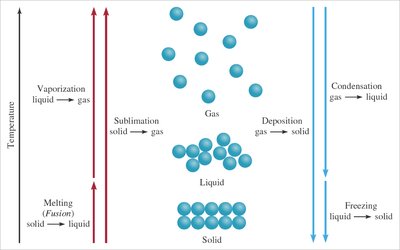
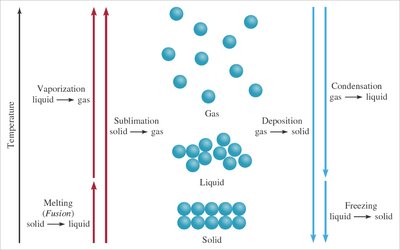
A phase is a homogeneous part of a system with a well-defined boundary. Substances can transition between solid, liquid, and gas phases through phase changes such as melting, freezing, vaporization, condensation, sublimation, and deposition.
Intermolecular Forces (IMAFs)
Types of Intermolecular Forces
Intermolecular forces (IMAFs) are the attractive forces between molecules that determine the physical properties of substances. They are distinct from intramolecular forces (bonds within molecules).
Dispersion (London) Forces: Weakest IMAF, present in all molecules due to temporary dipoles. Strength increases with molecular size.
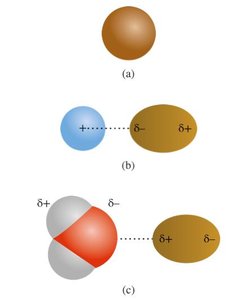
Dipole-Induced Dipole: Occur when a polar molecule induces a dipole in a nonpolar molecule by distorting its electron cloud.
Dipole-Dipole: Occur between polar molecules with permanent dipole moments, resulting in stronger interactions.
Ion-Dipole: Occur between ions and polar molecules, important in solutions (e.g., salt dissolving in water).
Hydrogen Bonding: Strongest IMAF, a special case of dipole-dipole interaction involving hydrogen bonded to N, O, or F interacting with N, O, or F in another molecule.
Dispersion Forces
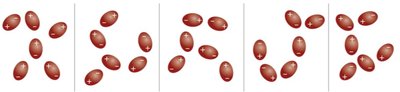
Dispersion forces arise from temporary fluctuations in electron distribution, creating instantaneous dipoles that induce dipoles in neighboring molecules. These forces are present in all substances and increase with molecular size and surface area.
Dipole-Induced Dipole Forces
These forces occur when a polar molecule induces a dipole in a nonpolar, polarizable molecule. Polarizability refers to the ease with which the electron cloud of a molecule can be distorted.
Dipole-Dipole Forces
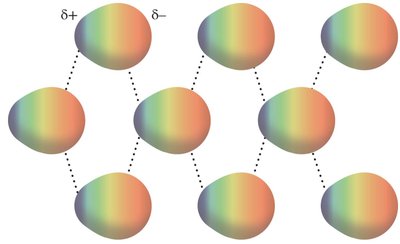
Dipole-dipole interactions are the attractive forces between polar molecules, which have permanent dipole moments. These interactions are stronger than dispersion forces.
Ion-Dipole Forces
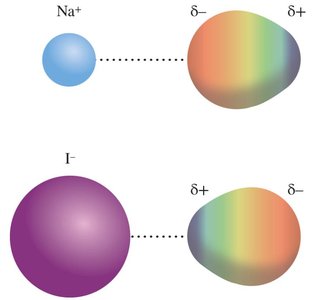
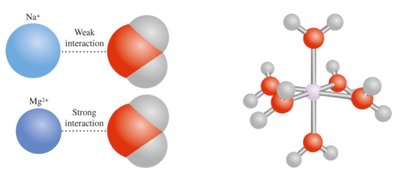
Ion-dipole interactions occur between an ion and a polar molecule. These are especially important in the dissolution of ionic compounds in polar solvents, such as salts in water.
Hydrogen Bonding
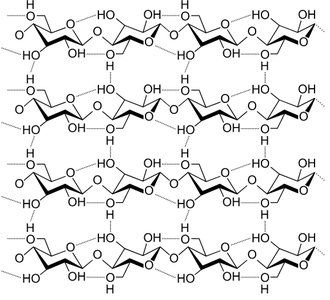
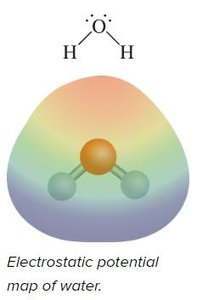
Hydrogen bonding is a strong type of dipole-dipole interaction that occurs when hydrogen is bonded to nitrogen, oxygen, or fluorine and interacts with N, O, or F in another molecule. Hydrogen bonds are much weaker than covalent bonds but significantly stronger than other IMAFs.
Hydrogen bonding is responsible for many unique properties of water, such as its high boiling point and the lower density of ice compared to liquid water.
Energy of hydrogen bonds: 10–40 kJ/mol (compared to ~464 kJ/mol for O–H covalent bond).
Properties of Liquids
Surface Tension and Capillary Action
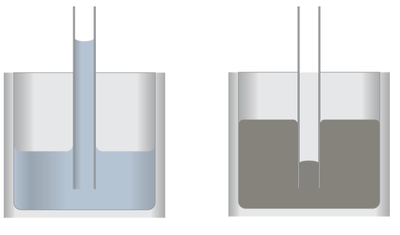
Surface tension is the energy required to increase the surface area of a liquid. It results from cohesive forces between molecules at the surface. Capillary action is the movement of liquid within narrow spaces due to adhesive and cohesive forces.
Cohesion: Attraction between molecules of the same substance.
Adhesion: Attraction between molecules of different substances.
Viscosity
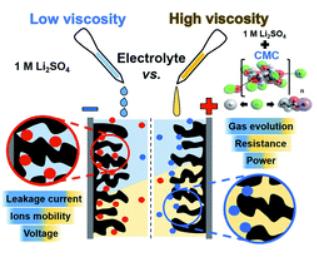
Viscosity is a liquid's resistance to flow. It depends on the strength of intermolecular forces, temperature, and molecular structure (entanglement).
Properties of Water
Water exhibits several unique properties due to hydrogen bonding:
High specific heat capacity
Liquid at room temperature
Ice is less dense than liquid water, causing it to float
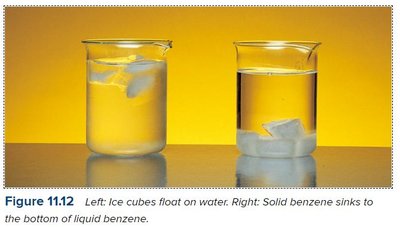
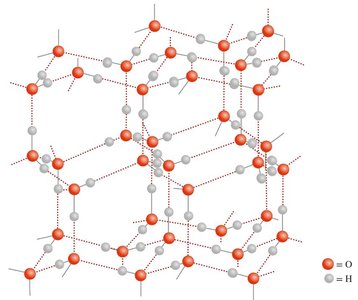
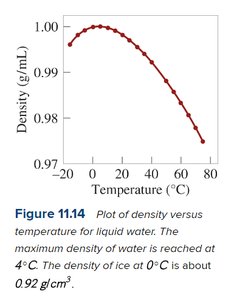
The density of water reaches a maximum at 4°C, and ice (solid water) is less dense than liquid water due to its open hydrogen-bonded structure.
Phase Changes and Energetics
Evaporation and Condensation
Evaporation is the process by which molecules escape from the liquid phase into the gas phase. As temperature increases, kinetic energy increases, allowing more molecules to escape. Condensation is the reverse process, where gas molecules return to the liquid phase. At equilibrium, the rates of evaporation and condensation are equal.
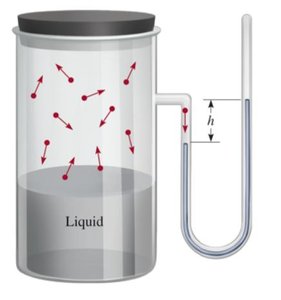
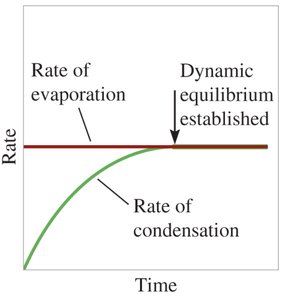
Boiling Point and Clausius-Clapeyron Equation
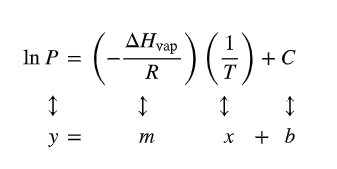
The boiling point is the temperature at which the vapor pressure of a liquid equals the external pressure. The molar heat of vaporization () is the energy required to vaporize one mole of liquid. The Clausius-Clapeyron equation relates vapor pressure and temperature:
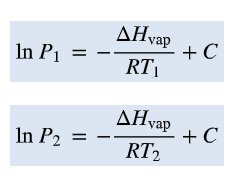
For two temperatures and pressures:
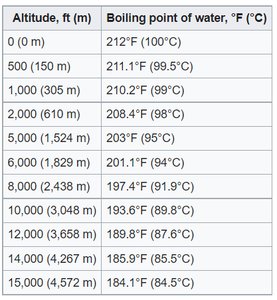
Boiling point varies with external pressure; at higher altitudes, boiling points are lower due to reduced atmospheric pressure.
Critical Temperature and Pressure
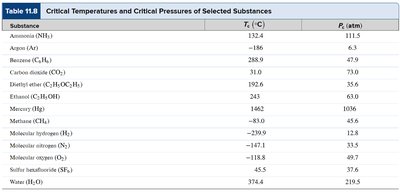
The critical temperature is the highest temperature at which a substance can exist as a liquid, regardless of pressure. The critical pressure is the minimum pressure required to liquefy a substance at its critical temperature.
Substance | Tc (°C) | Pc (atm) |
|---|---|---|
Ammonia (NH3) | 132.4 | 111.5 |
Argon (Ar) | -122.4 | 48.0 |
Benzene (C6H6) | 288.9 | 47.0 |
Carbon dioxide (CO2) | 31.0 | 73.0 |
Water (H2O) | 374.4 | 219.5 |
Freezing, Melting, and Heats of Fusion
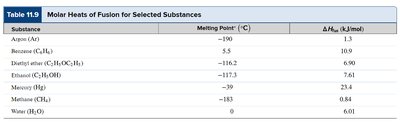
Freezing is the transition from liquid to solid, and melting is the reverse. The molar heat of fusion () is the energy required to melt one mole of solid. At equilibrium, the temperature remains constant until the phase change is complete.
Substance | Melting Point (°C) | (kJ/mol) |
|---|---|---|
Argon (Ar) | -190 | 1.3 |
Benzene (C6H6) | 5.5 | 10.9 |
Diethyl ether (C2H5OC2H5) | -116.2 | 6.90 |
Water (H2O) | 0 | 6.01 |
Sublimation and Deposition
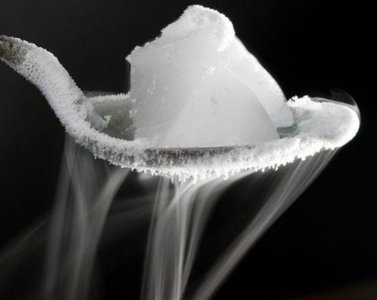
Sublimation is the direct transition from solid to gas, while deposition is the reverse. The heat of sublimation is the sum of the heats of fusion and vaporization.
Phase Diagrams
Understanding Phase Diagrams
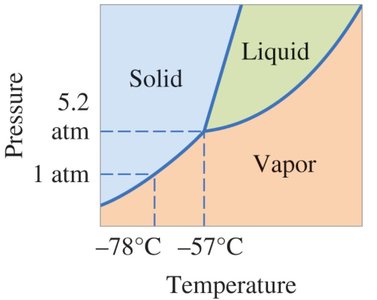
Phase diagrams graphically represent the phases of a substance as a function of temperature and pressure. They show the conditions under which a substance exists as a solid, liquid, or gas, and the lines of equilibrium between phases.
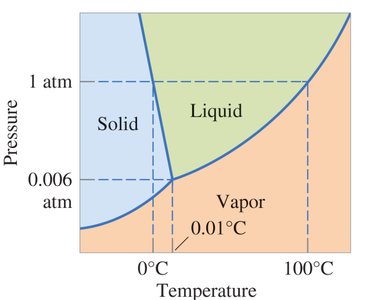
Key features include:
Triple point: The unique set of conditions where all three phases coexist in equilibrium.
Critical point: The end point of the liquid-gas boundary, beyond which the liquid and gas phases are indistinguishable.
Practice with Phase Diagrams
Phase diagrams can be used to answer questions about phase transitions, triple points, and the synthesis of materials (e.g., synthetic diamond from graphite).
Summary Table: Types of Intermolecular Forces
Type of Force | Occurs Between | Relative Strength | Example |
|---|---|---|---|
Dispersion (London) | All molecules | Weakest | I2, CH4 |
Dipole-Induced Dipole | Polar + nonpolar | Weak | O2 in H2O |
Dipole-Dipole | Polar molecules | Moderate | HCl, SO2 |
Ion-Dipole | Ion + polar molecule | Strong | Na+ in H2O |
Hydrogen Bonding | H bonded to N, O, or F | Strongest (IMAF) | H2O, NH3 |
Additional info: This guide expands on the original notes with definitions, examples, and tables for clarity and completeness, suitable for General Chemistry II students.
