 Indietro
Introduction to Chemistry: Classification of Matter, Atoms, and Isotopes
Guida di studio - Note intelligenti
 Appunti personalizzati basati sui tuoi materiali, ampliati con definizioni chiave, esempi e contesto.
Introduction to Chemistry
Overview of Chemistry and the Mole Concept
Chemistry is the scientific study of matter, its properties, composition, and the changes it undergoes during chemical reactions. Understanding the classification of matter and the structure of atoms is foundational for all topics in general chemistry. The mole concept is a central idea that connects the microscopic world of atoms and molecules to the macroscopic quantities used in the laboratory.
Classification of Matter
Types of Matter
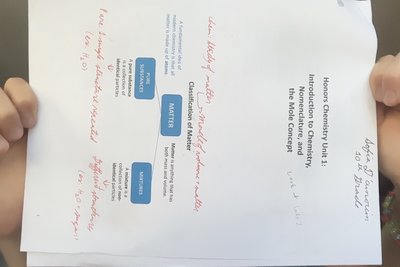
Matter is anything that has mass and occupies space. It can be classified based on its physical and chemical properties into pure substances and mixtures.
Pure Substances: Matter with a fixed composition and distinct properties. Includes elements and compounds.
Mixtures: Physical combinations of two or more substances where each retains its own properties. Can be homogeneous (uniform composition, also called solutions) or heterogeneous (non-uniform composition).
Elements and Compounds
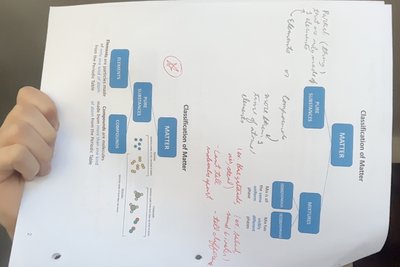
Elements: Substances that cannot be broken down into simpler substances by chemical means. Each element is made up of one kind of atom.
Compounds: Substances composed of two or more elements chemically combined in fixed proportions. Compounds can be broken down into elements by chemical reactions.
Examples: Oxygen (O2) is an element; water (H2O) is a compound.
Mixtures
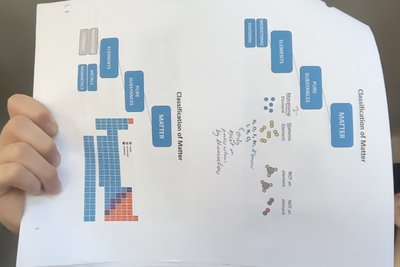
Homogeneous Mixtures (Solutions): The composition is uniform throughout. Example: saltwater.
Heterogeneous Mixtures: The composition is not uniform. Example: salad, sand in water.
Atoms and Elements
Atomic Structure
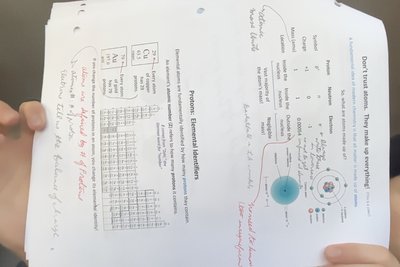
Atoms are the basic units of matter, consisting of a nucleus (protons and neutrons) and electrons in orbitals around the nucleus. The number of protons defines the element.
Proton (p+): Positively charged particle in the nucleus.
Neutron (n0): Neutral particle in the nucleus.
Electron (e-): Negatively charged particle in orbitals around the nucleus.
Isotopes
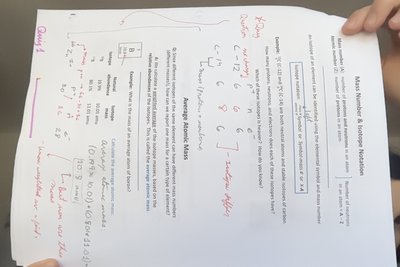
Isotopes are atoms of the same element with the same number of protons but different numbers of neutrons. This results in different mass numbers.
Mass Number (A): The total number of protons and neutrons in the nucleus.
Isotope Notation: AZX, where X is the element symbol, A is the mass number, and Z is the atomic number.
Example: Carbon-12 and Carbon-14 are isotopes of carbon.
Formation of Ions
Ion Formation and Charge
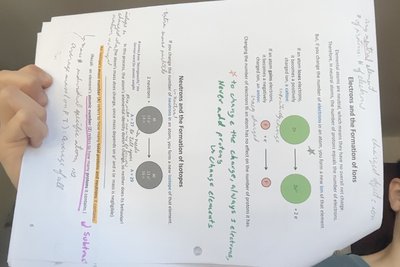
Atoms can gain or lose electrons to form ions. The loss of electrons forms positively charged ions (cations), while the gain of electrons forms negatively charged ions (anions).
Cation: An atom that has lost one or more electrons (e.g., Na+).
Anion: An atom that has gained one or more electrons (e.g., Cl-).
Average Atomic Mass
Calculating Average Atomic Mass
The average atomic mass of an element is calculated using the masses and relative abundances of its naturally occurring isotopes. The formula is:
Example: If an element has two isotopes with masses 10 amu (abundance 20%) and 11 amu (abundance 80%), the average atomic mass is:
Summary Table: Classification of Matter
Type | Description | Example |
|---|---|---|
Element | Pure substance, one type of atom | O2, Fe |
Compound | Pure substance, two or more elements chemically combined | H2O, CO2 |
Homogeneous Mixture | Uniform composition throughout | Saltwater, air |
Heterogeneous Mixture | Non-uniform composition | Salad, sand in water |
Key Terms and Definitions
Matter: Anything that has mass and occupies space.
Element: A pure substance made of only one kind of atom.
Compound: A substance made from two or more elements that are chemically bonded.
Mixture: A combination of two or more substances that are not chemically combined.
Isotope: Atoms of the same element with different numbers of neutrons.
Ion: An atom or molecule with a net electric charge due to the loss or gain of electrons.
Atomic Number (Z): The number of protons in the nucleus of an atom.
Mass Number (A): The total number of protons and neutrons in an atom's nucleus.
