 Indietro
Introduction to General Chemistry: Course Overview and Study Strategies
Guida di studio - Note intelligenti
 Appunti personalizzati basati sui tuoi materiali, ampliati con definizioni chiave, esempi e contesto.
Introduction to Chemistry
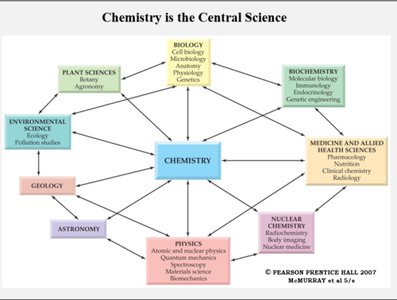
Chemistry as the Central Science
Chemistry is often referred to as the central science because it connects and underpins many other scientific disciplines. Understanding chemistry provides insight into fields such as biology, physics, environmental science, medicine, and engineering. The study of chemistry enables us to answer fundamental questions about the materials and processes that shape our world, from how fertilizers are made to how batteries store energy.
Interdisciplinary Connections: Chemistry is foundational to drug design, quantum computing, pollution ecology, and molecular biology.
Applications: Everyday objects and technologies, such as chairs and smartphones, rely on chemical principles.
Skills Developed in Chemistry
Thinking Like a Chemist
Success in chemistry requires a combination of cognitive and practical skills. Students must develop both deductive and inductive reasoning, memorize rules, and apply them in various contexts. Abstract thinking and the ability to organize large amounts of information are essential, as is physical dexterity for laboratory work.
Deductive Reasoning: Drawing logical conclusions from general principles.
Inductive Reasoning: Recognizing patterns and making generalizations from specific observations.
Memorization: Learning chemical rules, nomenclature, and periodic trends.
Abstract Concepts: Understanding models such as atomic structure and molecular geometry.
Physical Coordination: Performing laboratory techniques safely and accurately.
Course Structure and Components
Main Elements of Chem 2070
Chem 2070 is structured to provide a comprehensive learning experience through lectures, laboratory sessions, and recitation sections. Each component is designed to reinforce different aspects of chemistry learning.
Lecture: Core content delivery and conceptual explanations.
Lab: Hands-on experiments to apply theoretical knowledge.
Recitation: Problem-solving and discussion led by teaching assistants.
Digital Tools and Course Policies
Resources and Guidelines
Students are expected to utilize digital platforms such as Canvas, Gradescope, and Mastering Chemistry for assignments, grades, and interactive learning. Adherence to course policies, including late work penalties and academic integrity, is crucial for success.
Late Work: 10% penalty per day, up to 3 days; no credit after 3 days.
Grading: Final grades are determined at semester's end; assignment statistics are provided for self-assessment.
AI Policy: AI tools may be used for learning but not for credit-bearing submissions.
Study Strategies for Chemistry
Effective Learning Approaches
Mastery of chemistry requires active engagement and consistent practice. Students are encouraged to explain concepts, solve textbook problems, use flashcards, and seek help from instructors and peers.
Practice: Regularly work through problems to reinforce understanding.
Self-Explanation: Articulate concepts to yourself or others.
Flashcards: Use for memorizing key terms and formulas.
Participation: Attend lectures, recitations, and office hours.
Help-Seeking: Ask questions and utilize available support resources.
Preparatory Courses and Performance Data
Chem 1729 as a Foundation
Chem 1729 is a preparatory course for Chem 2070. Students who score below 60% on the pre-semester math test are strongly advised to take Chem 1729 to improve their performance in Chem 2070 and related courses.
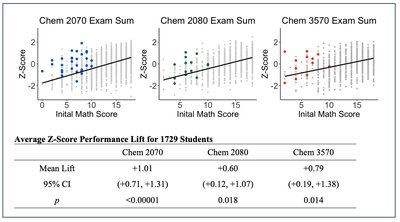
Performance Lift: Data shows that students who take Chem 1729 before Chem 2070, Chem 2080, or Chem 3570 achieve higher exam scores.
Statistical Evidence: Mean lift in Z-score performance is significant for all courses.
Grade Distribution for Students with Low Math Scores
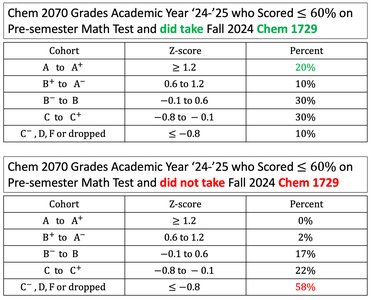
Tables comparing grade outcomes for students who scored ≤ 60% on the pre-semester math test and either did or did not take Chem 1729 highlight the importance of preparatory coursework.
Cohort | Z-score | Percent (Took Chem 1729) |
|---|---|---|
A to A+ | ≥ 1.2 | 20% |
B+ to A | 0.6 to 1.2 | 10% |
B- to B | -0.1 to 0.6 | 30% |
C to C+ | -0.8 to -0.1 | 30% |
C-, D, F or dropped | ≤ -0.8 | 10% |
Cohort | Z-score | Percent (Did NOT take Chem 1729) |
|---|---|---|
A to A+ | ≥ 1.2 | 2% |
B+ to A | 0.6 to 1.2 | 0% |
B- to B | -0.1 to 0.6 | 18% |
C to C+ | -0.8 to -0.1 | 22% |
C-, D, F or dropped | ≤ -0.8 | 58% |
Summary and Next Steps
Getting Started in Chemistry
Chemistry is a challenging yet rewarding discipline that provides essential skills and knowledge for a wide range of scientific fields. By actively engaging with course materials, utilizing support resources, and building a strong foundation through preparatory courses, students can maximize their success in Chem 2070 and beyond.
