 Indietro
Introduction to Matter, Measurement, and Atomic Theory in General Chemistry
Guida di studio - Note intelligenti
 Appunti personalizzati basati sui tuoi materiali, ampliati con definizioni chiave, esempi e contesto.
1. Matter
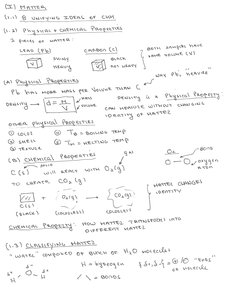
1.1 Physical & Chemical Properties
Matter is anything that has mass and occupies space. It can be described by its physical and chemical properties, which help distinguish between different types of matter.
Physical Properties: Characteristics that can be observed or measured without changing the substance's identity (e.g., mass, volume, density, melting point, boiling point).
Chemical Properties: Characteristics that describe a substance's ability to undergo changes that transform it into different substances (e.g., flammability, reactivity).
Example: Water (H2O) and carbon (C) are both forms of matter, but water is a liquid at room temperature while carbon is a solid.
1.2 Physical Changes vs. Chemical Changes
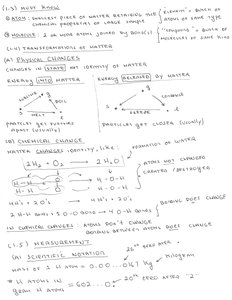
Changes in matter can be classified as physical or chemical based on whether the identity of the substance changes.
Physical Change: Alters the form or appearance of matter but does not change its identity (e.g., melting, freezing, dissolving).
Chemical Change: Results in the formation of one or more new substances with different properties (e.g., burning, rusting).
Example: Ice melting is a physical change; water decomposing into hydrogen and oxygen is a chemical change.
2. Measurement in Chemistry
2.1 Scientific Notation
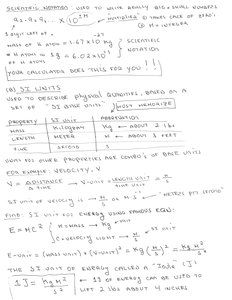
Scientific notation is used to express very large or very small numbers conveniently. It is especially useful in chemistry for representing quantities like Avogadro's number or atomic masses.
Format: where a is a number between 1 and 10, and n is an integer.
Example: is Avogadro's number, representing the number of particles in one mole.
2.2 SI Units
The International System of Units (SI) is used to describe physical quantities in chemistry. Each property has a standard unit.
Property | SI Unit | Abbreviation |
|---|---|---|
Length | meter | m |
Mass | kilogram | kg |
Time | second | s |
Amount | mole | mol |
Temperature | kelvin | K |
2.3 Energy and Its Units
Energy is a key concept in chemistry, often measured in joules (J). The energy of a photon can be calculated using Planck's equation:
Equation:
Where: E is energy, h is Planck's constant, and \nu is frequency.
1 J = 1 kg \( \cdot \) m2 / s2
3. Unit Conversions
3.1 Conversion Factors and Dimensional Analysis
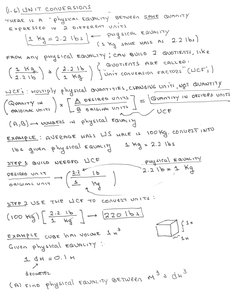
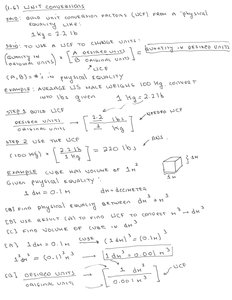
Unit conversions are essential for solving chemistry problems. Conversion factors (unit conversion factors, UCF) are ratios that express how many of one unit are equal to another unit.
General Formula:
Example: To convert 2 kg to pounds, use .
3.2 Multi-Step Unit Conversions
Some conversions require multiple steps, especially when converting between units of area or volume.
Example: To convert 1 dm3 to m3:
4. Atomic Theory and Structure
4.1 The Atom
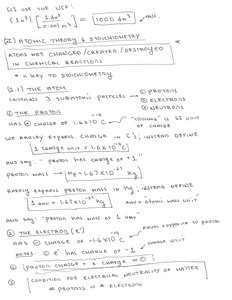
Atoms are the fundamental building blocks of matter. They consist of three subatomic particles: protons, neutrons, and electrons.
Proton (p+): Positively charged, located in the nucleus.
Neutron (n0): Neutral, located in the nucleus.
Electron (e-): Negatively charged, found outside the nucleus.
Atomic Number (Z): Number of protons in the nucleus; defines the element.
Mass Number (A): Total number of protons and neutrons.
4.2 Conservation of Atoms in Chemical Reactions
Atoms are not created or destroyed in chemical reactions; they are simply rearranged. This principle is fundamental to stoichiometry and the law of conservation of mass.
5. Views of Matter: Macroscopic and Microscopic
5.1 Macroscopic vs. Microscopic Views
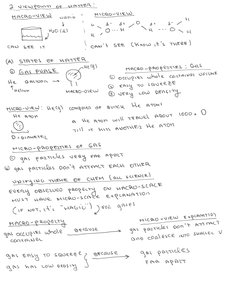
Chemists use both macroscopic (observable) and microscopic (atomic/molecular) perspectives to understand matter.
Macroscopic: Properties and changes visible to the naked eye (e.g., color, state, volume).
Microscopic: Behavior and arrangement of atoms and molecules (e.g., spacing, motion).
5.2 States of Matter: Focus on Gases
Gases have unique properties due to the large distances between their particles and their high kinetic energy.
Properties of Gases: Easily compressible, expand to fill their container, particles move rapidly and are far apart.
Explanation: On the microscopic level, gas particles move independently and rarely interact, explaining their macroscopic properties.
Additional info: These notes provide foundational concepts for understanding matter, measurement, and atomic structure, which are essential for all subsequent topics in General Chemistry.
