 Indietro
Introduction to Solutions and Aqueous Reactions – Study Notes
Guida di studio - Note intelligenti
 Appunti personalizzati basati sui tuoi materiali, ampliati con definizioni chiave, esempi e contesto.
Introduction to Solutions and Aqueous Reactions
Overview
This chapter introduces the fundamental concepts of solutions, their concentrations, and the types of reactions that occur in aqueous environments. It covers the classification of solutions, solubility, electrolytes, and the stoichiometry of reactions in solution, including precipitation, acid-base, gas-evolution, and oxidation-reduction reactions.
Solution Concepts
Definition of a Solution
A solution is a homogeneous mixture composed of two or more substances. The substance present in the largest amount is called the solvent, while the other substances are called solutes. Solutions are uniform at the molecular level.
Concentration of Solutions
Concentration describes the amount of solute dissolved in a given quantity of solvent or solution. Solutions can be described as concentrated (large amount of solute) or dilute (small amount of solute).
Molarity (M): The most common quantitative measure of concentration, defined as the number of moles of solute per liter of solution.
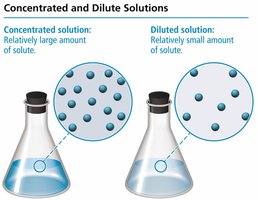
Solution Preparation and Dilution
To prepare a solution of a desired concentration, a known mass of solute is dissolved in solvent and diluted to a specific volume. Dilution involves adding solvent to decrease the concentration of a solution without changing the amount of solute.
The relationship for dilution is given by:
Where M1 and V1 are the initial molarity and volume, and M2 and V2 are the final molarity and volume.
Solubility and Types of Aqueous Solutions
Solubility
Solubility is the maximum amount of solute that can dissolve in a given amount of solvent at a specific temperature. Compounds are classified as soluble or insoluble based on their ability to dissolve in water.
Soluble ionic compounds dissociate completely in water, forming ions.
Insoluble ionic compounds do not dissolve appreciably and remain as solids.
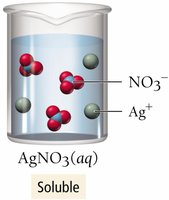
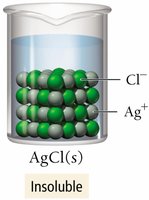
Solubility Rules
Solubility rules help predict whether an ionic compound will dissolve in water. These rules are summarized in tables and are essential for predicting the outcomes of precipitation reactions.
Compounds Generally Soluble | Exceptions |
|---|---|
Li+, Na+, K+, NH4+ | None |
NO3-, C2H3O2- | None |
Cl-, Br-, I- | Ag+, Hg22+, Pb2+ |
SO42- | Sr2+, Ba2+, Pb2+, Ag+, Ca2+ |
Compounds Generally Insoluble | Exceptions |
OH-, S2- | Li+, Na+, K+, NH4+, Ca2+, Sr2+, Ba2+ |
CO32-, PO43- | Li+, Na+, K+, NH4+ |
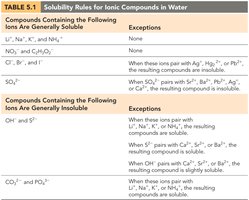
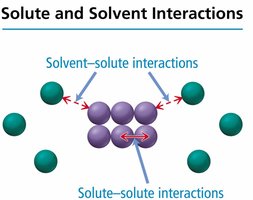
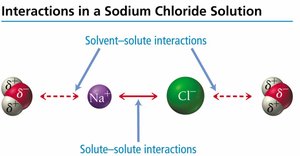
Solute-Solvent Interactions
When a solute dissolves, interactions occur between solute particles, solvent molecules, and between solute and solvent. Dissolution occurs if solute-solvent attractions are strong enough to overcome solute-solute and solvent-solvent attractions.
Electrolytes and Nonelectrolytes
Definitions
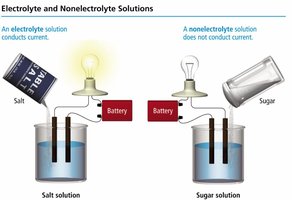
Electrolytes: Substances that dissolve in water to produce ions, allowing the solution to conduct electricity.
Nonelectrolytes: Substances that dissolve in water as molecules and do not conduct electricity.
Classification of Electrolytes
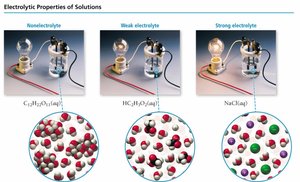
Strong electrolytes: Dissociate completely into ions (e.g., NaCl, strong acids, strong bases).
Weak electrolytes: Partially dissociate into ions (e.g., weak acids, weak bases).
Nonelectrolytes: Do not dissociate into ions (e.g., sugar, ethanol).
Types of Aqueous Reactions
Precipitation Reactions
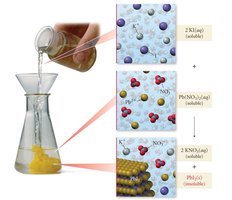
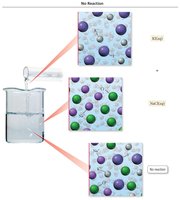
Precipitation reactions occur when two aqueous solutions combine to form an insoluble product, called a precipitate. The solubility rules are used to predict the formation of a precipitate.
General form: Reactant1 (aq) + Reactant2 (aq) → Product1 (aq) + Product2 (s)
Writing Equations for Aqueous Reactions
Molecular equation: All reactants and products are written as compounds.
Complete ionic equation: Strong electrolytes are written as ions.
Net ionic equation: Only species that change during the reaction are included; spectator ions are omitted.
Acid-Base (Neutralization) Reactions
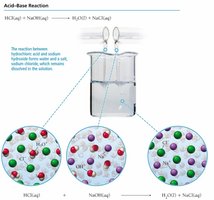
Acid-base reactions involve the transfer of H+ ions from an acid to a base, producing water and a salt. According to the Arrhenius definition:
Acid: Produces H+ ions in water.
Base: Produces OH- ions in water.
General equation: Acid + Base → Salt + Water
Gas-Evolution Reactions
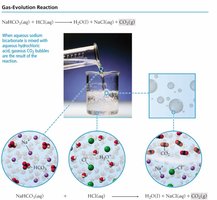
Some reactions in aqueous solution produce a gas, either directly or by decomposition of an unstable intermediate. Common gases evolved include H2S, CO2, SO2, and NH3.
Reactant Type | Intermediate Product | Gas Evolved | Example |
|---|---|---|---|
Sulfides | None | H2S | 2 HCl(aq) + K2S(aq) → H2S(g) + 2 KCl(aq) |
Carbonates/Bicarbonates | H2CO3 | CO2 | 2 HCl(aq) + K2CO3(aq) → CO2(g) + H2O(l) + 2 KCl(aq) |
Sulfites/Bisulfites | H2SO3 | SO2 | 2 HCl(aq) + K2SO3(aq) → SO2(g) + H2O(l) + 2 KCl(aq) |
Ammonium | NH4OH | NH3 | NH4Cl(aq) + NaOH(aq) → NH3(g) + H2O(l) + NaCl(aq) |

Stoichiometry in Solution
Using Molarity in Calculations
Molarity allows for the calculation of the amount of solute or volume of solution required for a reaction. The relationship is:
Stoichiometric calculations in solution follow the same principles as those for reactions in the solid state, but use volumes and concentrations instead of masses.
Acid–Base Titrations
Principles of Titration
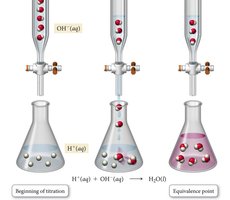
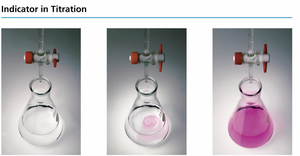
In an acid–base titration, a solution of known concentration (titrant) is added to a solution of unknown concentration until the reaction reaches the equivalence point, where moles of H+ equal moles of OH-. An indicator is used to signal the endpoint.
Oxidation-Reduction (Redox) Reactions
Definition and Identification
Redox reactions involve the transfer of electrons between species. The oxidation state (or number) is assigned to atoms to track electron transfer. Oxidation is the loss of electrons, and reduction is the gain of electrons.
Oxidizing agent: Causes oxidation, is itself reduced.
Reducing agent: Causes reduction, is itself oxidized.
Rules for assigning oxidation numbers include:
Group 1 metals: +1
Group 2 metals: +2
Fluorine: –1
Hydrogen: +1 (except in metal hydrides)
Oxygen: –2 (except in peroxides)
Sum of oxidation numbers in a compound is 0; in a polyatomic ion, equals the ion charge.
Activity Series
The activity series ranks metals by their tendency to lose electrons (be oxidized). A metal higher in the series will displace a metal ion lower in the series from solution.
Summary Table: Types of Electrolytes
Type | Definition | Example |
|---|---|---|
Strong Electrolyte | Completely dissociates into ions | NaCl, HCl |
Weak Electrolyte | Partially dissociates into ions | NH3, CH3COOH |
Nonelectrolyte | Does not dissociate into ions | C12H22O11 (sugar) |
Additional info: These notes include expanded academic context and examples for clarity and completeness, as well as relevant images and tables to reinforce key concepts.
