 Indietro
Introduction to the Atom: Structure, Subatomic Particles, and Ions
Guida di studio - Note intelligenti
 Appunti personalizzati basati sui tuoi materiali, ampliati con definizioni chiave, esempi e contesto.
Introduction to the Atom
What is Chemistry?
Chemistry is the scientific study of matter, its properties, composition, and the changes it undergoes. Matter is defined as anything that has mass and occupies space. The particulate nature of matter means that all substances are composed of discrete, tiny units called atoms.
Matter: Anything with mass and volume.
Atoms: The fundamental building blocks of matter.
Dalton’s Atomic Theory (1803)
John Dalton proposed one of the earliest scientific theories describing the nature of atoms. His postulates laid the foundation for modern atomic theory:
1. Elements are made up of tiny, indestructible particles called atoms.
2. Atoms of one element cannot change into atoms of another element; they can only rearrange in chemical reactions.
3. All atoms of a given element have the same mass and properties that distinguish them from atoms of other elements.
4. Atoms combine in simple, whole-number ratios to form compounds.
Subatomic Particles
Types of Subatomic Particles
Atoms are composed of three primary subatomic particles: protons, neutrons, and electrons. Each has distinct properties that determine the behavior and identity of an atom.
Proton (p+): Positively charged particle found in the nucleus.
Neutron (n0): Neutral particle (no charge) also located in the nucleus.
Electron (e-): Negatively charged particle found in orbitals surrounding the nucleus.
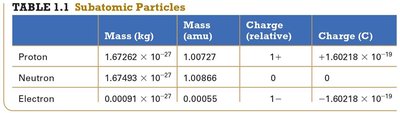
Table Purpose: This table summarizes the mass (in kg and amu), relative charge, and actual charge (in coulombs) for protons, neutrons, and electrons.
Atomic Number and Mass Number
Atomic Number (Z): The number of protons in the nucleus; defines the element.
Mass Number (A): The total number of protons and neutrons in the nucleus.
Example: Carbon-12 has 6 protons and 6 neutrons, so its mass number is 12.
Isotopes
Definition and Examples
Isotopes are atoms of the same element (same number of protons) but with different numbers of neutrons. This results in different mass numbers but identical chemical properties.
Example: Carbon-12 (6 protons, 6 neutrons) and Carbon-14 (6 protons, 8 neutrons) are isotopes of carbon.
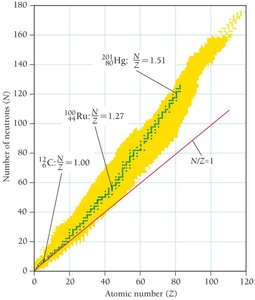
Image Purpose: This graph illustrates the relationship between the number of neutrons and protons for stable isotopes of various elements.
Electrons and Ions
Neutral Atoms and Ions
In a neutral atom, the number of electrons equals the number of protons. However, atoms can gain or lose electrons during chemical changes, forming charged particles called ions.
Cation: A positively charged ion formed when an atom loses one or more electrons (e.g., Na+).
Anion: A negatively charged ion formed when an atom gains one or more electrons (e.g., F-).
Equations:
Formation of a cation:
Formation of an anion:
Example: Sodium (Na) loses one electron to become Na+; fluorine (F) gains one electron to become F-.
Summary Table: Subatomic Particles
Particle | Mass (kg) | Mass (amu) | Charge (relative) | Charge (C) |
|---|---|---|---|---|
Proton | 1.67262 × 10⁻²⁷ | 1.00727 | 1+ | +1.60218 × 10⁻¹⁹ |
Neutron | 1.67493 × 10⁻²⁷ | 1.00866 | 0 | 0 |
Electron | 0.00091 × 10⁻²⁷ | 0.00055 | 1– | –1.60218 × 10⁻¹⁹ |
Additional info:
For further study, refer to Section 2.6 in your textbook and practice problems 2.41, 2.49, 2.61, 2.63, 2.65, and 2.67.
Understanding the structure of the atom is foundational for all subsequent topics in general chemistry, including chemical bonding, reactions, and periodic trends.
