Indietro
Ionic and Covalent Bonding: lecture 11
Guida di studio - Note intelligenti
 Appunti personalizzati basati sui tuoi materiali, ampliati con definizioni chiave, esempi e contesto.
Ionic Bonding
Formation of Ionic Bonds
Ionic bonding occurs when electrons are transferred from one atom to another, resulting in the formation of ions. These ions are held together by electrostatic forces in a crystal lattice.
Electron Transfer: Typically, a metal atom loses electrons to become a positively charged cation, while a nonmetal atom gains electrons to become a negatively charged anion.
Example: Sodium (Na) transfers an electron to chlorine (Cl), forming Na+ and Cl-.
Result: The oppositely charged ions attract each other, forming an ionic compound.
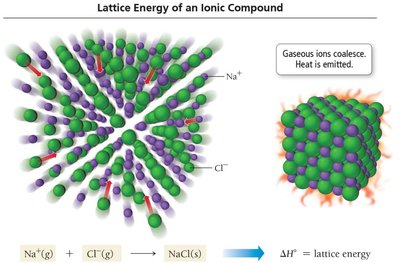
Lattice Energy
Lattice energy is the energy released when gaseous ions coalesce to form an ionic solid. It is a measure of the strength of the ionic bonds in a compound.
Definition: The enthalpy change () when one mole of an ionic compound forms from its gaseous ions.
Equation:
Significance: Higher lattice energy indicates stronger ionic bonding and greater stability.
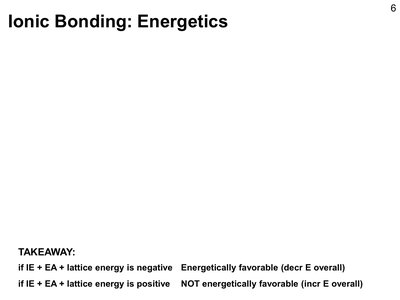
Energetics of Ionic Bond Formation
The formation of an ionic bond is energetically favorable if the sum of ionization energy (IE), electron affinity (EA), and lattice energy is negative. This means the process lowers the overall energy of the system.
Energetically Favorable:
Not Favorable:
Key Point: Ionic bonds form only when the process is energetically favorable (low energy).


Covalent Bonding
Nature of Covalent Bonds
Covalent bonding involves the sharing of electrons between atoms, typically nonmetals, to achieve a stable electron configuration. The shared electrons create a bond that holds the atoms together.
Electron Sharing: Atoms share pairs of electrons to fill their valence shells.
Resulting Bond: The shared electrons constitute a covalent bond.
Example: Two hydrogen atoms share electrons to form H2.

Comparison Table: Covalent Bonding
The following table summarizes the key aspects of covalent bonding:
e- being shared | atoms sharing | resulting bond |
|---|---|---|
1 pair | 2 nonmetals | Single covalent bond |
2 pairs | 2 nonmetals | Double covalent bond |
3 pairs | 2 nonmetals | Triple covalent bond |
*Additional info: Table entries inferred from standard covalent bonding types.*
Lewis Structures
Purpose and Construction
Lewis structures are diagrams that represent the bonding between atoms in a molecule using valence electrons. They help visualize how atoms are connected and where lone pairs of electrons are located.
Valence Electrons: Only the outermost electrons are shown, as they participate in bonding.
Bond Representation: Lines represent shared pairs (bonds), dots represent lone pairs.
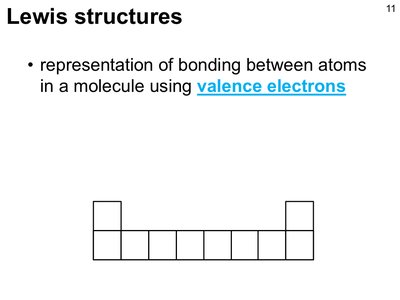
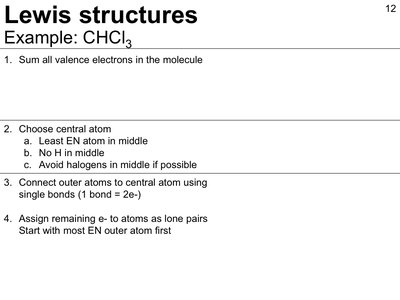
Steps for Drawing Lewis Structures (Example: CHCl3)
To draw a Lewis structure, follow these steps:
Sum all valence electrons in the molecule.
If the molecule has a negative charge, add 1 electron per negative charge.
If the molecule has a positive charge, remove 1 electron per positive charge.
Choose the central atom.
Least electronegative atom is placed in the middle.
Hydrogen is never the central atom.
Avoid halogens as central atoms if possible.
Connect outer atoms to the central atom using single bonds (1 bond = 2 electrons).
Assign remaining electrons to atoms as lone pairs, starting with the most electronegative outer atom.
Electronegativity
Definition and Importance
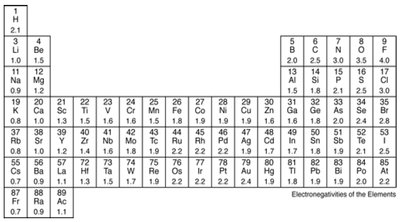
Electronegativity is a measure of how well an atom can attract an electron to itself within a chemical bond. It is a key factor in determining bond polarity and the distribution of electrons in molecules.
Trend: Electronegativity increases across a period and decreases down a group in the periodic table.
Most Electronegative Element: Fluorine (F) has the highest electronegativity.
Application: Used to predict the central atom in Lewis structures and the polarity of bonds.
Chemical Formulas
Molecular and Structural Formulas
Chemical formulas provide information about the composition and structure of compounds.
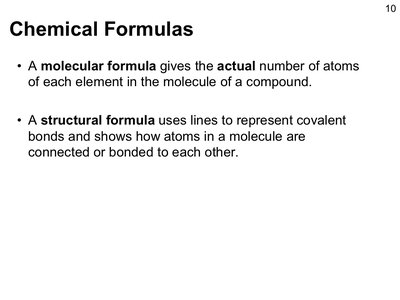
Molecular Formula: Gives the actual number of atoms of each element in a molecule (e.g., C6H12O6).
Structural Formula: Uses lines to represent covalent bonds and shows how atoms are connected or bonded to each other.
Recommended Practice and Readings
Further Study
To reinforce understanding, students are encouraged to read textbook sections 10.5–10.9 and complete recommended practice problems. These cover Lewis structures, ionic and covalent bonding, and related concepts.
Practice Problems: 10.53, 10.55, 10.57, 10.63, 10.65, 10.67, 10.69, 10.71, 10.73, 10.75, 10.77, 10.79, 10.81, 10.83, 10.91, 10.93, 10.97, 10.101, 10.103, 10.119
Reading: Sections 10.5–10.9 (focus on Lewis structures, no bond polarity yet)