 Indietro
Ionic and Covalent Compounds: Structure, Nomenclature, and Calculations
Guida di studio - Note intelligenti
 Appunti personalizzati basati sui tuoi materiali, ampliati con definizioni chiave, esempi e contesto.
Ionic and Covalent Compounds
Compounds
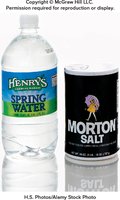
A compound is a substance composed of two or more elements combined in a specific ratio and held together by chemical bonds. Common examples include water (H2O) and sodium chloride (NaCl).
Key Point: Compounds have fixed ratios of elements.
Example: Water always contains two hydrogen atoms and one oxygen atom.
Lewis Dot Symbols
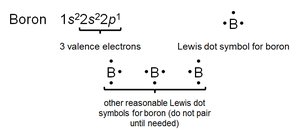
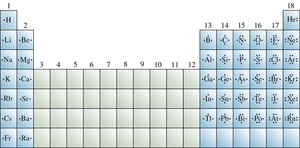
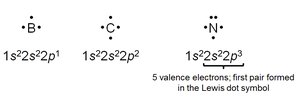
Lewis dot symbols represent the valence electrons of an atom as dots around the element's symbol. These are used to visualize electron interactions during bond formation.
Key Point: Each dot represents a valence electron.
Example: Boron has three valence electrons, shown as three dots.
Lewis Dot Symbols for Ions
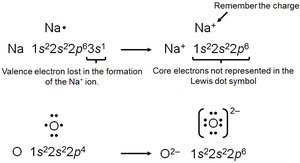
Ions are also represented by Lewis dot symbols, showing the gain or loss of electrons and the resulting charge.
Key Point: Cations have fewer dots; anions have eight dots and are shown in brackets with the charge.
Example: Na+ has no dots; O2− has eight dots.
Ionic Compounds and Bonding
Ionic Bonding
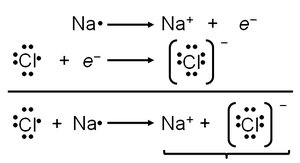
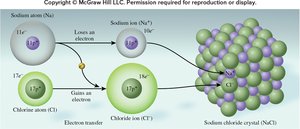
Ionic bonding is the electrostatic attraction between oppositely charged ions, forming ionic compounds. Electrons are transferred from metals to nonmetals.
Key Point: Ionic compounds are electrically neutral.
Example: Formation of NaCl from Na and Cl.
Lattice Energy
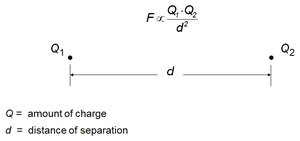
Lattice energy is the energy required to separate one mole of an ionic solid into its constituent ions in the gas phase. It is a measure of the stability of an ionic compound.
Key Point: Lattice energy increases with higher charge and smaller ionic radius.
Formula:
Example: LiI has higher lattice energy than NaI or KI due to smaller ionic radius.
Naming Ions and Ionic Compounds
Naming Ions
Monatomic cations: Add 'ion' to the element name (e.g., sodium ion).
Monatomic anions: Change the ending to '-ide' (e.g., chloride).
Variable charge metals: Use Roman numerals (e.g., iron(II) ion).
Formulas of Ionic Compounds
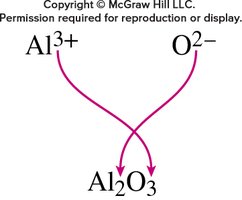
Ionic compounds must be electrically neutral. The sum of charges in the formula must equal zero.
Example: Aluminum oxide is Al2O3.
Naming Ionic Compounds
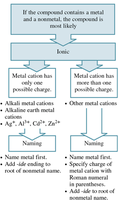
Name the cation (omit 'ion', use Roman numeral if needed).
Name the anion (omit 'ion').
Example: NaBr is sodium bromide; FeCl2 is iron(II) chloride.
Covalent Bonding and Molecules
Covalent Bonding
In covalent bonding, electrons are shared between atoms to achieve noble gas configurations. This is described by the Lewis theory of bonding.
Key Point: Covalent bonds involve shared pairs of electrons.
Example: H2 molecule forms by sharing electrons.
Molecules and Laws of Proportions
Molecule: Combination of at least two atoms held by chemical bonds.
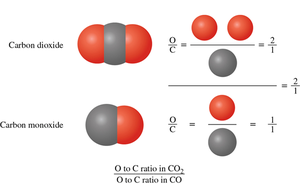
Law of Definite Proportions: Same compound always has same element ratio.
Law of Multiple Proportions: Elements can combine in different ratios to form different compounds.
Example: CO2 and CO have different O:C ratios.
Types of Molecules
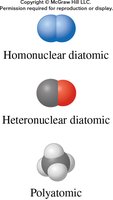
Diatomic molecules: Two atoms (homonuclear or heteronuclear).
Polyatomic molecules: More than two atoms.
Molecular and Empirical Formulas
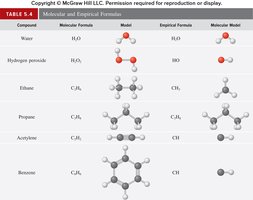
A molecular formula shows the exact number of atoms in a molecule. An empirical formula shows the simplest whole-number ratio of elements.
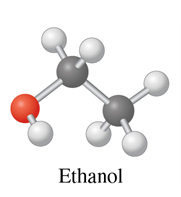
Example: Ethanol's molecular formula is C2H6O; empirical formula is CH3O.
Allotropes: Different forms of the same element (e.g., O2 and O3).
Naming Molecular Compounds
Binary Molecular Compounds
Name the first element.
Name the second element, changing its ending to '-ide'.
Use Greek prefixes to denote the number of atoms (mono-, di-, tri-, etc.).
Example: N2O5 is dinitrogen pentoxide.
Compounds Containing Hydrogen
Acids: Remove '-gen' from hydrogen, change '-ide' to '-ic' (e.g., hydrogen chloride → hydrochloric acid).
Must contain at least one ionizable hydrogen atom.
Organic Compounds
Hydrocarbons and Alkanes
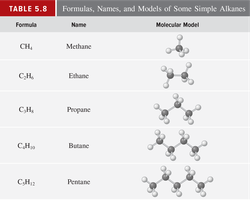
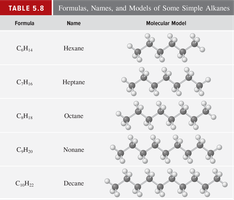
Organic compounds contain carbon and hydrogen, sometimes with other atoms. Hydrocarbons are compounds of only carbon and hydrogen. Alkanes are the simplest hydrocarbons.
Example: Methane (CH4), Ethane (C2H6), Propane (C3H8).
Functional Groups
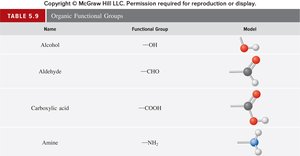
Functional groups are specific groups of atoms within molecules that determine their chemical reactivity.
Example: Alcohol (–OH), Aldehyde (–CHO), Carboxylic acid (–COOH), Amine (–NH2).
Covalent Bonding in Ionic Species
Polyatomic Ions
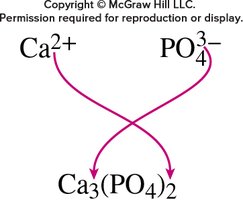
Polyatomic ions are ions composed of two or more atoms covalently bonded, carrying a net charge. They combine in ratios to form neutral compounds.
Example: Calcium phosphate, Ca3(PO4)2.
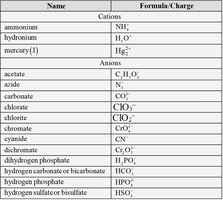
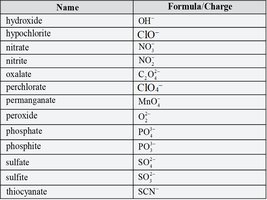
Common Polyatomic Ions
Name | Formula/Charge |
|---|---|
Ammonium | NH4+ |
Hydronium | H3O+ |
Acetate | C2H3O2− |
Carbonate | CO32− |
Nitrate | NO3− |
Sulfate | SO42− |
Phosphate | PO43− |
Hydroxide | OH− |
Oxoanions and Oxoacids
Oxoanions: Polyatomic anions containing oxygen and another element.
Naming: -ate (most O), -ite (one less O), per- (one more O), hypo- (two less O).
Oxoacids: Acids formed from oxoanions; -ic for -ate, -ous for -ite.
Example: HClO3 is chloric acid; HClO2 is chlorous acid.
Hydrates
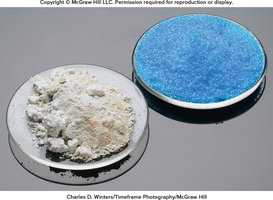
Hydrates are compounds with a specific number of water molecules in their structure. When water is removed, the compound is called anhydrous.
Example: CuSO4·5H2O is copper(II) sulfate pentahydrate; anhydrous CuSO4 is white, hydrated is blue.
Molecular and Formula Mass
Molecular Mass
The molecular mass is the sum of atomic masses of all atoms in a molecule, measured in atomic mass units (amu).
Formula:
Example: Propane (C3H8): amu
Formula Mass
For ionic compounds, the formula mass is calculated similarly, using the empirical formula.
Percent Composition of Compounds
Percent composition is the percent by mass of each element in a compound.
Formula:
Example: Lithium carbonate (Li2CO3): Calculate percent by mass for Li, C, and O.
Molar Mass and Interconversions
Molar Mass
Molar mass (M) is the mass in grams of one mole of a substance. For elements, it is numerically equal to the atomic mass.
Example: 1 mol C = 12.01 g
Interconverting Mass, Moles, and Number of Particles
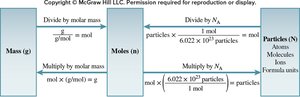
Conversions between mass, moles, and number of particles use molar mass and Avogadro's number.
Formula:
Formula:
Determination of Empirical and Molecular Formulas from Percent Composition
Empirical formulas are determined from percent composition by converting mass percentages to moles and finding the simplest ratio. Molecular formulas are found by dividing the molar mass by the empirical formula mass and multiplying the empirical formula subscripts by this number.
Example: A compound with 30.45% N and 69.55% O, molar mass 92 g/mol, has empirical formula NO2 and molecular formula N2O4.
Summary of Key Points
Compounds are formed from elements in fixed ratios.
Lewis dot symbols visualize valence electrons and bonding.
Ionic compounds are formed by electron transfer; covalent compounds by electron sharing.
Nomenclature rules differ for ionic and molecular compounds.
Polyatomic ions and hydrates have special naming conventions.
Molecular and formula masses, percent composition, and molar mass are essential for quantitative chemistry.
Empirical and molecular formulas can be determined from percent composition and molar mass.
