 Indietro
Lewis Structures and Formal Charge: Lecture 12
Guida di studio - Note intelligenti
 Appunti personalizzati basati sui tuoi materiali, ampliati con definizioni chiave, esempi e contesto.
Lewis Structures
Introduction to Lewis Structures
Lewis structures are a fundamental tool in general chemistry for representing the bonding between atoms in a molecule using valence electrons. They help visualize how atoms share or transfer electrons to achieve stable electron configurations, often obeying the octet rule.
Definition: A Lewis structure is a diagram showing the arrangement of atoms and the distribution of valence electrons in a molecule.
Purpose: To illustrate bonding, lone pairs, and predict molecular shape and reactivity.
Valence Electrons: Only the outermost electrons are considered in Lewis structures.
Steps for Drawing Lewis Structures
Constructing a Lewis structure involves a systematic approach to ensure all valence electrons are accounted for and the molecule's charge is correct.
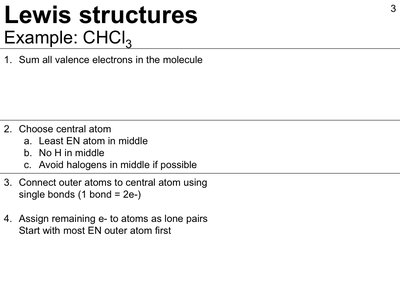
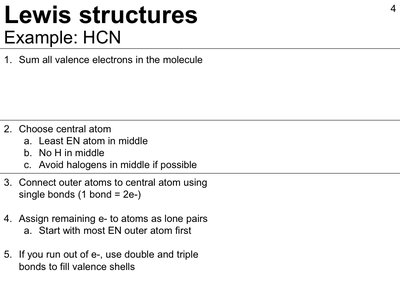
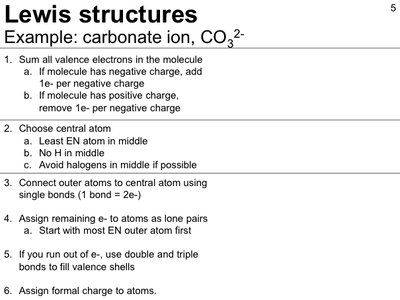
Step 1: Sum all valence electrons in the molecule. If the molecule is charged, adjust the electron count accordingly.
Step 2: Choose the central atom (usually the least electronegative, never hydrogen, and avoid halogens if possible).
Step 3: Connect outer atoms to the central atom using single bonds (each bond = 2 electrons).
Step 4: Assign remaining electrons as lone pairs, starting with the most electronegative outer atom.
Step 5: If you run out of electrons before all atoms have full valence shells, use double or triple bonds.
Example: CHCl3
Example: HCN
Example: Carbonate Ion (CO32-)
Formal Charge
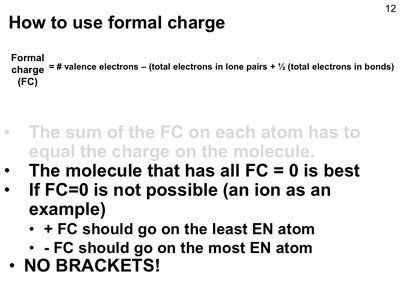
Formal charge is a concept used to determine the charge distribution within a molecule, helping to identify the most stable Lewis structure.
Definition: The formal charge of an atom is the difference between the number of valence electrons in the free atom and the number of electrons assigned to it in the Lewis structure.
Calculation:
Application: The sum of formal charges in a molecule must equal the overall charge of the molecule or ion.


Using Formal Charge to Determine Stability
Formal charge helps identify the most stable resonance structure and guides the placement of charges in ions.
The best structure has all formal charges equal to zero.
If zero formal charge is not possible, positive formal charge should be on the least electronegative atom, and negative formal charge on the most electronegative atom.
No brackets are used in the final structure.
Complexities in Lewis Structures
Resonance Structures
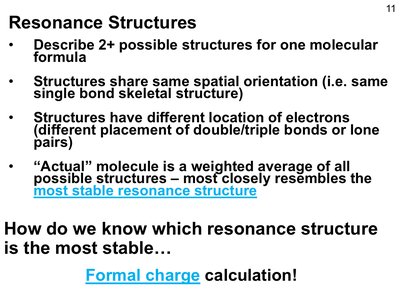
Some molecules have more than one valid Lewis structure, known as resonance structures. These structures share the same arrangement of atoms but differ in the placement of electrons.
Definition: Resonance structures are multiple valid Lewis structures for a single molecular formula.
Actual Structure: The true structure is a weighted average of all resonance forms, most closely resembling the most stable resonance structure.
Stability: Determined by formal charge calculations.
Incomplete Octets
Some atoms, particularly Be, B, and Al, can have fewer than eight electrons in their valence shell, resulting in an incomplete octet.
Definition: An incomplete octet occurs when an atom has less than eight electrons in its valence shell.
Common Elements: Beryllium (Be), Boron (B), and Aluminum (Al).
Example: Boron trifluoride (BF3) is a classic example.
Expanded Octets
Atoms with atomic number greater than 10 (Z=11+), such as halogens, sulfur, phosphorus, and noble gases, can accommodate more than eight electrons in their valence shell, forming expanded octets.
Definition: Expanded octets occur when the central atom has more than eight electrons in its valence shell.
Common Elements: Halogens, sulfur (S), phosphorus (P), and noble gases.
Example: Phosphorus pentachloride (PCl5) and sulfur hexafluoride (SF6).
Summary Table: Lewis Structure Complexities
Complexity | Description | Common Elements | Example |
|---|---|---|---|
Resonance | Multiple valid structures for one formula | O, N, C | CO32-, NO3- |
Incomplete Octet | Less than 8 electrons in valence shell | Be, B, Al | BF3, BeCl2 |
Expanded Octet | More than 8 electrons in valence shell | S, P, halogens, noble gases | SF6, PCl5 |
Key Equations
Formal Charge:
Conclusion
Lewis structures are essential for understanding molecular bonding, predicting molecular shape, and assessing stability through formal charge and resonance. Awareness of exceptions such as incomplete and expanded octets is crucial for accurate representation and interpretation of molecular structures in general chemistry.
