 Indietro
Lewis Structures and VSEPR Theory: Lecture 14 +15
Guida di studio - Note intelligenti
 Appunti personalizzati basati sui tuoi materiali, ampliati con definizioni chiave, esempi e contesto.
Lewis Structures and Their Complexities
Exceptions to the Octet Rule
Lewis structures are a fundamental tool for representing the arrangement of electrons in molecules. However, there are important exceptions to the octet rule:
Incomplete Octet: Some atoms, such as beryllium (Be), boron (B), and aluminum (Al), can have fewer than eight electrons in their valence shell.
Expanded Octet: Central atoms with atomic number Z ≥ 11 (such as halogens, sulfur (S), phosphorus (P), and noble gases) can be assigned more than eight electrons, allowing them to form more than four bonds.
Lewis Theory and Molecular Shape
Bonding vs. Shape Prediction
Lewis theory predicts the existence of regions of electrons (electron groups) in an atom, which are negatively charged and repel each other. While Lewis theory explains bonding, it does not directly predict the three-dimensional shape of molecules.
Electron repulsion: Electron groups repel each other, influencing the spatial arrangement of atoms.
Extension to shape: The repulsion between electron groups is the basis for predicting molecular shapes.
Valence Shell Electron Pair Repulsion (VSEPR) Theory
Principles of VSEPR Theory
VSEPR theory states that electron groups around a central atom will arrange themselves to be as far apart as possible, minimizing repulsion and maximizing stability. This geometric arrangement determines the shape and bond angles of the molecule.
Electron groups: Include both bonding pairs and lone pairs.
Stability: Most stable arrangement is achieved when electron groups are maximally separated.
Electron Groups and Lewis Structures
Counting Electron Groups
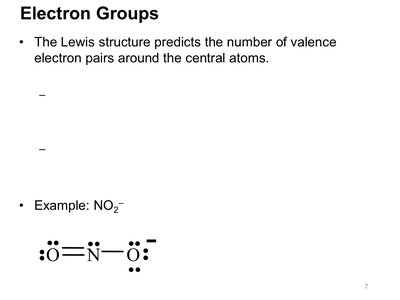
The Lewis structure helps predict the number of valence electron pairs (electron groups) around the central atom. These groups can be bonding pairs or lone pairs.
Example: The nitrite ion (NO2-) has three electron groups around the central nitrogen atom.
Electron Geometry
Definition and Examples
Electron geometry describes the spatial arrangement of all electron groups (bonding and lone pairs) around the central atom. Different numbers of electron groups lead to different shapes due to varying repulsion needs.
Examples: Ammonia (NH3), methane (CH4), and formaldehyde (CH2O) each have distinct electron geometries.

Electron Geometry vs. Molecular Geometry
Impact of Lone Pairs
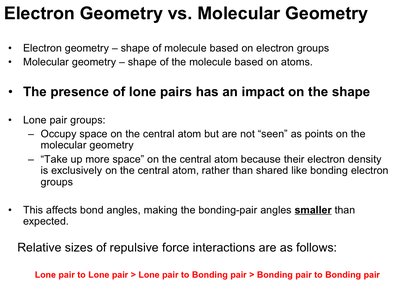
Electron geometry considers all electron groups, while molecular geometry considers only the arrangement of atoms. Lone pairs occupy space but are not visible in molecular geometry, and their presence affects bond angles.
Lone pairs: Take up more space than bonding pairs, causing bond angles to decrease.
Repulsive force hierarchy: Lone pair-lone pair > lone pair-bonding pair > bonding pair-bonding pair.
Common Electron Geometries and Examples
Linear Electron Geometry (Two Electron Groups)
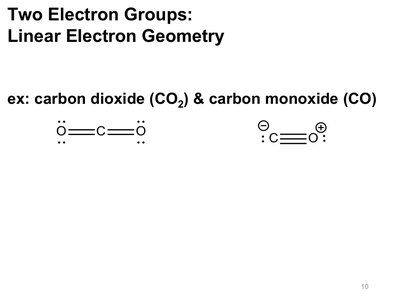
When there are two electron groups around the central atom, the geometry is linear, with a bond angle of 180°.
Examples: Carbon dioxide (CO2), carbon monoxide (CO).
Trigonal Planar Electron Geometry (Three Electron Groups)
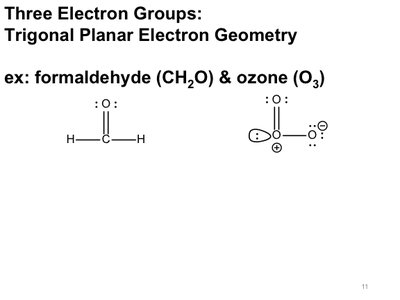
Three electron groups result in a trigonal planar geometry, with bond angles of 120°.
Examples: Formaldehyde (CH2O), ozone (O3).
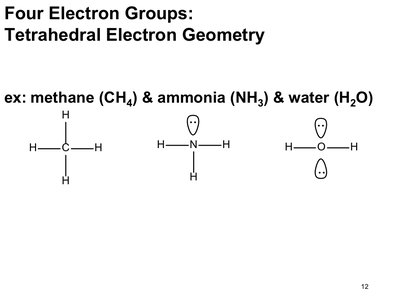
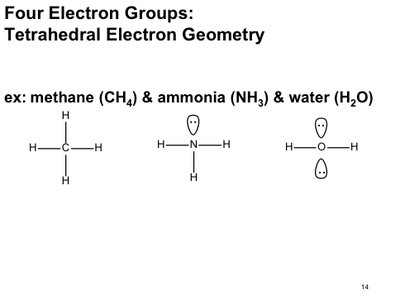
Tetrahedral Electron Geometry (Four Electron Groups)
Four electron groups form a tetrahedral geometry, with ideal bond angles of 109.5°. The presence of lone pairs modifies the molecular geometry and bond angles.
Examples: Methane (CH4), ammonia (NH3), water (H2O).
Representing Three-Dimensional Shapes on Paper
Drawing Conventions
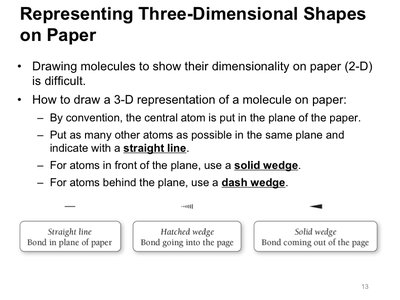
To represent 3-D molecular shapes on 2-D paper, chemists use specific conventions:
Straight line: Bond in the plane of the paper.
Solid wedge: Bond coming out of the page.
Dashed wedge: Bond going into the page.

Five Electron Groups: Trigonal Bipyramidal Electron Geometry
Structure and Examples
Five electron groups around a central atom result in a trigonal bipyramidal geometry. The arrangement includes three equatorial positions (120° apart) and two axial positions (90° to the equatorial plane).
Examples: Phosphorus pentafluoride (PF5), sulfur tetrafluoride (SF4), bromine trifluoride (BrF3), xenon difluoride (XeF2).
Six Electron Groups: Octahedral Electron Geometry
Structure and Examples
Six electron groups form an octahedral geometry, with bond angles of 90° between all adjacent positions.
Examples: Sulfur hexafluoride (SF6), bromine pentafluoride (BrF5), xenon tetrafluoride (XeF4).
Summary Table: Electron Group Geometries
Number of Electron Groups | Electron Geometry | Bond Angle | Example |
|---|---|---|---|
2 | Linear | 180° | CO2, CO |
3 | Trigonal Planar | 120° | CH2O, O3 |
4 | Tetrahedral | 109.5° | CH4, NH3, H2O |
5 | Trigonal Bipyramidal | 90°, 120° | PF5, SF4, BrF3, XeF2 |
6 | Octahedral | 90° | SF6, BrF5, XeF4 |
Key Equations
Bond angle for tetrahedral geometry:
Bond angle for trigonal planar geometry:
Bond angle for linear geometry:
Additional info:
These notes cover the core concepts of Lewis structures, exceptions to the octet rule, and the VSEPR theory, including the prediction of molecular shapes and bond angles. The summary table provides a quick reference for electron group geometries and their associated bond angles and examples.
