 Indietro
Ligand Substitution and Electron Transfer in Coordination Complexes
Guida di studio - Note intelligenti
 Appunti personalizzati basati sui tuoi materiali, ampliati con definizioni chiave, esempi e contesto.
Ligand Substitution Reactions in Coordination Complexes
Introduction to Ligand Substitution
Ligand substitution reactions are fundamental processes in inorganic and general chemistry, involving the exchange of ligands in metal complexes. These reactions are governed by both thermodynamic and kinetic factors, and are crucial for understanding the reactivity and stability of coordination compounds.
Ligand Substitution: A reaction where one Lewis base (ligand) replaces another in a metal complex (Lewis acid).
Leaving group (X): The ligand that departs from the complex.
Entering group (Y): The ligand that joins the complex.
The rate of conversion depends on the activation energy barrier between complexes.
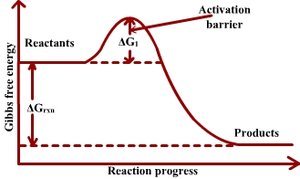
Thermodynamic vs. Kinetic Stability
The terms inert and labile describe the kinetic behavior of complexes, while stable and unstable refer to thermodynamic properties.
Inert: Thermodynamically unstable but slow to react (survive for long periods).
Labile: Rapidly undergoes ligand exchange.
There is no direct correlation between thermodynamic stability and kinetic lability.

Factors Affecting Rates of Ligand Substitution
Complexes of s-block ions (except Be(II), Mg(II)) are very labile.
f-block M(III) ions are labile.
d10 ions (Zn(II), Cd(II), Hg(II)) are labile.
3d-block M(II) ions are moderately labile; M(III) ions are less labile.
d3 and low-spin d6 (e.g., Cr(III), Fe(II), Co(III)) are non-labile due to large ligand field stabilization energies (LFSE).
Chelate complexes (e.g., [Fe(phen)3]2+) are particularly inert.
Non-lability is common in 4d and 5d series due to strong metal-ligand bonding.
Classification of Substitution Mechanisms
Dissociative (D) Mechanism
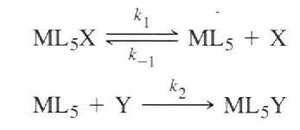
A dissociative mechanism involves the loss of a ligand before the new ligand attaches, forming an intermediate with a lower coordination number.
Two-step pathway: dissociation followed by association.
Intermediate: coordination number decreases.
Analogous to SN1 mechanism in organic chemistry.
Rate law:
Independent of [Y] (entering group).
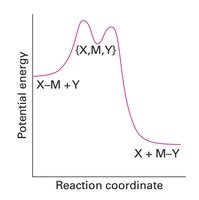
Associative (A) Mechanism
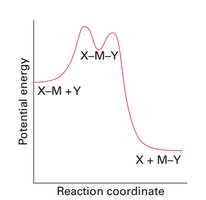
An associative mechanism involves the entering ligand attaching before the leaving ligand departs, forming an intermediate with a higher coordination number.
Two-step pathway: association followed by dissociation.
Intermediate: coordination number increases.
Analogous to SN2 mechanism in organic chemistry.
Rate law:
Dependent on both [ML5X] and [Y].

Interchange (I) Mechanism
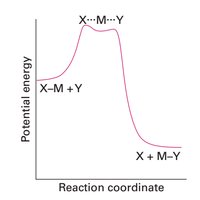
The interchange mechanism involves simultaneous bond formation and bond cleavage, with no detectable intermediate.
Bond formation and cleavage occur concurrently.
No intermediate species.
Can be associative (Ia) or dissociative (Id) depending on which step is rate-determining.
Ligand Substitution in Square-Planar Complexes
Mechanism and Stereochemistry
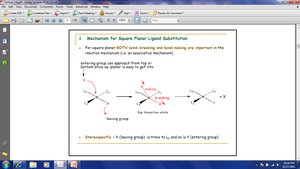
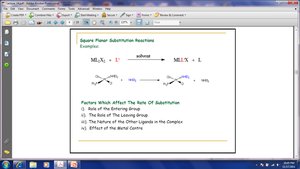
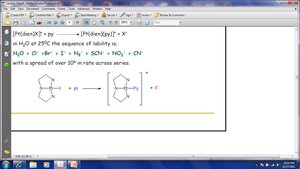
Square-planar complexes (e.g., Pt(II), Pd(II), Ni(II)) often undergo associative substitution, with both bond-breaking and bond-making being important.
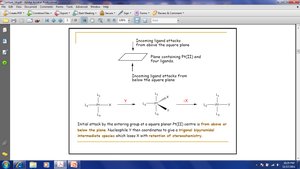
Attack by entering group occurs from above or below the plane.
Intermediate: trigonal bipyramidal geometry.
Retention of stereochemistry (stereospecific).
Factors Affecting Rate of Substitution
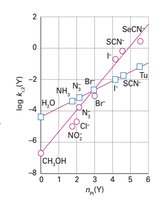
Role of Entering Group: Rate increases with nucleophilicity; Pt(II) prefers soft nucleophiles.
Role of Leaving Group: Sequence of lability varies; H2O > Cl- > Br- > I- > N3- > SCN- > NO2- > CN-.
Nature of Other Ligands: The trans effect influences which ligand is replaced.
Effect of Metal Center: Electronic configuration and ligand field stabilization energy affect lability.
The Trans Effect
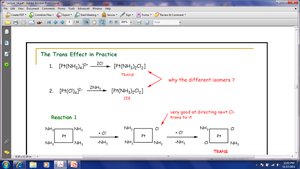
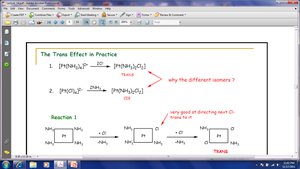
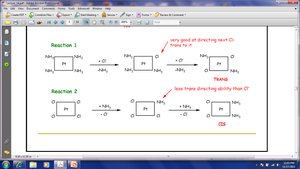
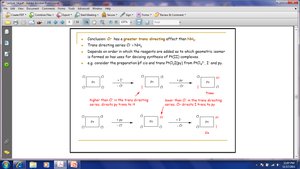
The trans effect describes how a ligand in a square planar complex influences the rate of substitution of the ligand opposite to it.
Ligands with strong trans effect direct substitution to the ligand trans to them.
Used in synthesis of geometric isomers (cis/trans).
Ligand Substitution in Octahedral Complexes
Mechanisms and Activation Parameters
Octahedral complexes typically react via interchange mechanisms, with the rate law distinguishing between associative and dissociative pathways.
Leaving group effects are pronounced in Id reactions.
Order of reactivity depends on metal's Lewis acid character.
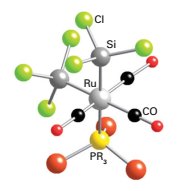
Stronger σ-donor ligands increase reaction rate by stabilizing transition state.
Steric crowding favors dissociative activation.
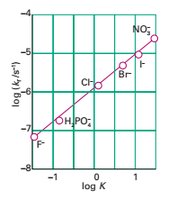
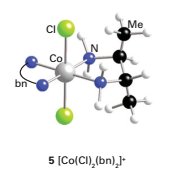
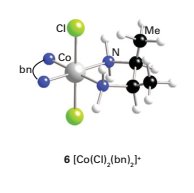
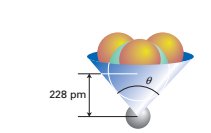
Ligand Field Activation Energy (LFAE)
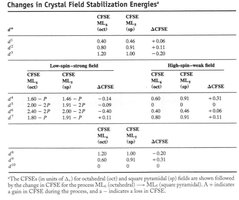
The difference in ligand field stabilization energy (LFSE) between the starting complex and the transition state is called ligand field activation energy (LFAE).
Large loss of LFSE leads to inert complexes.
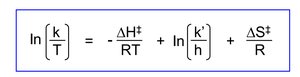
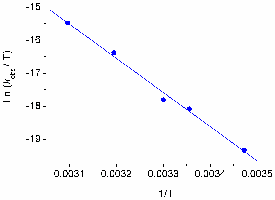
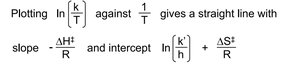
Activation Parameters: Gibbs Energy, Enthalpy, Entropy
Relationship between rate constant and activation parameters:
Volume of Activation (ΔV‡)
Associative mechanism: transition state has smaller volume (ΔV‡ negative).
Dissociative mechanism: transition state has larger volume (ΔV‡ positive).
ΔV‡ can be used to distinguish between mechanisms.
Electron Transfer (Redox) Reactions in Complexes
Outer Sphere Mechanism
Electron transfer occurs without major disturbance of coordination spheres.
Very fast reactions; rate depends on electronic and geometric structure.
Rate law:
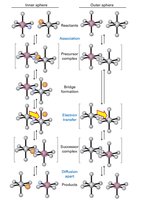
Inner Sphere Mechanism
Electron transfer occurs via a bridging ligand.
Often involves ligand exchange.
Reactions are faster than outer sphere electron transfer.
Rate law:
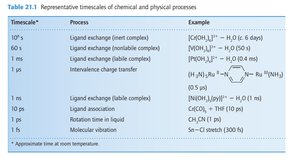
Summary Table: Timescales of Ligand Exchange and Related Processes
Timescale* | Process | Example |
|---|---|---|
105 s | Ligand exchange (inert complex) | [Co(NH3)6]3+ + H2O (6 days) |
60 s | Ligand exchange (nonlabile complex) | [Pt(NH3)4]2+ + H2O (1 min) |
1 s | Ligand exchange (labile complex) | [Ni(H2O)6]2+ + H2O (1 s) |
1 ps | Intervalence charge transfer | [Ru(NH3)5]2+ + [Ru(NH3)5]3+ (0.5 μs) |
1 ms | Ligand exchange (labile complex) | [Ni(H2O)6]2+ + H2O (1 ms) |
10 ps | Ligand association | CH2Cl2 + THF (10 ps) |
1 ps | Rotation time in liquid | CH4 (1 ps) |
1 fs | Molecular vibration | Sn–Cl stretch (300 fs) |
*Approximate times at room temperature
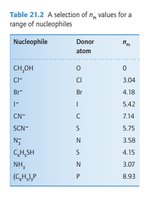
Summary Table: Nucleophilicity Values for Ligands
Nucleophile | Donor atom | nn |
|---|---|---|
CH3OH | O | 0 |
Cl- | Cl | 3.04 |
Br- | Br | 4.18 |
I- | I | 5.42 |
CN- | C | 7.14 |
SCN- | S | 5.75 |
N2 | N | 3.58 |
CH3SH | S | 4.15 |
NH3 | N | 3.07 |
(CH3)3P | P | 8.93 |
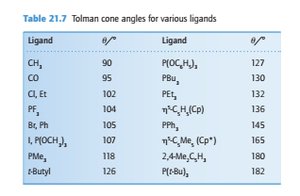
Summary Table: Tolman Cone Angles for Ligands
Ligand | θ/° | Ligand | θ/° |
|---|---|---|---|
CH3 | 90 | P(C6H5)3 | 145 |
CO | 95 | PBu3 | 130 |
Cl, Et | 102 | PEt3 | 132 |
PF3 | 104 | η1C5H5(Cp) | 136 |
Bz, Ph | 105 | η1C5Me5(Cp*) | 165 |
I, P(OCH3)3 | 107 | 2,4-Me2C6H3 | 185 |
PMe3 | 118 | P(t-Bu)3 | 182 |
t-Butyl | 126 |
Summary Table: Changes in Crystal Field Stabilization Energies
dn | CFSE (oct) | CFSE (sq pyr) | ΔCFSE |
|---|---|---|---|
d3 | 1.20 | 0.91 | -0.29 |
d4 (low-spin) | 1.80 | 1.28 | -0.52 |
d6 (low-spin) | 2.40 | 1.82 | -0.58 |
d8 (high-spin) | 0.00 | 0.00 | 0.00 |
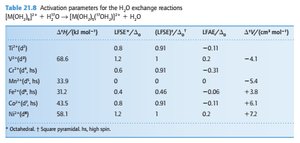
Summary Table: Activation Parameters for H2O Exchange Reactions
Ion | ΔH‡ (kJ mol-1) | LFSE/Δo | LFSE‡/Δo | LFAE/Δo | ΔV‡ (cm3 mol-1) |
|---|---|---|---|---|---|
Ti3+ (d1) | 68.6 | 1.20 | 0.91 | -0.29 | -4.1 |
V2+ (d3) | 31.2 | 1.20 | 0.91 | -0.29 | -5.4 |
Cr2+ (d4, hs) | 31.6 | 0.00 | 0.00 | 0.00 | +6.1 |
Fe2+ (d6, hs) | 41.5 | 0.00 | 0.00 | 0.00 | +8.1 |
Ni2+ (d8, hs) | 58.1 | 0.00 | 0.00 | 0.00 | +7.2 |
