 Indietro
Limiting Reagents, Acids & Bases, and pH Calculations: Study Notes for General Chemistry
Guida di studio - Note intelligenti
 Appunti personalizzati basati sui tuoi materiali, ampliati con definizioni chiave, esempi e contesto.
Chemical Quantities & Aqueous Reactions
Limiting Reagents
In chemical reactions, the limiting reagent is the reactant that is completely consumed first, thus determining the maximum amount of product that can be formed. Any other reactants present in excess are called excess reagents.
Step 1: Convert masses of reactants to moles using their molar masses.
Step 2: Use the stoichiometry of the balanced equation to determine which reactant produces the least amount of product; this is the limiting reagent.
Step 3: The maximum amount of product is determined by the limiting reagent.
Step 4: To find the amount of excess reagent left over, subtract the amount used (based on the limiting reagent) from the initial amount.
Example: For the reaction , if you start with 21.77 g Al2O3 (molar mass = 101.96 g/mol) and 0.701 g H2 (molar mass = 2.02 g/mol):
Moles of Al2O3: mol
Moles of H2: mol
Stoichiometry: 1 mol Al2O3 reacts with 3 mol H2
Limiting reagent: Compare the mole ratio to determine which reactant limits the reaction.
Application: Limiting reagent calculations are essential for predicting yields in laboratory and industrial chemical processes.
Acid and Base Equilibrium
Arrhenius and Brønsted-Lowry Definitions
Acids and bases can be defined in several ways. The two most common are the Arrhenius and Brønsted-Lowry definitions.
Arrhenius Acid: Produces H3O+ (hydronium) ions in water.
Arrhenius Base: Produces OH- ions in water.
Brønsted-Lowry Acid: Proton (H+) donor.
Brønsted-Lowry Base: Proton (H+) acceptor.
Example: In the reaction , HClO4 is the acid (proton donor), and H2O is the base (proton acceptor).
Some substances can act as either acids or bases depending on the reaction context; these are called amphiprotic or amphoteric substances (e.g., water).
Strong and Weak Acids
Strong acids completely dissociate in water, while weak acids only partially dissociate.
Strong Acids (must know):
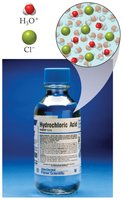
Hydrochloric acid (HCl)
Hydrobromic acid (HBr)
Hydroiodic acid (HI)
Nitric acid (HNO3)
Sulfuric acid (H2SO4)
Perchloric acid (HClO4)
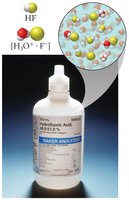
Weak Acids: Example: HF (hydrofluoric acid)
Example: HCl (strong acid): HF (weak acid):
Strong and Weak Bases
Strong bases are ionic compounds containing OH- that are soluble in water and completely dissociate. Weak bases only partially ionize.
Strong Bases: NaOH, KOH, Ba(OH)2 (all soluble hydroxides of Group 1 and Group 2 metals)
Weak Bases: NH3, PO43-
Example: (strong base) (weak base)
Neutralization Reactions
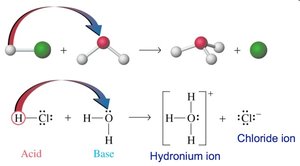
When an acid reacts with a base, a neutralization reaction occurs, typically producing water and a salt. This involves the transfer of a proton (H+) from the acid to the base.
Example:
Monoprotic and Polyprotic Acids
Monoprotic acids can donate one proton per molecule (e.g., HCl), while polyprotic acids can donate more than one (e.g., H2SO4 is diprotic).
Monoprotic:
Diprotic:
Summary Table: Arrhenius vs. Brønsted-Lowry Acids & Bases
Definition | Acid | Base |
|---|---|---|
Arrhenius | Produces H3O+ in water | Produces OH- in water |
Brønsted-Lowry | Proton donor | Proton acceptor |
pH, pOH, and Acidity Calculations
The pH Scale
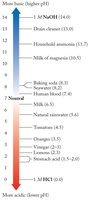
The pH scale is a logarithmic scale used to measure the acidity or basicity of a solution. It is defined as:
Low pH = more acidic (higher [H+])
High pH = more basic (lower [H+])
For aqueous solutions at 25°C:
Practice Calculations
Given [H+], find pH:
Given pH, find [H+]:
Given [OH-], find pOH:
Relationship:
Example 1: If [H+] = M, then
Example 2: If pH = 2.80, then M = 1.58 mM
Example 3: For a 0.175 M HNO3 solution (strong acid):
Example 4: For a 0.250 M KOH solution (strong base): M, ,
Example 5: If pH = 10.34, , M
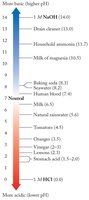
Additional info: Square brackets, such as [H+], denote molarity (mol/L) of the ion in solution. The pH scale is logarithmic, so each unit change represents a tenfold change in [H+].
