 Indietro
Liquids and Intermolecular Forces: States of Matter and Phase Changes
Guida di studio - Note intelligenti
 Appunti personalizzati basati sui tuoi materiali, ampliati con definizioni chiave, esempi e contesto.
Liquids and Intermolecular Forces
Introduction to States of Matter
The physical state of a substance—gas, liquid, or solid—is determined by the balance between the kinetic energy of its particles and the strength of the intermolecular forces acting between them. Understanding these states and the forces involved is essential for predicting and explaining the properties of materials.
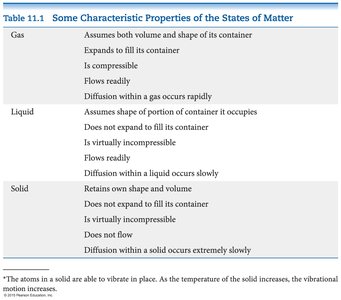
Characteristic Properties of the States of Matter
Gas: Assumes both the volume and shape of its container, is compressible, flows readily, and diffuses rapidly.
Liquid: Assumes the shape of the portion of the container it occupies, is virtually incompressible, flows readily, and diffuses more slowly than gases.
Solid: Retains its own shape and volume, is virtually incompressible, does not flow, and diffuses extremely slowly.
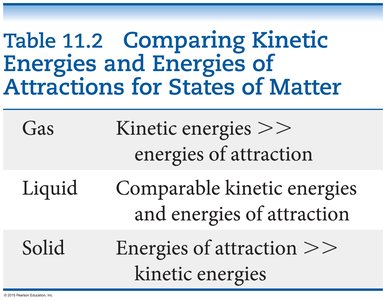
Kinetic Energy vs. Intermolecular Attractions
Gases: Kinetic energies are much greater than energies of attraction.
Liquids: Kinetic energies are comparable to energies of attraction.
Solids: Energies of attraction are much greater than kinetic energies.
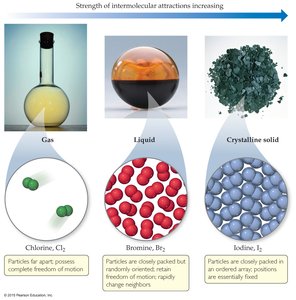
Examples of States of Matter
Chlorine (Cl2): Gas at room temperature, particles are far apart and move freely.
Bromine (Br2): Liquid at room temperature, particles are closely packed but can move past each other.
Iodine (I2): Crystalline solid at room temperature, particles are closely packed in an ordered array.
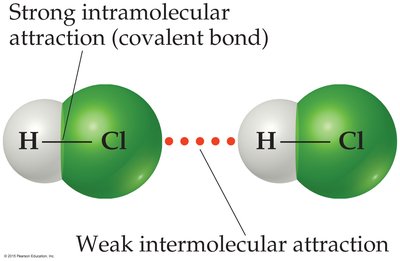
Intermolecular Forces
Types of Intermolecular Forces
Intermolecular forces are the forces of attraction between molecules. They are generally much weaker than the intramolecular forces (covalent or ionic bonds) that hold atoms together within a molecule.
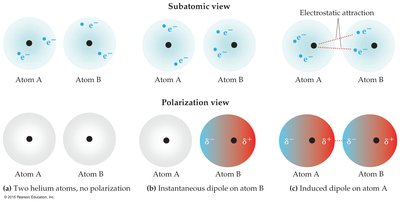
London Dispersion Forces (LDF): Present in all molecules, especially significant in nonpolar molecules. Arise from temporary fluctuations in electron distribution, creating instantaneous dipoles.
Dipole-Dipole Forces: Occur between polar molecules due to the attraction between positive and negative ends of dipoles.
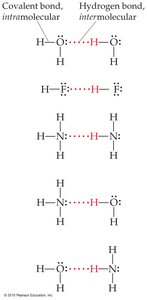
Hydrogen Bonding: A special, strong type of dipole-dipole interaction that occurs when hydrogen is bonded to highly electronegative atoms (N, O, or F).
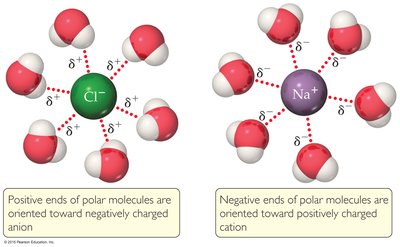
Ion-Dipole Forces: Occur between ions and polar molecules, important in solutions of ionic compounds in polar solvents.
London Dispersion Forces (LDF)
London dispersion forces are the only intermolecular forces present in nonpolar molecules and noble gases. They arise due to temporary, instantaneous dipoles that induce dipoles in neighboring atoms or molecules.
Polarizability: The ease with which the electron cloud of a molecule can be distorted. Larger, heavier atoms/molecules are more polarizable and have stronger LDFs.
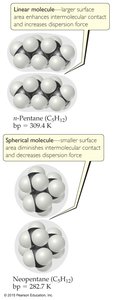
Molecular Shape: Molecules with greater surface area (linear shapes) have stronger dispersion forces than compact, spherical molecules.
Trends in Boiling Points
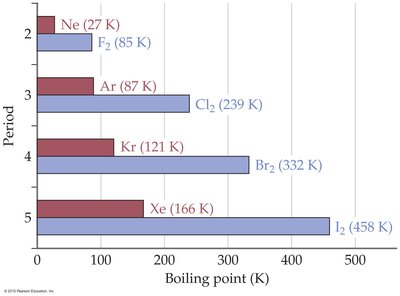
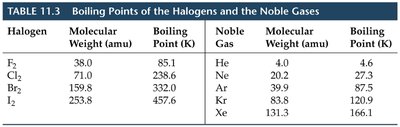
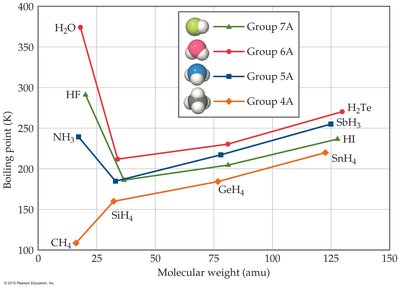
Boiling points increase with increasing molecular weight and polarizability due to stronger dispersion forces. For example, among the halogens and noble gases, heavier elements have higher boiling points.
Halogen | Molecular Weight (amu) | Boiling Point (K) | Noble Gas | Molecular Weight (amu) | Boiling Point (K) |
|---|---|---|---|---|---|
F2 | 38.0 | 85.1 | He | 4.0 | 4.6 |
Cl2 | 71.0 | 238.6 | Ne | 20.2 | 27.3 |
Br2 | 159.8 | 332.0 | Ar | 39.9 | 87.5 |
I2 | 253.8 | 457.6 | Kr | 83.8 | 120.9 |
Xe | 131.3 | 166.1 |
Dipole-Dipole Interactions
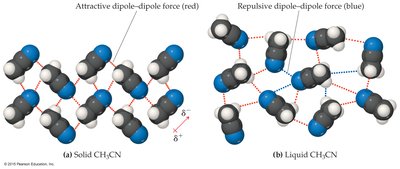
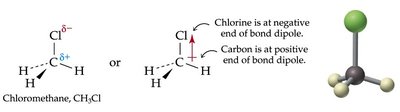
Dipole-dipole forces occur between polar molecules, where the positive end of one molecule is attracted to the negative end of another. The strength of these interactions increases with the magnitude of the molecular dipole moment.
Example: Acetonitrile (CH3CN) has a higher boiling point than propane (C3H8) due to its strong dipole-dipole interactions.
Net Dipole Moment and Molecular Geometry
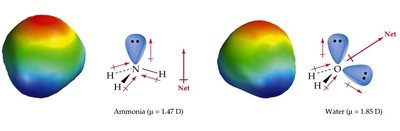
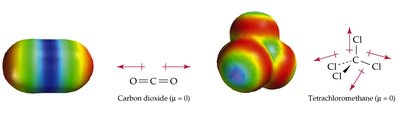
The overall polarity of a molecule depends on both the individual bond dipoles and the molecular geometry (VSEPR theory). For example, water (H2O) and ammonia (NH3) are polar, while carbon dioxide (CO2) and tetrachloromethane (CCl4) are nonpolar due to their symmetrical shapes.
Hydrogen Bonding
Hydrogen bonding is a particularly strong type of dipole-dipole interaction. It occurs when hydrogen is covalently bonded to a highly electronegative atom (N, O, or F), and is attracted to a lone pair on another electronegative atom in a neighboring molecule.
Hydrogen bonds are responsible for many unique properties of water, such as its high boiling point and surface tension.
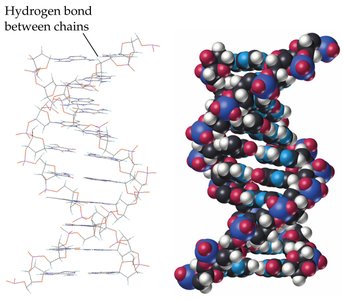
Hydrogen bonding is also crucial in biological molecules, such as DNA and proteins.
Ion-Dipole Interactions
Ion-dipole forces are important in solutions where ionic compounds are dissolved in polar solvents. The strength of these interactions explains why salts dissolve in water.
Properties of Liquids
Viscosity
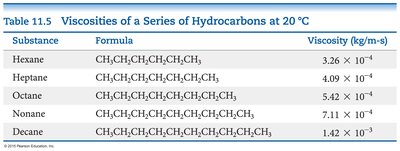
Viscosity is the resistance of a liquid to flow. It depends on the strength of intermolecular forces; stronger forces result in higher viscosity. For example, honey flows more slowly than water due to its higher viscosity.
Substance | Formula | Viscosity (kg/m·s) |
|---|---|---|
Hexane | CH3CH2CH2CH2CH2CH3 | 3.26 × 10⁻⁴ |
Heptane | CH3CH2CH2CH2CH2CH2CH3 | 4.09 × 10⁻⁴ |
Octane | CH3CH2CH2CH2CH2CH2CH2CH3 | 5.42 × 10⁻⁴ |
Nonane | CH3CH2CH2CH2CH2CH2CH2CH2CH3 | 7.11 × 10⁻⁴ |
Decane | CH3CH2CH2CH2CH2CH2CH2CH2CH2CH3 | 1.42 × 10⁻³ |
Surface Tension
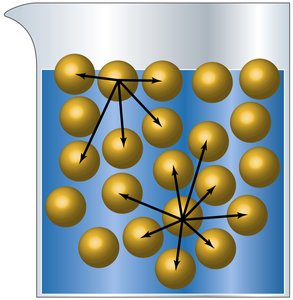
Surface tension is the energy required to increase the surface area of a liquid. It results from the imbalance of intermolecular forces at the surface of a liquid, causing the surface to behave like a stretched elastic membrane.
Capillary Action
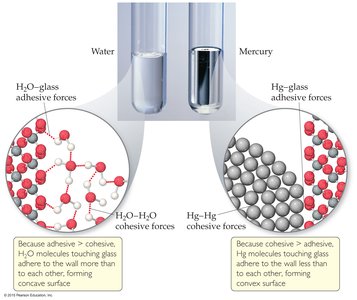
Capillary action is the rise of a liquid in a narrow tube due to the interplay of adhesive forces (between the liquid and the tube) and cohesive forces (between the liquid molecules). Water rises in glass due to strong adhesive forces, while mercury does not due to stronger cohesive forces.
Phase Changes
Types of Phase Changes
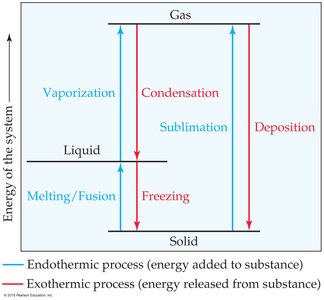
Phase changes are transitions between solid, liquid, and gas states. They involve the absorption or release of energy:
Melting (Fusion): Solid to liquid
Freezing: Liquid to solid
Vaporization: Liquid to gas
Condensation: Gas to liquid
Sublimation: Solid to gas
Deposition: Gas to solid
Enthalpy Changes in Phase Transitions
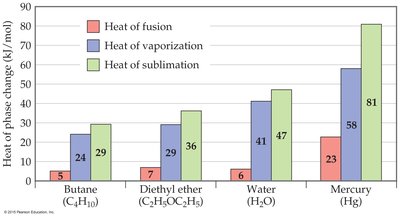
Heat of Fusion (ΔHfus): Energy required to melt a solid at its melting point.
Heat of Vaporization (ΔHvap): Energy required to vaporize a liquid at its boiling point.
Heat of Sublimation (ΔHsub): Energy required to convert a solid directly to a gas.
Generally, ΔHvap > ΔHfus because it takes more energy to completely separate molecules than to partially separate them.
Heating Curves
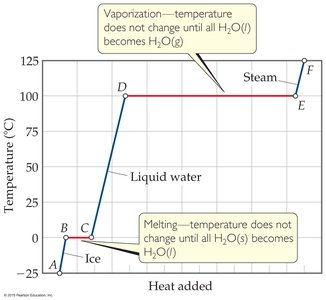
A heating curve is a plot of temperature versus heat added. During a phase change, the temperature remains constant while the substance absorbs or releases heat.
Within a phase:
During a phase change: or
Vapor Pressure and Boiling Point
Vapor Pressure
Vapor pressure is the pressure exerted by a vapor in equilibrium with its liquid at a given temperature. As temperature increases, vapor pressure increases because more molecules have enough energy to escape the liquid phase.
Boiling Point
The boiling point is the temperature at which the vapor pressure of a liquid equals the external (atmospheric) pressure. The normal boiling point is defined at 1 atm (760 torr).
Phase Diagrams
Understanding Phase Diagrams
A phase diagram is a graph of pressure versus temperature that shows the conditions under which the solid, liquid, and gas phases of a substance exist. Key features include:
Triple Point: The unique set of conditions where all three phases coexist in equilibrium.
Critical Point: The end point of the liquid-gas boundary, beyond which the liquid and gas phases are indistinguishable.
Special Cases
Water: The solid-liquid line has a negative slope, meaning that increasing pressure lowers the melting point.
Carbon Dioxide: Cannot exist as a liquid at pressures below its triple point; sublimes at atmospheric pressure.
Additional info: These notes provide a comprehensive overview of the key concepts in Chapter 11: Liquids and Intermolecular Forces, including the nature of intermolecular forces, their effects on physical properties, and the behavior of substances during phase changes. Understanding these principles is essential for predicting the properties and behaviors of materials in various chemical contexts.
