 Indietro
Liquids, Solids, and Intermolecular Forces: General Chemistry Study Guide
Guida di studio - Note intelligenti
 Appunti personalizzati basati sui tuoi materiali, ampliati con definizioni chiave, esempi e contesto.
Liquids, Solids, and Intermolecular Forces
10.1 Intermolecular Forces
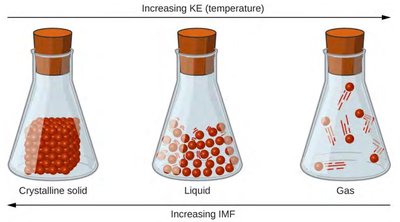
The physical states of matter—solid, liquid, and gas—are determined by the balance between kinetic energy (KE) and intermolecular forces (IMFs). IMFs are the forces of attraction between molecules, while KE is the energy that allows molecules to overcome these attractions.
Solids: Particles are tightly packed in a regular pattern and vibrate about fixed positions.
Liquids: Particles are close together with no regular arrangement and move past each other.
Gases: Particles are far apart and move independently except during collisions.
IMFs vs. KE: IMFs hold particles together; KE allows them to move apart.
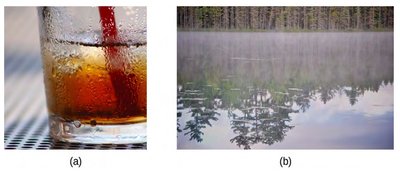
Condensation occurs when water vapor forms liquid droplets, such as on a cold glass or as fog.
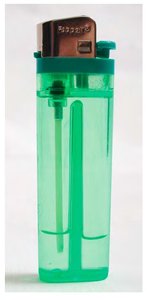
Gases can be compressed to liquids under high pressure and low temperature, as seen in a lighter.
Do not confuse intermolecular forces (between molecules) with intramolecular forces (within molecules).
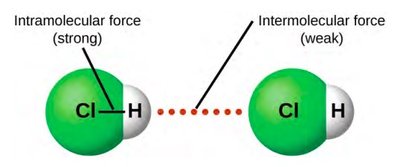
All attractive forces between neutral atoms and molecules are called van der Waals forces, which include:
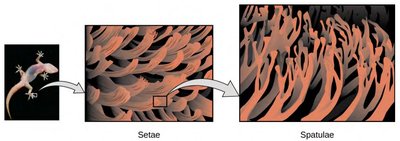
Dispersion Forces (London Dispersion): Temporary dipoles induce dipoles in neighboring molecules. Larger, heavier atoms/molecules have stronger dispersion forces.
Polarizability: The ease with which a molecule's charge distribution can be distorted.
Surface Area: Greater surface area leads to stronger dispersion forces.
Dipole-Dipole Forces: Occur between polar molecules, where partial positive and negative charges attract.
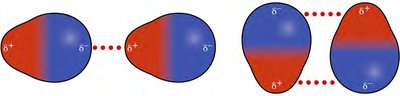
Example: CO (polar) has a higher boiling point than N2 (nonpolar) due to dipole-dipole attractions.
Example: ICl (polar) has a higher boiling point than Br2 (nonpolar) due to stronger dipole-dipole forces.
Hydrogen Bonding: A special, strong type of dipole-dipole interaction occurs when hydrogen is bonded to F, O, or N.
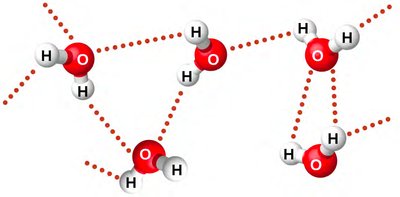
Hydrogen bonds are much weaker than covalent bonds but stronger than other IMFs.
Example: Ethanol (with -OH group) has a much higher boiling point than dimethylether or propane due to hydrogen bonding.
Example: Methylamine (with -NH group) has higher melting and boiling points than ethane due to hydrogen bonding.
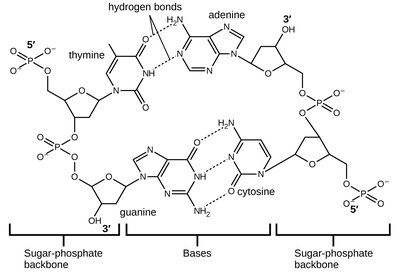
Hydrogen bonding is crucial in biological molecules, such as DNA, where it holds the double helix together.
Dipole-Induced Dipole Forces (Debye Forces): Occur when a permanent dipole induces a dipole in a nonpolar molecule.
10.2 Properties of Liquids
The physical properties of liquids are determined by the strength and type of intermolecular forces present. Cohesive forces (between like molecules) and adhesive forces (between different molecules) play key roles.
Viscosity: Resistance to flow; higher IMFs lead to higher viscosity.
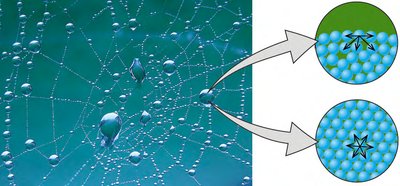
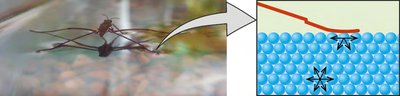
Surface Tension: Energy required to increase the surface area of a liquid; results from cohesive forces.
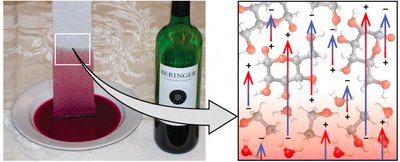
Adhesive Forces: Attraction between liquid molecules and surfaces; responsible for wetting and capillary action.
Capillary action occurs when adhesive and cohesive forces move a liquid up a narrow tube.
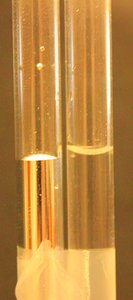
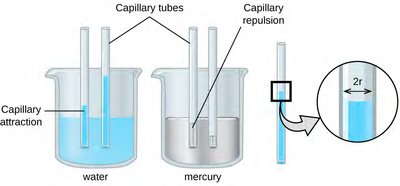
The height to which a liquid rises in a capillary tube is given by:
Where is surface tension, is contact angle, is density, is gravity, and is tube radius.
10.3 Phase Transitions
Phase transitions are changes between solid, liquid, and gas states. These processes are classified as endothermic (requiring heat) or exothermic (releasing heat).
Endothermic: Melting, vaporization, sublimation
Exothermic: Freezing, condensation, deposition
Phase transition temperatures depend on the strength of IMFs.
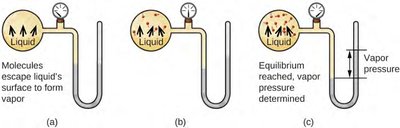
Vapor Pressure: The pressure exerted by a vapor in equilibrium with its liquid. Stronger IMFs result in lower vapor pressure.
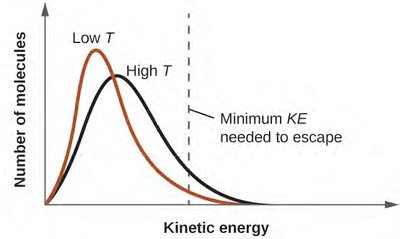
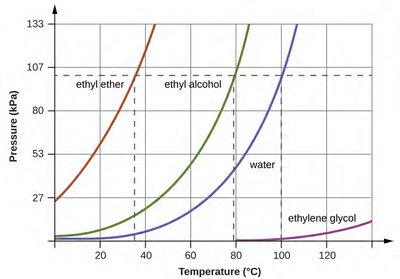
The Clausius-Clapeyron equation relates vapor pressure and temperature:
Where is enthalpy of vaporization, is the gas constant, and is temperature in Kelvin.
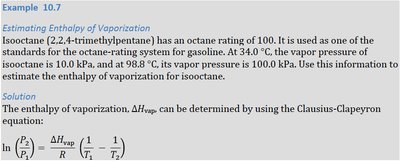

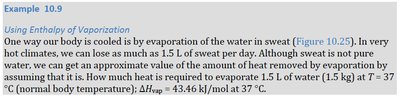
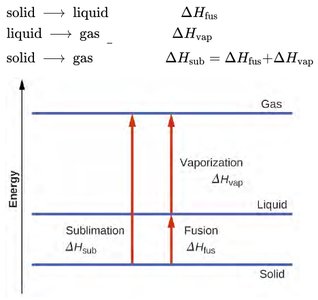
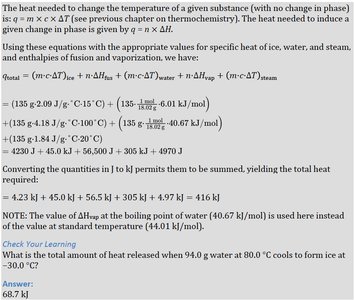
Enthalpy of Vaporization (): Heat required to convert one mole of liquid to gas.
Enthalpy of Fusion (): Heat required to convert one mole of solid to liquid.
Enthalpy of Sublimation (): Heat required to convert one mole of solid to gas.
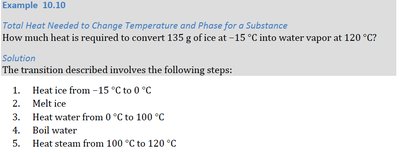
Heating and Cooling Curves: The total heat required for temperature and phase changes is calculated using:
(for temperature change)
(for phase change)
10.4 Phase Diagrams
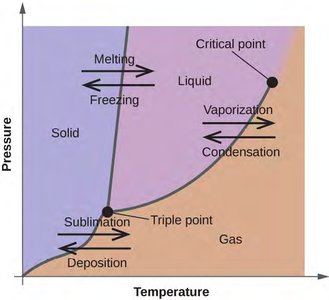
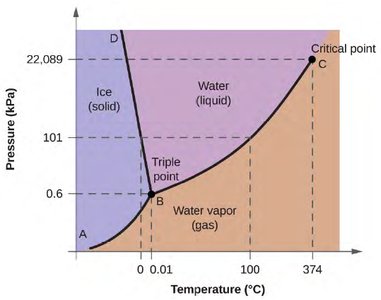
Phase diagrams show the regions of stability for solid, liquid, and gas phases as a function of temperature and pressure. Key features include the triple point (where all three phases coexist) and the critical point (beyond which a liquid phase cannot exist).
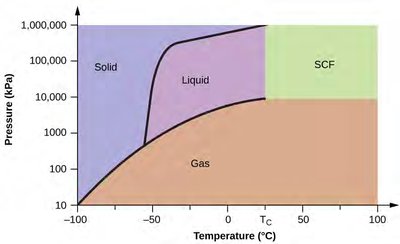
Supercritical Fluids: Above the critical temperature and pressure, substances exist as supercritical fluids, which have properties of both liquids and gases.
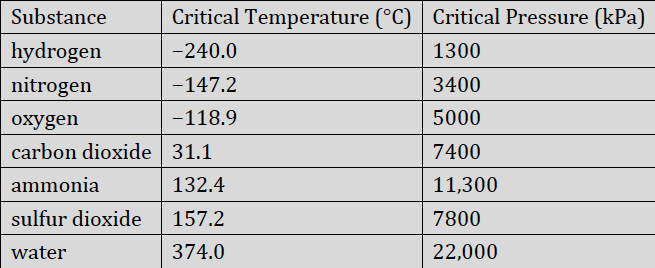
Substance | Critical Temperature (°C) | Critical Pressure (kPa) |
|---|---|---|
hydrogen | −240.0 | 1300 |
nitrogen | −147.2 | 3400 |
oxygen | −118.9 | 5000 |
carbon dioxide | 31.1 | 7400 |
ammonia | 132.4 | 11,300 |
sulfur dioxide | 157.2 | 7800 |
water | 374.0 | 22,000 |
10.5 The Solid State of Matter
Solids can be crystalline (ordered structure) or amorphous (disordered). Types of crystalline solids include ionic, metallic, covalent network, and molecular solids. Properties depend on particle type, arrangement, and strength of attractions.
10.6 Lattice Structures in Crystalline Solids
Crystalline solids are described by unit cells and packing arrangements. Metal atoms and ions pack in various structures, and the arrangement affects physical properties such as melting point and conductivity.
Summary Table: Types of Intermolecular Forces
Type | Strength | Example |
|---|---|---|
London Dispersion | Weak | Halogens, noble gases |
Dipole-Dipole | Moderate | CO, ICl |
Hydrogen Bonding | Strong | H2O, DNA |
Additional info: These notes expand on the original content by providing definitions, examples, equations, and tables for clarity and completeness, suitable for exam preparation in General Chemistry.
