 Indietro
Liquids, Solids, and Intermolecular Forces: General Chemistry Study Notes
Guida di studio - Note intelligenti
 Appunti personalizzati basati sui tuoi materiali, ampliati con definizioni chiave, esempi e contesto.
Liquids, Solids, and Intermolecular Forces
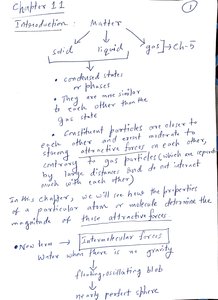
Introduction to Matter and Its States
Matter exists in three primary states: solid, liquid, and gas. These states are distinguished by the arrangement and behavior of their constituent particles, and are covered in Chapter 11 of General Chemistry.
Condensed States: Solids and liquids are referred to as condensed states or phases because their particles are closely packed.
Similarity: Solids and liquids are more similar to each other than to gases.
Gas State: Gases have particles that are far apart and interact weakly.
Intermolecular Forces: The attractive forces between particles determine the properties of each state.
New Term: Intermolecular forces are the forces that exist between molecules or atoms, influencing their physical properties.
Comparison of Solids, Liquids, and Gases
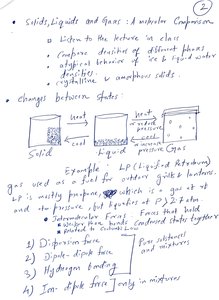
The physical properties of solids, liquids, and gases are determined by the strength and type of intermolecular forces present. Changes between these states occur through heating or cooling.
Solid: Particles are tightly packed and have fixed positions.
Liquid: Particles are close but can move past each other.
Gas: Particles are far apart and move freely.
Example: LPG (liquefied petroleum gas) is used as fuel and demonstrates the transition between liquid and gas states.
Types of intermolecular forces:
Dispersion force
Dipole-dipole force
Hydrogen bonding
Ion-dipole force (only in mixtures)
Dispersion Forces (London Forces)
Dispersion forces arise from temporary fluctuations in electron distribution within atoms or molecules, creating instantaneous dipoles that induce dipoles in neighboring particles.
Definition: Weakest intermolecular force, present in all molecules and atoms.
Example: Boiling points of noble gases increase with atomic mass due to stronger dispersion forces.
Noble Gas | Molar Mass (g/mol) | Boiling Point (K) |
|---|---|---|
He | 4.0 | 4 |
Ne | 20.18 | 27 |
Ar | 39.95 | 120 |
Kr | 83.8 | 145 |
Xe | 131.3 | 165 |
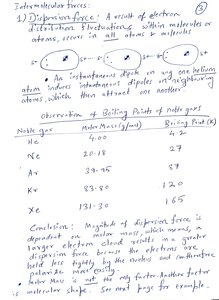
Conclusion: The magnitude of dispersion forces increases with molar mass and molecular size.
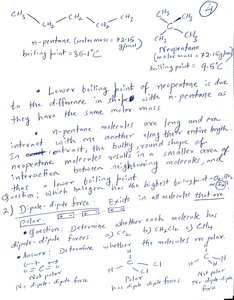
Shape and Boiling Point: n-Pentane vs. Neopentane
The boiling point of a molecule is influenced by its shape and the strength of its intermolecular forces. Molecules with greater surface area have stronger dispersion forces.
n-Pentane: Linear shape, higher boiling point.
Neopentane: Compact shape, lower boiling point.
Both have the same molar mass, but n-pentane's elongated shape allows for more contact between molecules, increasing intermolecular attraction.
Dipole-Dipole Forces
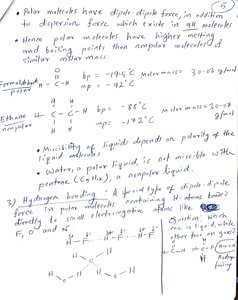
Dipole-dipole forces exist between polar molecules, where positive and negative ends of molecules attract each other.
Polar Molecules: Have permanent dipoles due to uneven electron distribution.
Example: Formaldehyde (CH2O) and ethane (C2H6) show differences in boiling points due to polarity.
Polar molecules have higher melting and boiling points than nonpolar molecules of similar molar mass.
Hydrogen Bonding
Hydrogen bonding is a special type of dipole-dipole interaction that occurs when hydrogen is bonded directly to highly electronegative atoms (F, O, N).
Strength: Strongest type of intermolecular force among neutral molecules.
Example: Water (H2O) exhibits extensive hydrogen bonding, leading to high boiling and melting points.
Ion-Dipole Forces
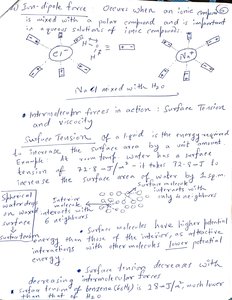
Ion-dipole forces occur when an ionic compound is mixed with a polar compound, such as NaCl dissolved in water.
Importance: Essential for dissolving ionic substances in polar solvents.
Intermolecular Forces in Action: Surface Tension and Viscosity
Surface tension is the energy required to increase the surface area of a liquid due to intermolecular forces. Viscosity is the resistance of a liquid to flow.
Surface Tension: Higher in liquids with strong intermolecular forces.
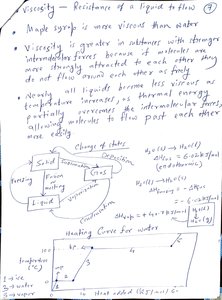
Viscosity: Greater in substances with stronger intermolecular forces; decreases with increasing temperature.
Phase Diagrams
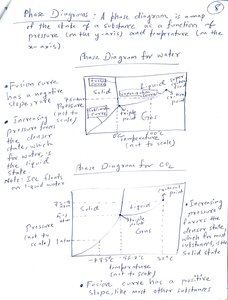
A phase diagram maps the state of a substance as a function of pressure and temperature. It shows regions of solid, liquid, and gas phases, and the transitions between them.
Fusion Curve: Indicates melting/freezing points.
Critical Point: The temperature and pressure at which the liquid and gas phases become indistinguishable.
Heating Curve for Water
The heating curve illustrates the temperature changes of water as it is heated, showing phase transitions from solid to liquid to gas.
Plateaus: Represent phase changes where temperature remains constant.
Slopes: Represent temperature increases within a single phase.
Vapor Pressure and Temperature
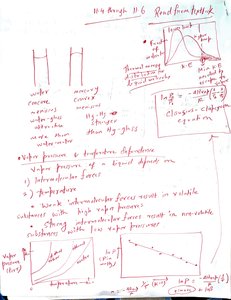
Vapor pressure is the pressure exerted by a vapor in equilibrium with its liquid phase. It depends on temperature and the strength of intermolecular forces.
Strong Intermolecular Forces: Result in low vapor pressure (non-volatile substances).
Weak Intermolecular Forces: Result in high vapor pressure (volatile substances).
Summary Table: Types of Intermolecular Forces
Type | Occurs Between | Relative Strength | Example |
|---|---|---|---|
Dispersion | All molecules/atoms | Weakest | Noble gases |
Dipole-Dipole | Polar molecules | Moderate | Formaldehyde |
Hydrogen Bonding | H bonded to F, O, N | Strongest (neutral) | Water |
Ion-Dipole | Ions and polar molecules | Strongest (overall) | NaCl in water |
Practice Problems and Applications
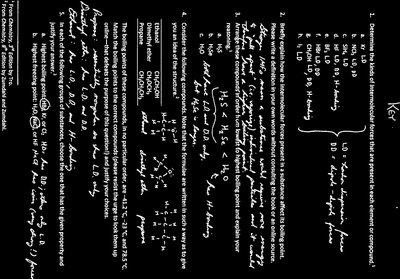
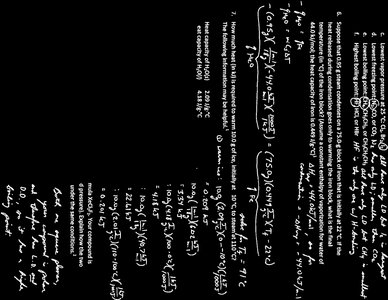
Understanding intermolecular forces is essential for predicting physical properties such as boiling point, melting point, solubility, and viscosity. Practice problems often involve identifying the types of forces present and explaining their effects on properties.
Additional info:
These notes cover the core concepts of Chapter 11: Liquids, Solids, and Intermolecular Forces, including the classification of matter, types of intermolecular forces, phase diagrams, and physical properties related to these forces. The content is directly relevant to General Chemistry college courses.
