 Indietro
Liquids, Solids, and Intermolecular Forces: Structure, Properties, and Phase Changes
Guida di studio - Note intelligenti
 Appunti personalizzati basati sui tuoi materiali, ampliati con definizioni chiave, esempi e contesto.
Liquids, Solids, and Intermolecular Forces
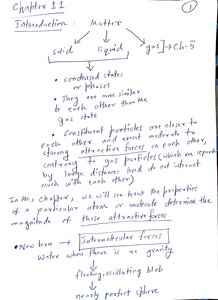
Introduction to States of Matter
Matter exists in three primary states: solid, liquid, and gas. These states are distinguished by the arrangement and energy of their constituent particles. The properties of each state are determined by the magnitude of the intermolecular forces present.
Solids: Particles are closely packed in a fixed structure; definite shape and volume.
Liquids: Particles are close but can move past each other; definite volume but no fixed shape.
Gases: Particles are far apart and move freely; no definite shape or volume.
Intermolecular forces are attractive forces between molecules that influence the physical properties of substances, such as boiling and melting points.
New term: Intermolecular forces – forces that act between molecules, affecting their physical behavior.
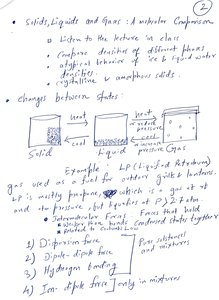
Comparison of Solids, Liquids, and Gases
The molecular arrangement and behavior differ among solids, liquids, and gases. These differences account for their distinct physical properties.
Solids have a fixed structure due to strong intermolecular forces.
Liquids have moderate intermolecular forces, allowing flow but maintaining volume.
Gases have weak intermolecular forces, allowing particles to move independently.
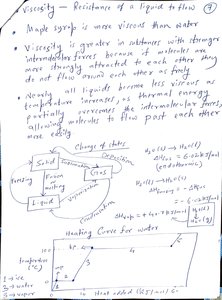
Changes between states (e.g., melting, boiling, condensation) involve energy changes and rearrangement of particles.
Types of Intermolecular Forces
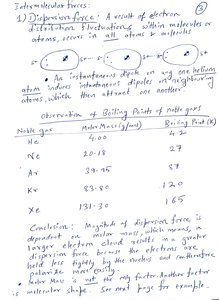
There are several types of intermolecular forces, each with distinct origins and effects on molecular properties:
Dispersion Forces (London Forces): Present in all molecules due to temporary fluctuations in electron distribution, inducing temporary dipoles.
Dipole-Dipole Forces: Occur between polar molecules with permanent dipoles.
Hydrogen Bonding: A special, strong type of dipole-dipole interaction involving H bonded to N, O, or F.
Ion-Dipole Forces: Occur between ions and polar molecules, important in solutions.
Dispersion forces increase with molecular size and mass. The boiling points of noble gases rise with increasing molar mass due to stronger dispersion forces.
Noble Gas | Molar Mass (g/mol) | Boiling Point (K) |
|---|---|---|
He | 4.00 | 4 |
Ne | 20.18 | 27 |
Ar | 39.95 | 87 |
Kr | 83.80 | 120 |
Xe | 131.30 | 165 |
Effect of Molecular Shape on Intermolecular Forces
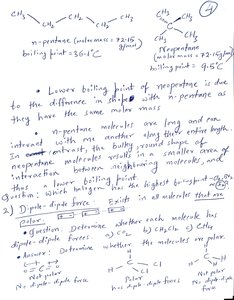
Molecules with similar molar masses can have different boiling points due to differences in shape, which affect the strength of intermolecular forces. For example, n-pentane (linear) has a higher boiling point than neopentane (compact) because linear molecules have more surface area for intermolecular interactions.
Dipole-Dipole Forces and Molecular Polarity
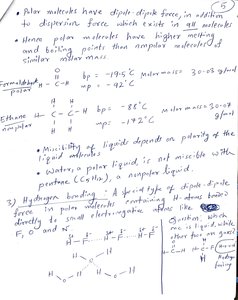
Polar molecules experience dipole-dipole forces in addition to dispersion forces. These forces increase boiling and melting points compared to nonpolar molecules of similar mass. The polarity of a molecule depends on the difference in electronegativity between atoms and the molecular geometry.
Formaldehyde (H2CO): bp = -19.5°C, polar
Ethane (C2H6): bp = -88°C, nonpolar
Hydrogen Bonding
Hydrogen bonding is a particularly strong type of dipole-dipole interaction. It occurs when hydrogen is bonded directly to highly electronegative atoms (N, O, or F). This leads to unusually high boiling points and affects properties such as solubility and viscosity.
Water (H2O) exhibits extensive hydrogen bonding, resulting in a high boiling point and unique properties.
Ion-Dipole Forces
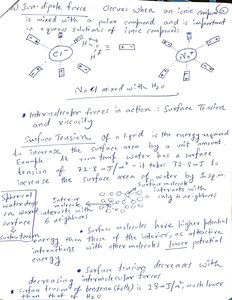
Ion-dipole forces occur when an ion interacts with a polar molecule. These forces are crucial in solutions, such as when NaCl dissolves in water. The positive and negative ions are stabilized by the partial charges on the water molecules.
Surface Tension and Viscosity
Surface tension is the energy required to increase the surface area of a liquid. It arises from intermolecular forces at the surface. Liquids with strong intermolecular forces have higher surface tension.
Surface tension decreases with increasing temperature.
Water has a higher surface tension than many other liquids due to hydrogen bonding.
Viscosity is the resistance of a liquid to flow. Substances with strong intermolecular forces are more viscous. Viscosity decreases with increasing temperature.
Phase Diagrams
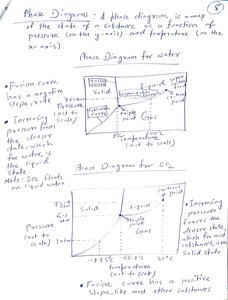
A phase diagram maps the state of a substance as a function of temperature and pressure. It shows regions of stability for solid, liquid, and gas phases, as well as lines of equilibrium (e.g., melting, boiling points).
The fusion curve (solid-liquid boundary) for water has a negative slope, unlike most substances.
Phase diagrams help predict the state of a substance under different conditions.
Vapor Pressure and Temperature
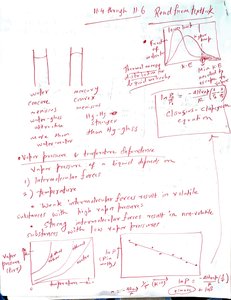
Vapor pressure is the pressure exerted by a vapor in equilibrium with its liquid at a given temperature. It depends on the strength of intermolecular forces and temperature.
Substances with strong intermolecular forces have low vapor pressures (non-volatile).
Vapor pressure increases with temperature.
Summary Table: Types of Intermolecular Forces
Type of Force | Occurs Between | Relative Strength | Examples |
|---|---|---|---|
Dispersion (London) | All molecules/atoms | Weakest | Noble gases, nonpolar molecules |
Dipole-Dipole | Polar molecules | Intermediate | HCl, CH2O |
Hydrogen Bonding | H with N, O, or F | Strong | H2O, NH3, HF |
Ion-Dipole | Ions and polar molecules | Strongest | NaCl in water |
Key Equations
Clausius-Clapeyron Equation (relates vapor pressure and temperature):
Heat required for phase changes: (for temperature change) (for phase change)
Examples and Applications
Explaining why water has a high boiling point (hydrogen bonding).
Understanding why oil and water do not mix (difference in polarity and intermolecular forces).
Predicting the state of CO2 at different temperatures and pressures using a phase diagram.
Additional info: These notes cover the core concepts of Chapter 11 (Liquids, Solids, and Intermolecular Forces) in a General Chemistry course, including definitions, examples, diagrams, and key equations for exam preparation.
