 Indietro
Liquids, Solids, and Intermolecular Forces: Study Guide
Guida di studio - Note intelligenti
 Appunti personalizzati basati sui tuoi materiali, ampliati con definizioni chiave, esempi e contesto.
Liquids, Solids, and Intermolecular Forces
The States of Matter
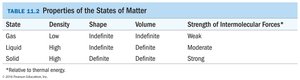
The three primary states of matter—solid, liquid, and gas—differ in their physical properties and the strength of intermolecular forces. Understanding these differences is fundamental to predicting the behavior of substances under various conditions.
Solids: Have a rigid shape and fixed volume. Their external shape often reflects the atomic or molecular arrangement. Intermolecular forces are strong.
Liquids: Have a definite volume but no fixed shape. They fill containers partially and intermolecular forces are moderate.
Gases: Expand to fill their container, with weak intermolecular forces.
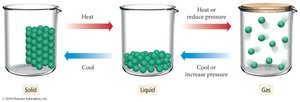
Example: Water exists as ice (solid), liquid water, and steam (gas) depending on temperature and pressure.
Phase Changes and Phase Diagrams
Phase changes occur when matter transitions between solid, liquid, and gas due to changes in temperature or pressure. Phase diagrams graphically represent these transitions and the conditions under which each phase exists.
Critical Point: The highest temperature and pressure at which the liquid phase can exist.
Triple Point: The unique set of conditions where all three phases coexist in equilibrium.
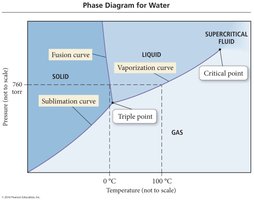
Example: Water's phase diagram shows regions for solid, liquid, gas, and supercritical fluid.
Molecular Comparison of Water's Phases
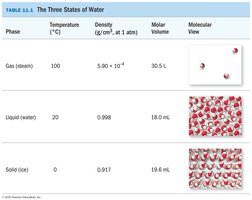
The arrangement and density of water molecules differ in each phase, affecting their physical properties.
Gas (steam): Molecules are far apart, low density.
Liquid (water): Molecules are closer, moderate density.
Solid (ice): Molecules are arranged in a lattice, high density (though ice is less dense than liquid water).
Intermolecular Forces
Intramolecular vs. Intermolecular Forces
Intramolecular forces are the strong attractions within a molecule (covalent, ionic, metallic bonds), while intermolecular forces are weaker attractions between molecules or ions.
Intramolecular: Hold atoms together in a molecule.
Intermolecular: Hold molecules together; responsible for physical properties like boiling and melting points.
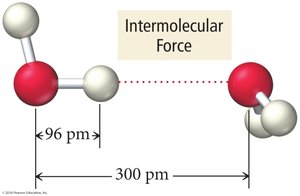
Types of Intermolecular Forces
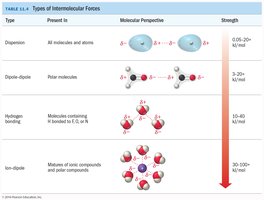
There are several types of intermolecular forces, each with varying strength and molecular requirements.
Dispersion (London) Forces: Present in all molecules and atoms; weakest.
Dipole-Dipole Forces: Occur between polar molecules.
Hydrogen Bonding: Special dipole-dipole interaction involving H bonded to N, O, or F; much stronger.
Ion-Dipole Forces: Occur between ions and polar molecules; strongest among intermolecular forces.
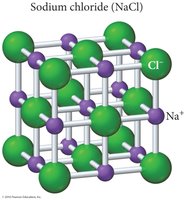
Ion–Ion Attractions
Ion–ion attractions are the strongest intermolecular forces, typically found in ionic compounds. These forces result in high melting points and ordered crystalline structures.
Example: Sodium chloride (NaCl) forms a cubic lattice due to strong ion–ion attractions.
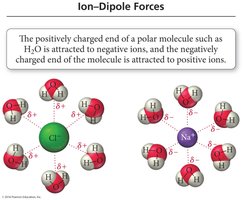
Ion–Dipole Forces
Ion–dipole forces occur when an ion interacts with a polar molecule. These are important in the dissolution of salts in water.
Example: Na+ and Cl− ions surrounded by water molecules.
Dipole–Dipole Interactions
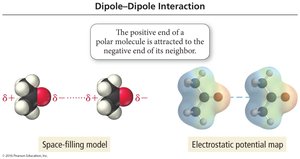
Dipole–dipole forces exist between polar molecules, where the positive end of one molecule is attracted to the negative end of another.
Strength: 5–40 kJ/mol, weaker than ion–dipole forces.
Hydrogen bonding: A special, stronger case of dipole–dipole interaction.
Hydrogen Bonding
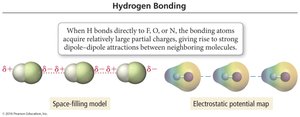
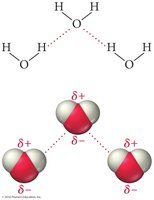
Hydrogen bonding occurs when hydrogen is bonded to highly electronegative atoms (N, O, F), resulting in strong dipole–dipole attractions.
Example: Water molecules form extensive hydrogen bonds, accounting for its unique properties.
Dispersion Forces
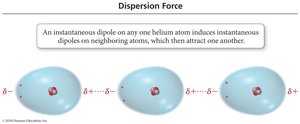
Dispersion forces (London forces) are present in all molecules, arising from temporary dipoles. They are the weakest intermolecular forces but become significant in large, nonpolar molecules.
Example: Instantaneous dipoles in helium atoms induce dipoles in neighboring atoms.
Molecular Shape and Dispersion Forces
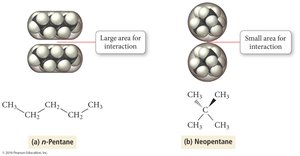
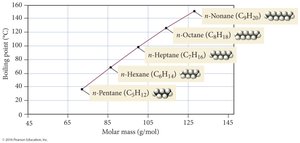
The shape of a molecule affects the strength of dispersion forces. Molecules with larger surface areas for interaction have stronger dispersion forces and higher boiling points.
Example: n-pentane vs. neopentane; n-pentane has a higher boiling point due to greater surface area.
Properties of Liquids and Solids
Surface Tension
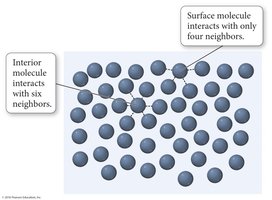
Surface tension is the resistance of a liquid to increase its surface area. It results from cohesive intermolecular forces and causes liquids to form spherical droplets.
Stronger intermolecular forces lead to higher surface tension.
Temperature increase reduces surface tension.

Viscosity
Viscosity is a liquid's resistance to flow. It depends on the strength of intermolecular forces and molecular shape.
Stronger intermolecular forces increase viscosity.
More spherical molecules have lower viscosity.
Temperature increase reduces viscosity.

Capillary Action
Capillary action is the spontaneous movement of a liquid up a narrow tube or paper, resulting from cohesive and adhesive forces.
Cohesive forces: Attraction between liquid molecules.
Adhesive forces: Attraction between liquid molecules and container surface.
Meniscus shape: Indicates relative strength of cohesive vs. adhesive forces.
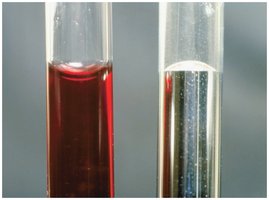
Solubility and Intermolecular Forces
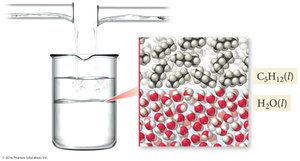
Solubility depends on the similarity of intermolecular forces between solute and solvent. "Like dissolves like" is a guiding principle.
Polar substances dissolve in polar solvents (hydrophilic groups).
Nonpolar substances dissolve in nonpolar solvents (hydrophobic groups).
Immiscible liquids do not mix due to lack of common intermolecular forces.
Phase Changes and Energetics
Vaporization and Condensation
Vaporization is the process of converting a liquid to a gas, requiring energy to overcome intermolecular forces. Condensation is the reverse, releasing energy.
Vaporization: Endothermic process.
Condensation: Exothermic process.
Volatile liquids: Evaporate easily (weak intermolecular forces).
Nonvolatile liquids: Do not evaporate easily (strong intermolecular forces).
Equilibrium Vapor Pressure
Equilibrium vapor pressure is the pressure exerted by a vapor over a liquid in a closed container when the rates of evaporation and condensation are equal. It depends on temperature and intermolecular forces.
Boiling point: Occurs when vapor pressure equals external pressure.
Clausius–Clapeyron equation: Used to relate vapor pressure, temperature, and enthalpy of vaporization.
Clausius–Clapeyron equation:
Heat of Vaporization and Fusion
The heat of vaporization () is the energy required to convert one mole of liquid to gas. The heat of fusion () is the energy required to melt one mole of solid.
Both are endothermic processes.
Heat of vaporization is always greater than heat of fusion for the same substance.
Sublimation and Deposition
Sublimation is the direct transition from solid to gas, while deposition is the reverse. Both involve changes in kinetic energy and intermolecular forces.
Phase Diagrams and Critical Points
Phase Diagrams
Phase diagrams show the regions of stability for solid, liquid, and gas phases as a function of temperature and pressure. They also indicate the triple point and critical point.
Critical point: Highest temperature and pressure where liquid can exist.
Triple point: All three phases coexist.
Supercritical Fluids
Supercritical fluids occur above the critical temperature and pressure, where liquid and gas phases merge. They have properties of both liquids and gases.
Water: An Extraordinary Substance
Unique Properties of Water
Water's unique properties arise from its ability to form hydrogen bonds. It is a liquid at room temperature, has high specific heat, and expands upon freezing.
High boiling point for its molecular mass.
Excellent solvent for ionic and polar substances.
Ice is less dense than liquid water.
Kinetic-Molecular Theory for Solids and Liquids
Kinetic-Molecular Theory for Liquids
Liquids have particles packed closely together, limiting their movement. They are incompressible and have definite volume but indefinite shape.
Kinetic-Molecular Theory for Solids
Solids have particles packed together with only vibrational motion. They are incompressible and have definite shape and volume.
Additional info: All equations are provided in LaTeX format for clarity. Tables and images are included only when directly relevant to the explanation.
