 Indietro
Manipulating Chemical Equilibria and Calculating Equilibrium Constants
Guida di studio - Note intelligenti
 Appunti personalizzati basati sui tuoi materiali, ampliati con definizioni chiave, esempi e contesto.
Manipulating Equilibrium Reactions
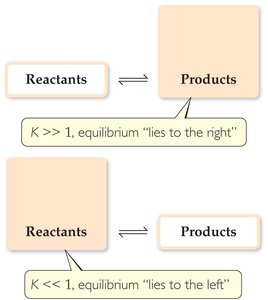
Magnitude of the Equilibrium Constant
The equilibrium constant (K) provides insight into the relative amounts of reactants and products at equilibrium. The value of K indicates whether the equilibrium favors products or reactants.
K >> 1: The equilibrium "lies to the right," meaning products are favored.
K << 1: The equilibrium "lies to the left," meaning reactants are favored.
Manipulating Reactions I: Reversing a Reaction
When a chemical equation is reversed, the equilibrium constant for the reversed reaction is the inverse of the equilibrium constant for the forward reaction.
Equation:
Example: For , if , then for , .
Manipulating Reactions II: Multiplying by a Common Factor
If the coefficients in a balanced equation are multiplied by a constant, the equilibrium constant is raised to the power of that constant.
Equation: where is the factor by which the equation is multiplied.
Example: Doubling gives , so .
Manipulating Reactions III: Adding Reactions
When two or more reactions are added, the equilibrium constant for the overall reaction is the product of the equilibrium constants for the individual reactions.
Equation:
Example:
,
,
Adding gives ,
Heterogeneous Equilibria
Activities and Units
Equilibrium constants are calculated using activities, which are dimensionless quantities. For practical purposes, activities are approximated by concentrations (in molarity) for solutions and partial pressures (in atm) for gases. The activities of pure solids and liquids are defined as 1, so they do not appear in equilibrium constant expressions.
Ideal gas: Activity = (often just in atm)
Solute in ideal solution: Activity = (often just in M)
Pure solid or liquid: Activity = 1
Heterogeneous Equilibria Examples
Because the activities of pure solids and liquids are 1, they are omitted from equilibrium constant expressions. For example, for the reaction:
(since solids are omitted)
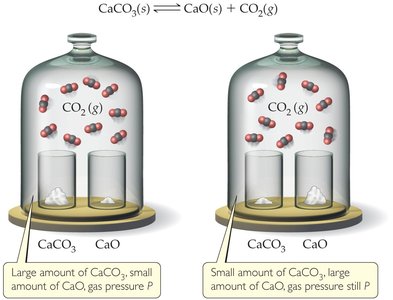
Changing the amount of solid does not affect the equilibrium pressure of the gas.
Solvents in Equilibrium Expressions
If a solvent is also a reactant or product, it is omitted from the equilibrium expression. For example:
Calculating Equilibrium Constants
ICE Tables (Initial, Change, Equilibrium)
ICE tables are used to organize the calculation of equilibrium concentrations or pressures. The steps are:
Write the balanced equation and set up the ICE table.
Fill in initial values for all species.
Express changes in terms of a variable (usually x) based on stoichiometry.
Write equilibrium values in terms of x.
Substitute equilibrium values into the equilibrium constant expression and solve for x.
Calculate final concentrations or pressures.
Example: Calculating
For , if , use the ICE table to find .
Set up the table, solve for x, and substitute into .
Example: Calculating
For , if initial atm and equilibrium atm, use the ICE table to find .
Set up the table, solve for x, and substitute into .
Quadratic Approximations in Equilibrium Calculations
When solving for x in equilibrium problems, if x is much smaller than the initial concentrations or pressures (typically less than 5%), it can be neglected to simplify calculations. Otherwise, the quadratic equation must be used:
Quadratic formula:
Check the validity of the approximation by comparing x to the initial values.
Summary Table: Activities in Equilibrium Expressions
Substance | Activity | Simplified Form |
|---|---|---|
Ideal gas | (in atm) | |
Solute in ideal solution | (in M) | |
Pure solid or liquid | 1 | 1 |
Additional info: The notes above include expanded academic context and examples to ensure clarity and completeness for exam preparation.
