 Indietro
Mastering Scientific Notation and Significant Figures in Chemistry
Guida di studio - Note intelligenti
 Appunti personalizzati basati sui tuoi materiali, ampliati con definizioni chiave, esempi e contesto.
Q1. Convert between decimal and scientific notation for the following numbers:
Background
Topic: Scientific Notation
This question tests your ability to express numbers in scientific notation and convert scientific notation back to decimal form. This is essential in chemistry for handling very large or very small values efficiently.
Key Terms and Formulas:
Scientific Notation: A way to express numbers as a product of a coefficient and a power of ten, e.g., .
Decimal Notation: The standard way of writing numbers without exponents.
Step-by-Step Guidance
Identify the decimal point location and count how many places it moves to convert to scientific notation.
Write the coefficient (a number between 1 and 10) and determine the exponent based on the direction and number of decimal places moved.
For negative exponents, the decimal moves to the left; for positive exponents, it moves to the right.
Practice converting both ways: decimal to scientific notation and scientific notation to decimal.
Try solving on your own before revealing the answer!
Final Answer:
0.07882 =
0.00000272338 =
118000 =
-0.00458 =
6.64 × 10-7 = 0.000000664
4.5 × 102 = 450
7.41717 × 104 = 74171.7
-2.5 × 103 = -2500
Scientific notation helps simplify calculations and express values with appropriate precision.
Q2. Perform addition and subtraction using scientific notation:
Background
Topic: Operations with Scientific Notation
This question tests your ability to add and subtract numbers written in scientific notation, which is important for calculations involving measurements in chemistry.
Key Terms and Formulas:
Add/Subtract: Make sure exponents are the same before combining coefficients.
Step-by-Step Guidance
Check if the exponents are the same for both numbers.
If not, adjust one number so both have the same exponent.
Add or subtract the coefficients as required.
Express the result in scientific notation, adjusting the coefficient and exponent if needed.
Try solving on your own before revealing the answer!
Final Answer:
(5.2 × 10³) + (7.72 × 10³) = 1.292 × 10⁴
(4.2 × 10⁻²) – (3.3 × 10⁻³) = 3.87 × 10⁻²
(2.7 × 10⁵) + (9.72 × 10⁴) = 3.672 × 10⁵
(5.6 × 10⁻³) – (2.3 × 10⁻⁴) = 5.37 × 10⁻³
Always align exponents before performing addition or subtraction in scientific notation.
Q3. Multiply and divide numbers in scientific notation:
Background
Topic: Multiplication and Division in Scientific Notation
This question tests your ability to multiply and divide numbers written in scientific notation, which is essential for calculations involving measurements and conversions in chemistry.
Key Terms and Formulas:
Multiplication: Multiply coefficients and add exponents:
Division: Divide coefficients and subtract exponents:
Step-by-Step Guidance
Multiply or divide the coefficients as required.
Add exponents for multiplication, subtract exponents for division.
Express the result in scientific notation, adjusting the coefficient and exponent if needed.
Check if the coefficient is between 1 and 10; if not, adjust accordingly.
Try solving on your own before revealing the answer!
Final Answer:
(3.7 × 10-3) × (2.5 × 108) = 9.25 × 10⁵
-(2 × 10-5) × (13 × 10-4) = -2.6 × 10-8
= 3.75 × 10-14
= -3 × 10¹¹
Multiplying and dividing in scientific notation makes calculations with very large or small numbers manageable.
Q4. Place the following numbers in increasing order:
Background
Topic: Comparing Numbers in Scientific Notation
This question tests your ability to compare and order numbers written in scientific notation and decimal form, which is important for understanding the relative size of values in chemistry.
Key Terms and Formulas:
Scientific Notation: Express numbers in a comparable form to easily determine their order.
Decimal Notation: Convert scientific notation to decimal form if needed for comparison.
Step-by-Step Guidance
Convert all numbers to decimal form or scientific notation for easy comparison.
Identify negative and positive values, and compare their magnitudes.
Arrange the numbers from smallest to largest based on their values.
Try solving on your own before revealing the answer!
Final Answer:
-4.103 < -1 < -8.10-5 < 0 < 4.10-3 < 0.025 < 1 < 58,000 < 2.106
Arranging numbers in order helps visualize their relative sizes, which is useful in scientific analysis.
Q5. Calculate using scientific notation:
Background
Topic: Calculations with Scientific Notation
This question tests your ability to perform calculations using scientific notation, including addition, subtraction, multiplication, and division.
Key Terms and Formulas:
Scientific Notation Operations: Use rules for addition/subtraction (align exponents) and multiplication/division (add/subtract exponents).
Step-by-Step Guidance
For addition/subtraction, align exponents before combining coefficients.
For multiplication/division, multiply/divide coefficients and add/subtract exponents.
Express the result in scientific notation, adjusting the coefficient and exponent if needed.
Try solving on your own before revealing the answer!
Final Answer:
- (1.25 × 10⁻²) – 2(1.3 × 10⁻³) = -1.51 × 10-2
= -2.66 × 10¹⁴
Careful application of scientific notation rules ensures accurate calculations.
Q6. Reading and interpreting significant figures in measurements:
Background
Topic: Significant Figures in Measurements
This question tests your understanding of how to read measurements and determine the number of significant figures, which is crucial for reporting data accurately in chemistry.
Key Terms and Formulas:
Significant Figures: Digits in a measurement that are known with certainty plus one estimated digit.
Precision: The degree to which repeated measurements under unchanged conditions show the same results.
Step-by-Step Guidance
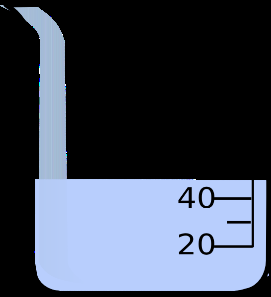
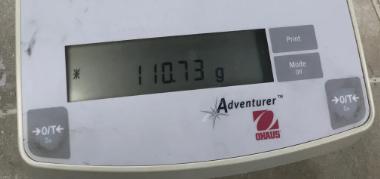
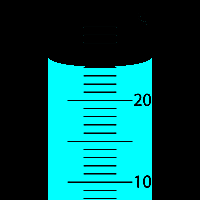
Read the measurement from the instrument (balance, ruler, beaker, graduated cylinder).
Identify the certain digits and the estimated digit.
Determine the number of significant figures based on the instrument's precision.
Express the measurement with the correct number of significant figures.

Try solving on your own before revealing the answer!
Final Answer:
Balance reading: 110.73 g (5 sig. fig., precision to hundredths place)
Ruler measurement: 4.8 cm (2 sig. fig., precision to tenths place)
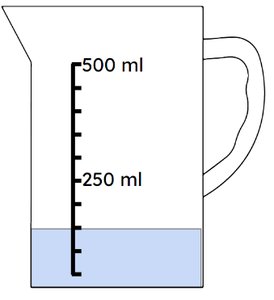
Beaker: 48 mL (2 sig. fig., precision to ones place)
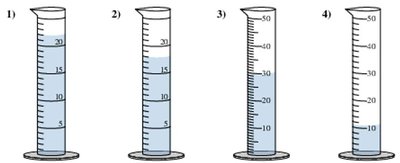
Graduated cylinder: 24.0 mL (3 sig. fig., precision to tenths place)
Always report measurements with the correct number of significant figures to reflect the instrument's precision.
Q7. Practice reading cylinders, burets, and beakers with precision:
Background
Topic: Precision and Significant Figures in Laboratory Measurements
This question tests your ability to read volumes from various glassware and determine the precision and significant figures for each measurement.
Key Terms and Formulas:
Meniscus: The curve seen at the surface of a liquid in response to its container.
Precision: Determined by the smallest increment on the measuring device.
Significant Figures: Reflect the certainty and uncertainty in the measurement.
Step-by-Step Guidance
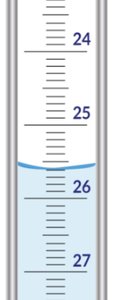
Observe the meniscus and read the value at eye level.
Identify the smallest increment on the device to determine the precision.
Record the measurement, including all certain digits and one estimated digit.
Determine the number of significant figures based on the precision.
Try solving on your own before revealing the answer!
Final Answer:
V1 = 22.0 mL (tenth's place, 3 sig. fig.)
V2 = 18.0 mL (tenth's place, 3 sig. fig.)
V3 = 30.0 mL (tenth's place, 3 sig. fig.)
V4 = 11 mL (one's place, 2 sig. fig.)
V5 = 25.60 mL (hundredths place, 4 sig. fig., buret)
V6 = 150 mL (tens place, 2 sig. fig., beaker)
The buret is the most precise (hundredths place, 4 sig. fig.), while the beaker is the least precise (tens place, 2 sig. fig.).
Q8. Explain why scientific notation, significant figures, and units matter in chemistry:
Background
Topic: Importance of Scientific Notation, Significant Figures, and Units
This question tests your understanding of why these concepts are essential for accuracy, precision, and communication in chemistry.
Key Terms and Formulas:
Scientific Notation: Simplifies calculations with very large or small numbers.
Significant Figures: Reflects the precision of measurements and calculations.
Units: Standardizes measurements for clear communication and comparison.
Step-by-Step Guidance
Consider how scientific notation helps manage extreme values in chemistry.
Think about how significant figures indicate the reliability and precision of measurements.
Reflect on the importance of using standardized units for scientific communication.
Try solving on your own before revealing the answer!
Final Answer:
Scientific notation allows chemists to work efficiently with very large or small numbers. Significant figures ensure that the precision of measurements and calculations is accurately represented. Units provide a standardized way to communicate and compare results, preventing errors and misinterpretation.
