 Indietro
Matter and Measurement: Foundations of General Chemistry
Guida di studio - Note intelligenti
 Appunti personalizzati basati sui tuoi materiali, ampliati con definizioni chiave, esempi e contesto.
Matter and Measurement
Scientific Notation
Scientific notation is a method used to express very large or very small numbers as the product of a number between 1 and 10 and a power of 10. This notation is essential in chemistry for handling measurements and calculations efficiently.
Format: The first part is a number between 1 and 10; the second part is a power of 10.
Positive exponent: Indicates a value greater than one.
Negative exponent: Indicates a value less than one.
Example: represents 623,500.
Units of Measurement
The International System of Units (SI) is the standard for scientific measurements, closely related to the metric system. Using units is crucial in chemistry, as measurements must always include units to convey meaning.
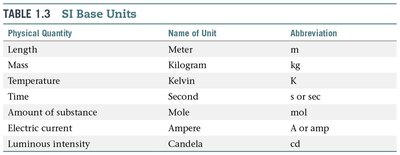
SI Base Units: Fundamental units for physical quantities.
Physical Quantity | Name of Unit | Abbreviation |
|---|---|---|
Length | Meter | m |
Mass | Kilogram | kg |
Temperature | Kelvin | K |
Time | Second | s or sec |
Amount of substance | Mole | mol |
Electric current | Ampere | A or amp |
Luminous intensity | Candela | cd |
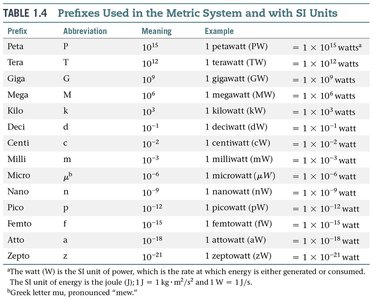
Prefix Multipliers: Prefixes represent powers of ten and allow conversion between units of different magnitudes.
Prefix | Abbreviation | Meaning | Example |
|---|---|---|---|
Peta | P | 1015 | 1 petawatt (PW) = 1 × 10¹⁵ watts |
Tera | T | 1012 | 1 terawatt (TW) = 1 × 10¹² watts |
Giga | G | 109 | 1 gigawatt (GW) = 1 × 10⁹ watts |
Mega | M | 106 | 1 megawatt (MW) = 1 × 10⁶ watts |
Kilo | k | 103 | 1 kilowatt (kW) = 1 × 10³ watts |
Deci | d | 10-1 | 1 deciwatt (dW) = 1 × 10⁻¹ watt |
Cent | c | 10-2 | 1 centiwatt (cW) = 1 × 10⁻² watt |
Milli | m | 10-3 | 1 milliwatt (mW) = 1 × 10⁻³ watt |
Micro | μ | 10-6 | 1 microwatt (μW) = 1 × 10⁻⁶ watt |
Nano | n | 10-9 | 1 nanowatt (nW) = 1 × 10⁻⁹ watt |
Pico | p | 10-12 | 1 picowatt (pW) = 1 × 10-12 watt |
Femto | f | 10-15 | 1 femtowatt (fW) = 1 × 10-15 watt |
Atto | a | 10-18 | 1 attowatt (aW) = 1 × 10-18 watt |
Zepto | z | 10-21 | 1 zeptowatt (zW) = 1 × 10-21 watt |
Derived Units
Derived units are obtained by combining base units through multiplication or division. For example, speed is a derived unit calculated as distance divided by time:
Formula:
SI unit for speed:
Volume and Its Units
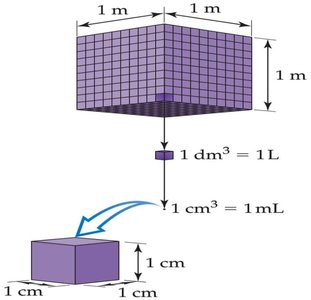
Volume is a derived unit representing the amount of three-dimensional space a substance occupies. The SI unit for volume is the liter (L), which is equivalent to a cubic decimeter (dm3).
Formula:
1 L = 1 dm3 = 1000 mL = 1000 cm3
1 mL = 1 cm3
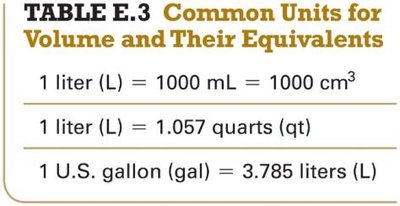
Unit | Equivalent |
|---|---|
1 liter (L) | 1000 mL = 1000 cm3 |
1 liter (L) | 1.057 quarts (qt) |
1 U.S. gallon (gal) | 3.785 liters (L) |
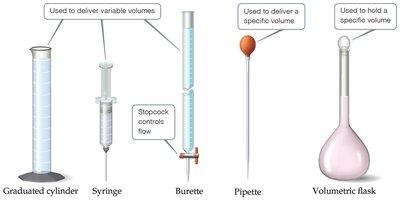
Lab Equipment for Measuring Volume: Graduated cylinders, syringes, burettes, pipettes, and volumetric flasks are commonly used to measure and deliver specific volumes in laboratory settings.
Density
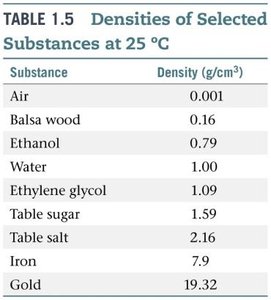
Density is defined as the mass of a substance per unit volume. It is a fundamental property used to identify substances and solve various chemistry problems.
Formula:
Common units: , ,
Substance | Density (g/cm3) |
|---|---|
Air | 0.001 |
Balsa wood | 0.16 |
Ethanol | 0.79 |
Water | 1.00 |
Ethylene glycol | 1.09 |
Table sugar | 1.59 |
Table salt | 2.16 |
Iron | 7.9 |
Gold | 19.32 |
Uncertainty in Measurement
Making Measurements
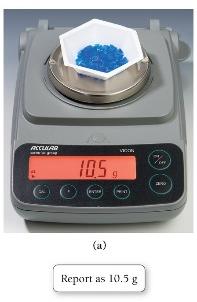
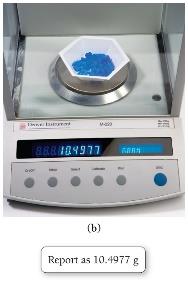
All measurements have some degree of uncertainty, and the last digit in a measurement is always estimated. The precision of a measurement depends on the measuring device used.
Example: A digital balance may report mass as 10.5 g or 10.4977 g, depending on its precision.
Significant Figures
Significant figures (sig figs) are the digits in a measurement that are known with certainty plus one estimated digit. They convey the precision of a measurement.
Rules for Counting Significant Figures:
Non-zero digits are always significant.
Trapped zeroes (between non-zero digits) are always significant.
Leading zeroes (before the first non-zero digit) are never significant.
Trailing zeroes are significant only if there is a decimal point.
Exact measurements: Defined quantities (e.g., 1 week = 7 days) have infinite significant figures.
Accuracy and Precision
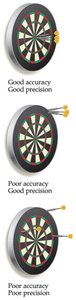
Accuracy refers to how close a measurement is to the true value, while precision refers to the reproducibility of measurements.
Example: Dartboard analogy:
Good accuracy and precision: Darts clustered at the bullseye.
Poor accuracy, good precision: Darts clustered away from the bullseye.
Poor accuracy and precision: Darts scattered randomly.
Reading Measurements
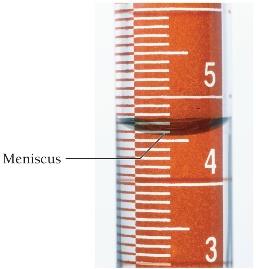
When reading a scale, always report the value to the correct number of significant figures, including one uncertain digit. For liquid measurements, read the meniscus at eye level.
Classifying Matter
States of Matter
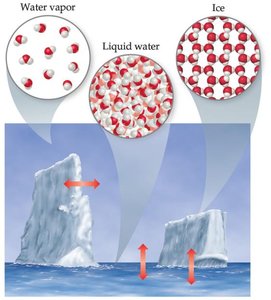
Matter exists in three main states: solid, liquid, and gas. Each state has distinct properties regarding shape and volume.
Solids: Fixed volume and rigid shape.
Liquids: Fixed volume, shape of container.
Gases: Volume and shape of container, compressible.
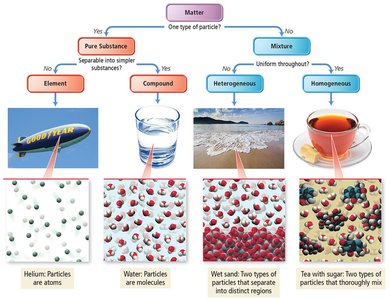
Pure Substances and Mixtures
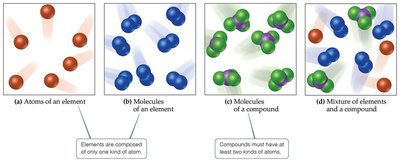
Pure substances have invariant composition and are classified as elements or compounds. Mixtures contain two or more components and can be homogeneous or heterogeneous.
Element: Cannot be chemically broken down; composed of one type of atom.
Compound: Composed of two or more elements in fixed proportions.
Mixture: Composition can vary; can be homogeneous (uniform) or heterogeneous (non-uniform).
Properties of Matter
Physical and Chemical Properties
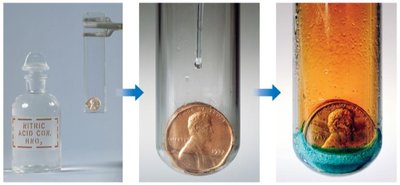
Properties of matter are classified as physical or chemical. Physical properties can be observed without changing the substance, while chemical properties describe how a substance reacts.
Intensive properties: Independent of amount (e.g., density, boiling point).
Extensive properties: Dependent on amount (e.g., mass, volume).
Example: Flammability is a chemical property; color is a physical property.
Physical and Chemical Changes
Physical changes do not alter the composition of a substance, while chemical changes result in the formation of new substances.
Example: Melting ice is a physical change; burning coal is a chemical change.
Methods for Separating Mixtures
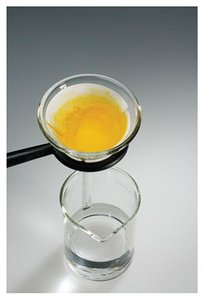
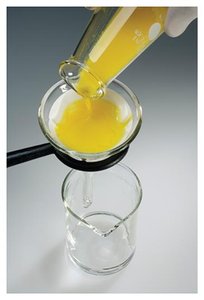
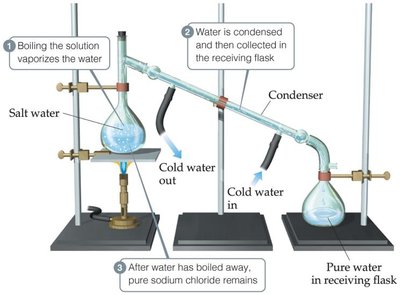
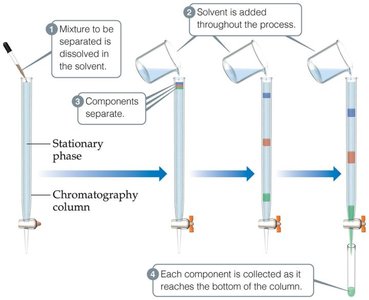
Mixtures can be separated based on physical properties using methods such as filtration, distillation, and chromatography.
Filtration: Separates solids from liquids in heterogeneous mixtures.
Distillation: Uses differences in boiling points to separate homogeneous mixtures.
Chromatography: Separates substances based on their ability to adhere to surfaces.
The Atomic Theory of Matter
Historical Development
The concept of atoms originated with Leucippus and Democritus, who proposed that matter is composed of small, indestructible particles. Dalton's atomic theory further developed this idea, stating that elements are made of atoms, atoms of the same element are identical, and compounds are formed from combinations of atoms.
Law of Conservation of Mass: Mass is conserved in chemical reactions.
Law of Constant Composition: Compounds have fixed ratios of elements.
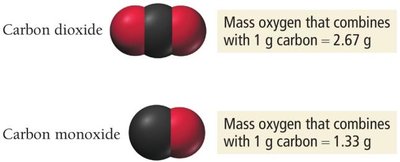
Law of Multiple Proportions: When elements form more than one compound, the ratios of masses are small whole numbers.
The Discovery of Atomic Structure
Key Experiments and Models
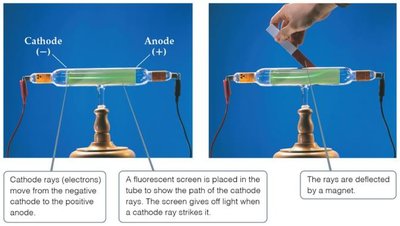
J.J. Thomson: Used cathode ray tubes to discover the electron.
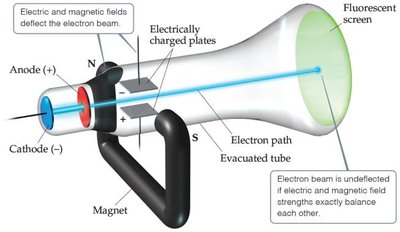
Robert Millikan: Determined the charge and mass of the electron through the oil drop experiment.
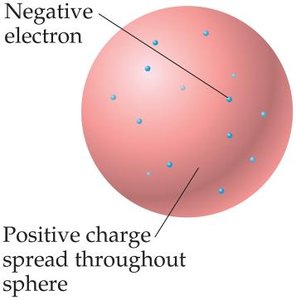
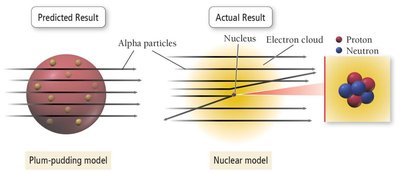
Lord Kelvin: Proposed the "Plum Pudding" model, with electrons embedded in a sphere of positive charge.
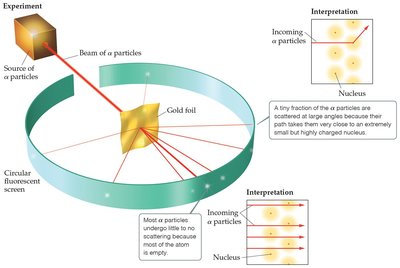
Ernest Rutherford: Gold foil experiment led to the nuclear model of the atom, with a dense, positively charged nucleus and electrons at a distance.
Subatomic Particles
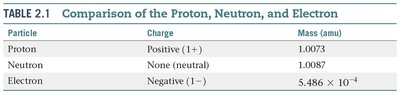
Particle | Charge | Mass (amu) |
|---|---|---|
Proton | Positive (1+) | 1.0073 |
Neutron | None (neutral) | 1.0087 |
Electron | Negative (1–) | 5.486 × 10⁻⁴ |
The Modern View of Atomic Structure
Atomic Number, Mass Number, and Isotopes
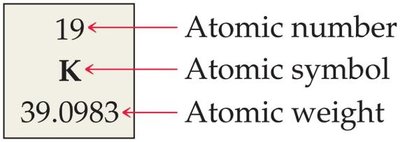
The atomic number (Z) is the number of protons in the nucleus and defines the element. Isotopes are atoms of the same element with different numbers of neutrons, resulting in different mass numbers.
Mass Number:
Example: Carbon-12 has 6 protons and 6 neutrons.
Ions
Ions are charged atoms formed by gaining or losing electrons. Anions are negatively charged (gain electrons), while cations are positively charged (lose electrons).
Atomic Mass and Mass Spectrometry
Calculating Atomic Mass
The atomic mass of an element is a weighted average of the masses of its isotopes, based on their natural abundances. Mass spectrometry is used to measure the mass and relative abundance of isotopes.
Formula:
Example Calculation
Chlorine: 75.77% chlorine-35 (mass 34.97 amu), 24.23% chlorine-37 (mass 36.97 amu).
Additional info: These notes cover foundational concepts in general chemistry, including measurement, classification of matter, properties, atomic theory, and atomic structure. All images included are directly relevant to the explanations provided.
