 Indietro
Matter Classification, Atomic Theory, and the Periodic Table: Foundational Concepts in General Chemistry
Guida di studio - Note intelligenti
 Appunti personalizzati basati sui tuoi materiali, ampliati con definizioni chiave, esempi e contesto.
Matter, Measurement & Problem Solving
Classification of Matter
Matter is anything that has mass and occupies space. It can be classified based on its physical and chemical properties, as well as its composition. Understanding the classification of matter is fundamental to the study of chemistry.
Pure Substances: Substances with a fixed composition and distinct properties. They can be elements or compounds.
Mixtures: Physical combinations of two or more pure substances. Mixtures can be separated by physical means and are classified as homogeneous or heterogeneous.

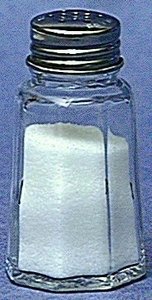
Pure Substances
Element: The simplest kind of matter with unique physical and chemical properties. Cannot be broken down into simpler substances by chemical means. Example: Copper (Cu).
Compound: A substance composed of two or more elements chemically combined in fixed proportions. Example: Sodium chloride (NaCl).
Mixtures
Homogeneous Mixture (Solution): Uniform composition throughout. Example: Apple juice.
Heterogeneous Mixture: Non-uniform composition; individual components are visible. Example: Granite rock.
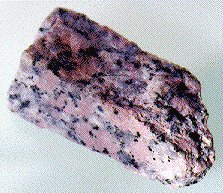

Separation of Mixtures
Mixtures can be separated into their components by physical methods, which do not involve chemical changes.
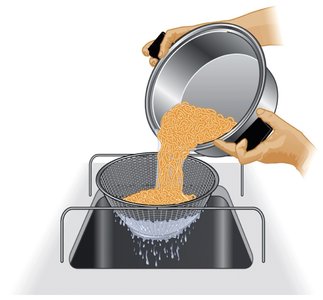
Filtration: Used to separate solids from liquids in heterogeneous mixtures.
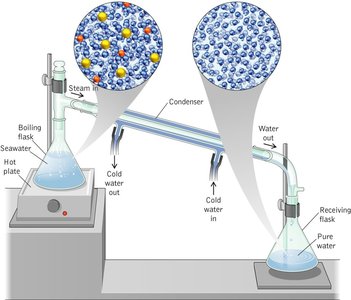
Distillation: Used to separate components of a homogeneous mixture based on differences in boiling points.
Atoms & Elements
Atomic Theory
The atomic theory states that all matter is composed of small, indivisible particles called atoms. Atoms are the fundamental building blocks of elements and compounds.
Atoms: The smallest unit of an element that retains its chemical properties.
Elements: Substances made up of only one kind of atom.
Compounds: Substances composed of atoms of two or more elements chemically combined in fixed ratios.
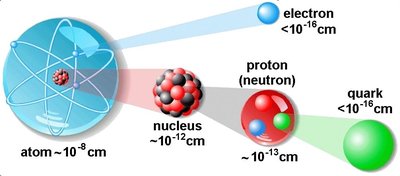
Structure of the Atom
Nucleus: Contains protons (positively charged) and neutrons (neutral).
Electrons: Negatively charged particles located in orbitals around the nucleus.

Atomic Number and Mass Number
Atomic Number (Z): Number of protons in the nucleus; uniquely identifies an element.
Mass Number (A): Total number of protons and neutrons in the nucleus.
Notation: where X is the element symbol, A is the mass number, and Z is the atomic number.
Ions
Cation: Atom that has lost electrons (positive charge).
Anion: Atom that has gained electrons (negative charge).
Formulas:
Number of protons = Atomic number (Z)
Number of neutrons = Mass number (A) – Atomic number (Z)
Number of electrons = Atomic number (Z) – Charge
Isotopes
Isotopes are atoms of the same element with the same number of protons but different numbers of neutrons. They have different mass numbers but identical chemical properties.
Radioisotopes: Isotopes that are unstable and undergo radioactive decay.
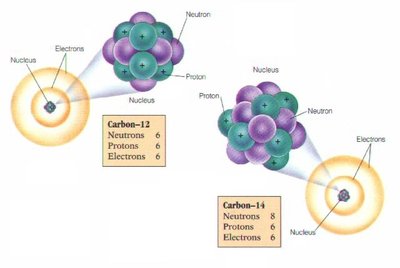
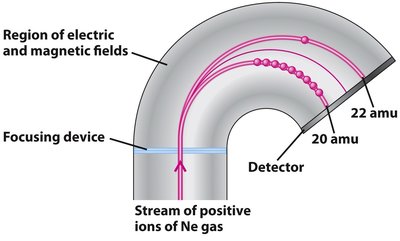
Isotopic Measurements and Average Atomic Mass
The average atomic mass of an element is calculated based on the masses and relative abundances of its naturally occurring isotopes.
Formula:
Isotope | Mass (amu) | Natural Abundance (%) |
|---|---|---|
Neon-20 | 19.9924 | 90.4838 |
Neon-21 | 20.99395 | 0.2696 |
Neon-22 | 21.9914 | 9.2465 |
Example Calculation:
Introduction to the Periodic Table
Development and Structure of the Periodic Table
The periodic table organizes elements based on increasing atomic number and recurring chemical properties. It provides a framework for understanding element classification and predicting chemical behavior.
Periods: Horizontal rows in the periodic table.
Groups (Families): Vertical columns containing elements with similar chemical properties due to similar valence electron configurations.

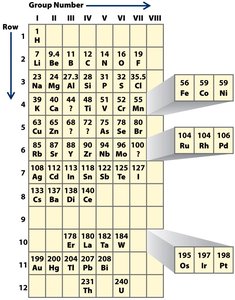
Classification of Elements
Main Group Elements: Groups 1, 2, and 13–18 (or 1A, 2A, 3A–8A).
Transition Metals: Groups 3–12 (or 1B–10B).
Alkali Metals: Group 1 elements.
Alkaline Earth Metals: Group 2 elements.
Halogens: Group 17 elements.
Noble Gases: Group 18 elements.
Metals, Nonmetals, Metalloids: Elements are also classified based on their physical and chemical properties.
Key Point: Elements in the same group have similar chemical properties due to similar valence electron configurations.
Summary Table: Classification of Matter
Type | Definition | Example |
|---|---|---|
Element | Pure substance, cannot be decomposed | Copper (Cu) |
Compound | Pure substance, can be decomposed chemically | Sodium chloride (NaCl) |
Homogeneous Mixture | Uniform composition | Apple juice |
Heterogeneous Mixture | Non-uniform composition | Granite |
Additional info:
The periodic table is a central tool in chemistry for predicting the properties and behaviors of elements.
Isotopic abundance is crucial for calculating the average atomic mass used in chemical calculations.
