 Indietro
Matter, Measurement, and Problem Solving: Foundations of General Chemistry
Guida di studio - Note intelligenti
 Appunti personalizzati basati sui tuoi materiali, ampliati con definizioni chiave, esempi e contesto.
Matter, Measurement & Problem Solving
Introduction to Chemistry
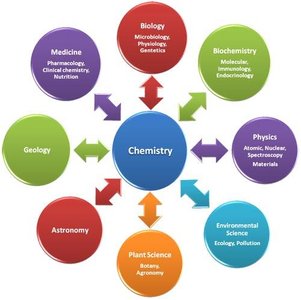
Chemistry is the science that studies matter, its properties, and the changes it undergoes. It is often called the central science because it connects and overlaps with other scientific disciplines such as biology, physics, geology, medicine, and environmental science.
Analytical thinking and problem-solving are core skills developed through chemistry.
Chemistry helps us understand the composition and behavior of everyday substances.
Matter and Its Classification
Matter is anything that has mass and occupies space. It is composed of tiny particles called atoms. Atoms are the smallest units of elements that retain their chemical properties.
Element: A pure substance made of only one kind of atom (e.g., gold, oxygen).
Molecule: Two or more atoms bonded together (e.g., O2, H2O).
Compound: A substance made of two or more different elements chemically combined (e.g., NaCl).
States of Matter
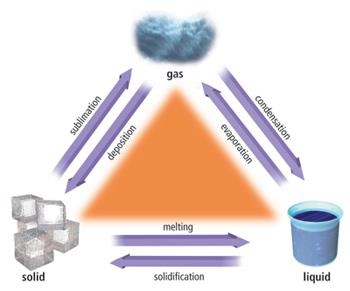
Matter exists in three main states: solid, liquid, and gas. Each state has distinct physical properties.
Solids: Rigid shape, fixed volume.
Liquids: Fluid shape, fixed volume.
Gases: Expand to fill their container.
Atoms and Elements
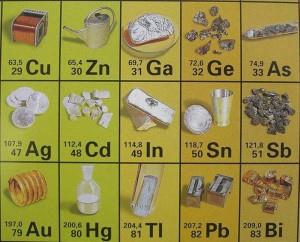
Elements are distinguished by their atomic structure and properties, such as color and state at room temperature. The periodic table organizes elements based on these properties.
Measurement in Chemistry
Types of Numbers in Chemistry
Exact Numbers: Defined values or counted quantities (e.g., 1 inch = 2.54 cm, 12 eggs in a dozen).
Measured Numbers: Obtained through measurement, subject to uncertainty (e.g., 12.4 mL).
Significant Figures
Significant figures (sig figs) indicate the precision of a measured value. They include all certain digits plus one uncertain digit.
Non-zero digits are always significant (e.g., 1.212 has 4 sig figs).
Zeros between significant digits are significant (e.g., 1.08701 has 6 sig figs).
Leading zeros are not significant (e.g., 0.00254 has 3 sig figs).
Trailing zeros after a decimal point are significant (e.g., 0.2540 has 4 sig figs).
Trailing zeros without a decimal point are ambiguous (e.g., 4500 may have 2, 3, or 4 sig figs).
Exact numbers have infinite significant figures.
Determining Significant Figures
0.00120 → 3 sig figs
120. → 3 sig figs
12.00 → 4 sig figs
1.20 x 10³ → 3 sig figs
Calculations with Significant Figures
Multiplication/Division: The result has the same number of sig figs as the measurement with the fewest sig figs.
Addition/Subtraction: The result has the same number of decimal places as the measurement with the fewest decimal places.
Example (Multiplication): 5.02 × 89.665 × 0.10 = 45 (2 sig figs)
Example (Addition): 7.59 + 6.5 = 14.1 (1 decimal place)
Rounding Rules
If the digit after the last significant figure is 0-4, round down.
If the digit is 5-9, round up.
Round only at the end of multi-step calculations to avoid cumulative error.
Example: 0.0237 rounded to 2 sig figs is 0.024.
Precision and Accuracy
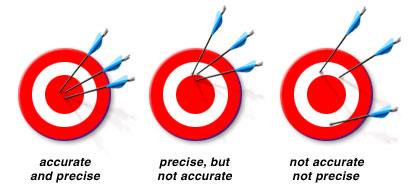
Accuracy refers to how close a measurement is to the true value. Precision refers to how close repeated measurements are to each other.
Units and Dimensional Analysis
SI Units
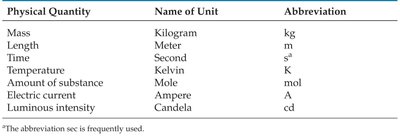
The International System of Units (SI) is the standard for scientific measurements. Each physical quantity has a base unit.
Physical Quantity | Name of Unit | Abbreviation |
|---|---|---|
Mass | Kilogram | kg |
Length | Meter | m |
Time | Second | s |
Temperature | Kelvin | K |
Amount of substance | Mole | mol |
Electric current | Ampere | A |
Luminous intensity | Candela | cd |
SI Prefixes
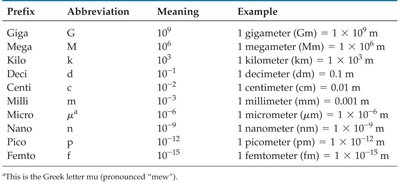
Prefixes are used to express multiples or fractions of base units.
Prefix | Abbreviation | Meaning | Example |
|---|---|---|---|
Giga | G | 109 | 1 gigameter (Gm) = 1 × 10⁹ m |
Mega | M | 106 | 1 megameter (Mm) = 1 × 10⁶ m |
Kilo | k | 103 | 1 kilometer (km) = 1 × 10³ m |
Deci | d | 10-1 | 1 decimeter (dm) = 0.1 m |
Centi | c | 10-2 | 1 centimeter (cm) = 0.01 m |
Milli | m | 10-3 | 1 millimeter (mm) = 0.001 m |
Micro | μ | 10-6 | 1 micrometer (μm) = 1 × 10⁻⁶ m |
Nano | n | 10-9 | 1 nanometer (nm) = 1 × 10⁻⁹ m |
Pico | p | 10-12 | 1 picometer (pm) = 1 × 10-12 m |
Femto | f | 10-15 | 1 femtometer (fm) = 1 × 10-15 m |
Derived Units: Volume and Density
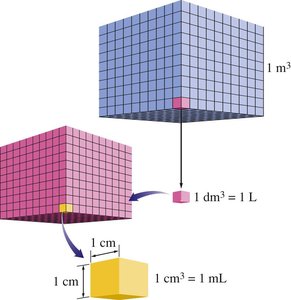
Volume: The amount of 3D space occupied by a substance. SI unit is cubic meter (m3), but cm3 and mL are commonly used.
1 mL = 1 cm3; 1 L = 1 dm3
Density: Mass per unit volume.
Temperature and Its Measurement
Temperature Scales
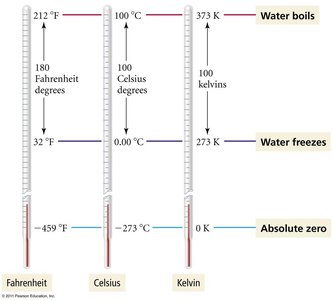
Temperature measures the average kinetic energy of particles. Three main scales are used:
Fahrenheit (°F): Used mainly in the U.S.
Celsius (°C): Used worldwide.
Kelvin (K): The SI unit; absolute scale with no negative values. 0 K is absolute zero.
Temperature Conversions
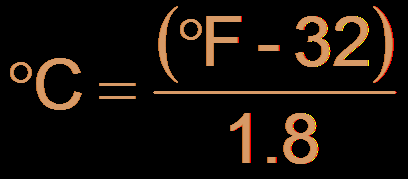
Dimensional Analysis and Unit Conversions
Dimensional Analysis
Dimensional analysis is a systematic approach to problem-solving that uses conversion factors to move from one unit to another.
Conversion factors are ratios that express how many of one unit are equal to another unit.
Always check that units cancel appropriately to yield the desired unit.


Examples of Unit Conversions
Convert 1.76 yd to centimeters: 1.76 yd × (1 m / 1.094 yd) × (100 cm / 1 m) = 161 cm (rounded to 3 sig figs)
Convert 0.0833 lbs of glucose to mg: 0.0833 lb × (453.6 g / 1 lb) × (1000 mg / 1 g) = 3.78 × 10⁴ mg
Convert density of silver (10.5 g/cm3) to kg/m3: 10.5 g/cm3 × (1 kg / 1000 g) × (106 cm3 / 1 m3) = 1.05 × 10⁴ kg/m3
Practice Problems
Find the mass of an ice cube that raises water volume from 16.5 mL to 19.2 mL (density of ice = 0.9167 g/cm3).
Calculate the mass of a block of iron (dimensions: 2.25 in × 3.65 cm × 44.0 mm; density = 7.86 g/cm3).
Determine the mass of liquid ethyl alcohol in a sphere (diameter = 4.50 cm; density = 0.8205 g/mL).
Additional info: These foundational concepts are essential for all subsequent topics in general chemistry, including chemical reactions, stoichiometry, and laboratory measurements.
