 Indietro
Matter, Measurement & Problem Solving: General Chemistry Study Notes
Guida di studio - Note intelligenti
 Appunti personalizzati basati sui tuoi materiali, ampliati con definizioni chiave, esempi e contesto.
Classification of Matter
Types of Matter
Chemistry is the study of matter and the changes it undergoes. Matter is anything that occupies space and has mass. Matter can be classified into three main types:
Element: The simplest type of matter, composed of one kind of atom.
Compound: Matter composed of two or more different elements that are chemically bonded together.
Mixture: Matter composed of elements and/or compounds that are physically mixed together.
Example: Classify the following substances:
Gatorade: Homogeneous mixture
Crystalline sugar: Pure substance (compound)
Lead wire: Pure substance (element)
Salsa: Heterogeneous mixture
Physical and Chemical Changes
Physical Changes
Physical changes alter the physical state of a substance without changing its composition. Common examples include melting, boiling, dissolving, and tearing.
Example: Dissolving sugar in water is a physical change.
Chemical Changes
Chemical changes involve changes in chemical composition, resulting in new chemical bonds and products. Examples include burning, rusting, and cooking.
Example: Cooking an egg is a chemical change.
Reversible and Irreversible Changes
Reversible changes can be undone to restore the original structure (e.g., phase changes, dissolving). Irreversible changes are permanent (e.g., chemical reactions).
Phase Changes
Phase Change Diagram
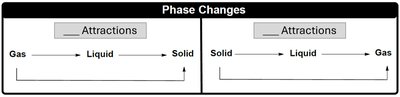
Phase changes involve transitions between solid, liquid, and gas states. These changes are governed by the strength of intermolecular attractions.
Increasing Attractions: Gas → Liquid → Solid
Decreasing Attractions: Solid → Liquid → Gas
Measurement in Chemistry
Perimeter, Area, and Volume
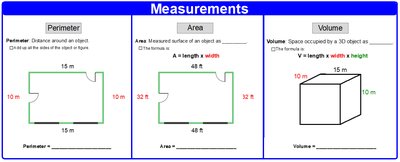
Measurements are fundamental in chemistry for quantifying physical properties. Perimeter is the distance around an object, area is the measured surface, and volume is the space occupied by a 3D object.
Perimeter: Sum of all sides
Area:
Volume:
SI Units and Metric Prefixes
SI Base Units
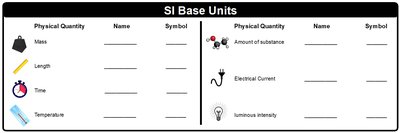
The International System of Units (SI) is based on seven base units, each corresponding to a physical quantity.
Physical Quantity | Name | Symbol |
|---|---|---|
Mass | kilogram | kg |
Length | meter | m |
Time | second | s |
Temperature | kelvin | K |
Amount of substance | mole | mol |
Electric current | ampere | A |
Luminous intensity | candela | cd |
Significant Figures
Definition and Rules
Significant figures are the digits in a measurement that contribute to its precision. The more significant figures, the more precise the measurement.
Non-zero digits are always significant.
Zeros between significant digits are significant.
Leading zeros are not significant.
Trailing zeros in the decimal portion are significant.
Exact numbers have an infinite number of significant figures.
Recording Measurements
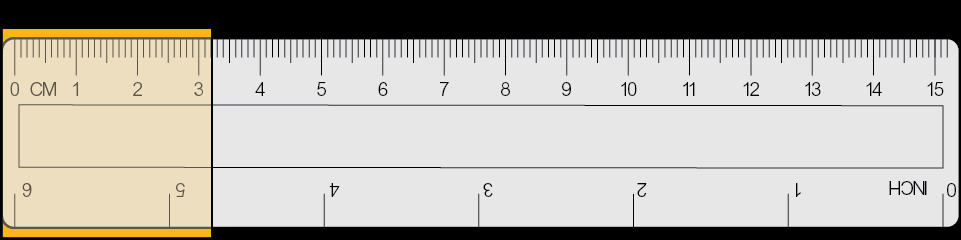
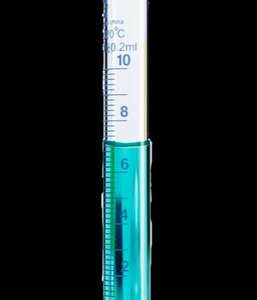
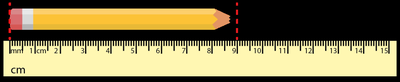
When recording measurements, include all known digits plus one estimated digit.
Significant Figures in Calculations
Multiplication and Division
For multiplication and division, the result should have the same number of significant figures as the value with the least significant figures.
Addition and Subtraction
For addition and subtraction, the result should have the same number of decimal places as the value with the least decimal places.
Mixed Operations
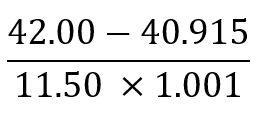
Follow the order of operations (PEMDAS: Parentheses, Exponents, Multiplication/Division, Addition/Subtraction) and apply significant figure rules at each step.
Temperature and Heat
Thermal Energy, Temperature, and Heat
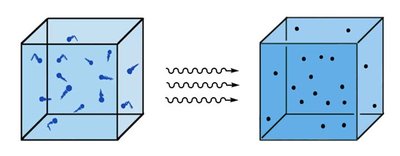
Thermal energy is the sum of kinetic and potential energies of all atoms in an object. Temperature is the average kinetic energy, while heat is the transfer of thermal energy from a hotter object to a cooler one.
Temperature Conversions
Celsius (ºC), Fahrenheit (ºF), and Kelvin (K) are common units.
Conversion formulas:
Chemical and Physical Properties
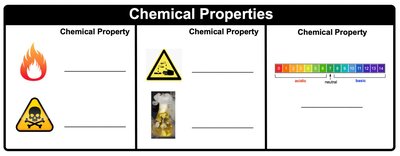
Chemical Properties
Chemical properties are observed during a chemical reaction and result in the formation of new substances.
Physical Properties
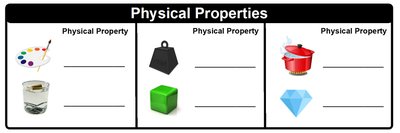
Physical properties are measurable and describe the state of a chemical compound without changing its chemical structure.
Intensive and Extensive Properties
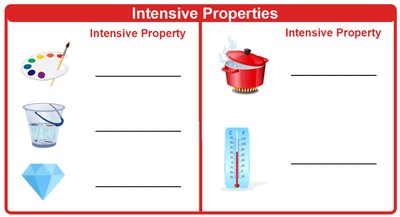
Intensive Properties
Intensive properties are independent of the size or amount of substance present. Examples include melting point, density, and temperature.
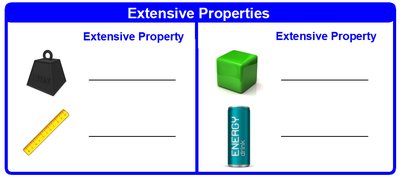
Extensive Properties
Extensive properties depend on the size or amount of substance present. Examples include mass, volume, and energy.
Conversion Factors and Dimensional Analysis
Conversion Factors
Conversion factors are ratios that relate different units. They are used to convert measurements from one unit to another.
Quantity | Conversion Factor |
|---|---|
Length | 1 inch = 2.54 cm |
Volume | 1 L = 1 dm3 |
Mass | 1 kg = 2.2046 lbs |
Dimensional Analysis
Dimensional analysis is a systematic method for converting units using conversion factors. The process involves starting with the given amount and multiplying by conversion factors to reach the desired unit.
Density
Definition and Formula
Density is the amount of mass per unit volume. For solids and liquids, units are typically g/cm3 or kg/m3. For gases, units are g/L or kg/m3.
Formula:
Density of Geometric Objects
For geometric objects, density can be calculated using their mass and volume. Volume formulas for common shapes:
Cube:
Sphere:
Cylinder:
Density of Non-Geometric Objects: Water Displacement
Water displacement is used to determine the volume of irregularly shaped objects by measuring the change in water level when the object is submerged.
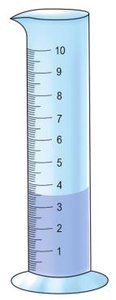
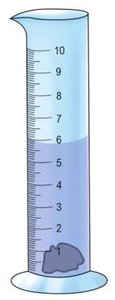
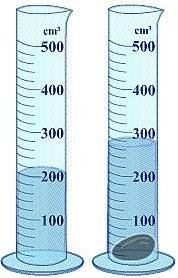
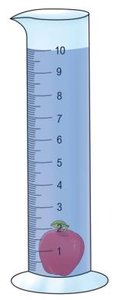
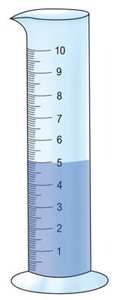
Example: If a solid weighs 0.045 lbs and displaces 60 mL of water, its density is calculated as follows:
Convert mass to grams:
Density:
----------------------------------------
