Indietro
Matter, Measurement, and Problem Solving – General Chemistry Study Notes
Guida di studio - Note intelligenti
 Appunti personalizzati basati sui tuoi materiali, ampliati con definizioni chiave, esempi e contesto.
Classification of Matter
Types of Matter
Chemistry is the study of matter and the changes it undergoes. Matter is anything that occupies space and has mass. Matter can be classified into three main types:
Element: The simplest type of matter, composed of one kind of atom.
Compound: Matter composed of two or more different elements that are chemically bonded together.
Mixture: Matter composed of elements and/or compounds that are physically mixed together, not chemically bonded.
Examples: Gold bar (element), ammonia (compound), orange juice (mixture).
Key Point: Compounds can only be separated into simpler substances by chemical means, while mixtures can be separated by physical means.
Homogeneous vs. Heterogeneous Mixtures
Mixtures can be further classified as:
Homogeneous Mixture: Uniform composition throughout (e.g., saline solution, coffee).
Heterogeneous Mixture: Non-uniform composition (e.g., trail mix, fruit salad).
Physical and Chemical Changes
Physical Changes
Physical changes alter the state or appearance of matter without changing its composition. Examples include melting, freezing, dissolving, and tearing.
Example: Dissolving sugar in water is a physical change.
Chemical Changes
Chemical changes result in the formation of new substances with different properties. Examples include burning, rusting, and cooking an egg.
Example: Cooking an egg is a chemical change.
Reversible vs. Irreversible Changes
Reversible Change: Can be undone (e.g., melting and re-solidifying chocolate).
Irreversible Change: Cannot be undone (e.g., baking a cake).
SI Units and Measurements
SI Base Units
The International System of Units (SI) is based on seven base units:
Physical Quantity | Name | Symbol |
|---|---|---|
Mass | kilogram | kg |
Length | meter | m |
Time | second | s |
Temperature | kelvin | K |
Amount of substance | mole | mol |
Electric current | ampere | A |
Luminous intensity | candela | cd |
Perimeter, Area, and Volume
Perimeter: Distance around an object. Formula:
Area: Measured surface of an object. Formula:
Volume: Space occupied by a 3D object. Formula:
Metric Prefixes
Metric Prefix Multipliers
Metric prefixes are modifiers that are multiples of ten. They are used to express very large or very small quantities conveniently.
Prefix | Symbol | Multiplier |
|---|---|---|
tera | T | |
giga | G | |
mega | M | |
kilo | k | |
centi | c | |
milli | m | |
micro | \mu | |
nano | n | |
pico | p |

Significant Figures
Rules for Significant Figures
Non-zero digits are always significant.
Any zeros between significant digits are significant.
Leading zeros are not significant.
Trailing zeros in the decimal portion are significant.
Trailing zeros in a whole number with a decimal point are significant.
Exact numbers have an infinite number of significant figures.
Significant Figures in Calculations
Multiplication/Division: The result should have as many significant figures as the value with the fewest significant figures.
Addition/Subtraction: The result should have as many decimal places as the value with the fewest decimal places.
Precision in Measurements
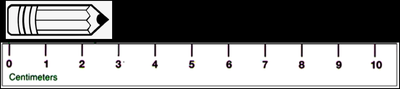
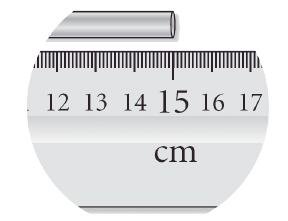
When recording measurements, include all known digits plus one estimated digit.
Temperature
Temperature vs. Heat
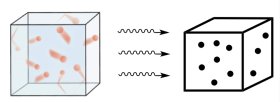
Temperature: The average kinetic energy of particles in a substance.
Heat: The transfer of thermal energy from a hotter object to a cooler one.
Temperature Conversions
Celsius to Kelvin:
Celsius to Fahrenheit:
Scientific Notation
Format and Use
Scientific Notation: , where is the coefficient (1 ≤ N < 10), and is an integer exponent.
Positive exponent: Move decimal to the right (large numbers).
Negative exponent: Move decimal to the left (small numbers).
Chemical and Physical Properties
Chemical Properties
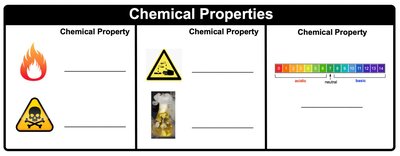
Chemical properties describe how a substance reacts with other substances, resulting in a change in composition.
Examples: Reactivity with oxygen, flammability, acidity/basicity.
Physical Properties
Physical properties can be observed or measured without changing the substance's chemical identity.
Examples: Color, density, melting point, boiling point, luster.

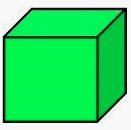
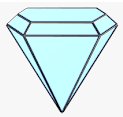
Intensive vs. Extensive Properties
Intensive Properties
Intensive properties do not depend on the amount of substance present. They are characteristic properties of the material.
Examples: Density, melting point, color, luster.

Extensive Properties
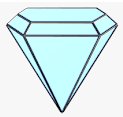
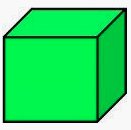
Extensive properties depend on the amount of substance present. They are additive for the same material.
Examples: Mass, volume, length, energy.

Conversion Factors and Dimensional Analysis
Conversion Factors
A conversion factor is a ratio that expresses how many of one unit are equal to another unit. They are used to convert between units in calculations.
Example:
Example:
Dimensional Analysis
Dimensional analysis is a systematic approach to problem solving that uses conversion factors to move from one unit to another.
General format:
Density
Definition and Formula
Density is the amount of mass per unit volume. It is an intensive property.
Formula:
Units
Solids/Liquids: or
Gases:
Density of Geometric Objects
Cube:
Sphere:
Cylinder:
Density of Non-Geometric Objects: Water Displacement
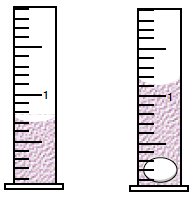
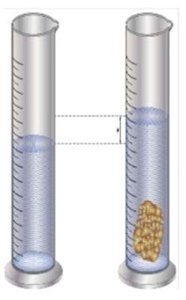
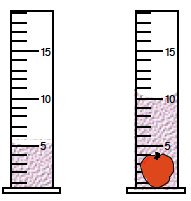
Water displacement is used to determine the volume of irregularly shaped objects by measuring the change in water level when the object is submerged.