 Indietro
Matter, Measurement, and Problem Solving: General Chemistry Study Guide
Guida di studio - Note intelligenti
 Appunti personalizzati basati sui tuoi materiali, ampliati con definizioni chiave, esempi e contesto.
Classification of Matter
Types of Matter
Chemistry is the study of matter and the changes it undergoes. Matter is anything that occupies space and has mass. Matter can be classified into three main types:
Element: The simplest type of matter, composed of one kind of atom.
Compound: Matter composed of two or more different elements that are chemically bonded together.
Mixture: Matter composed of elements and/or compounds that are physically mixed together.
Example: Classify Gatorade, crystalline sugar, lead wire, and salsa. Gatorade is a homogeneous mixture, crystalline sugar and lead wire are pure substances, and salsa is a heterogeneous mixture.
Pure Substances vs. Mixtures
Pure Substances: Have uniform composition and cannot be separated into simpler substances by physical means.
Mixtures: Have variable composition and can be separated by physical means.
Example: Milk is a homogeneous mixture; concrete is a heterogeneous mixture.
Physical and Chemical Changes
Physical Changes
Physical changes alter the physical state of a substance without changing its composition.
Examples: Melting, freezing, dissolving, tearing.
Example: Dissolving sugar in water is a physical change.
Chemical Changes
Chemical changes alter the chemical composition, creating new chemical bonds and products.
Examples: Burning, rusting, cooking, bond formation.
Example: Cooking an egg is a chemical change.
Reversible and Irreversible Changes
Reversible Changes: Can be undone, such as phase changes and dissolving.
Irreversible Changes: Cannot be undone, such as most chemical changes.
Example: Melting and re-solidifying chocolate is reversible; baking a cake is irreversible.
SI Units and Measurement
SI Base Units
The International System of Units (SI) is based on seven base units:
Physical Quantity | Name | Symbol |
|---|---|---|
Mass | Kilogram | kg |
Length | Meter | m |
Time | Second | s |
Temperature | Kelvin | K |
Amount of substance | Mole | mol |
Electric current | Ampere | A |
Luminous intensity | Candela | cd |
Area: Volume:
Metric Prefixes
Metric Prefix Multipliers
Metric prefixes are modifiers that represent multiples or fractions of base units. Common prefixes include:
Prefix | Symbol | Multiplier |
|---|---|---|
Kilo | k | |
Milli | m | |
Micro | \mu | |
Nano | n | |
Pico | p |
Example: Convert 694 kg to micrograms (g).
Significant Figures
Rules for Significant Figures
Non-zero digits are always significant.
Zeros between significant digits are significant.
Leading zeros are not significant.
Trailing zeros in the decimal portion are significant.
Trailing zeros in a whole number with a decimal point are significant.
Exact numbers have an infinite number of significant figures.
Example: 0.003840 has 4 significant figures.
Precision in Measurements
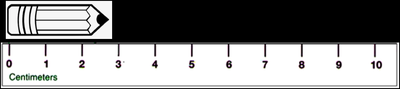
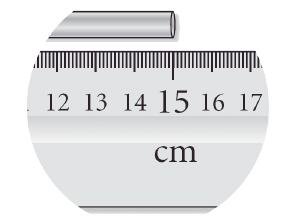
The more significant figures, the more precise the measurement. When recording measurements, include all known digits plus one estimated digit.
Significant Figures in Calculations
Multiplication/Division: The result has the same number of significant figures as the value with the least significant figures.
Addition/Subtraction: The result has the same number of decimal places as the value with the least decimal places.
Temperature
Temperature vs. Heat
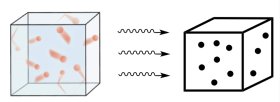
Thermal energy is the sum of kinetic and potential energies of all atoms in an object. Temperature is the average kinetic energy, while heat is the transfer of thermal energy from a hotter object to a cooler one.
Temperature Conversions
Celsius (ºC)
Fahrenheit (ºF)
Kelvin (K)
Conversion formulas:
Scientific Notation
Format and Conversion
Scientific notation expresses numbers as a coefficient (≥1 and <10), a base (10), and an exponent. It is used for very large or small numbers.
Positive exponent: Move decimal right, making the number larger.
Negative exponent: Move decimal left, making the number smaller.
Example:
Chemical Properties
Definition and Examples
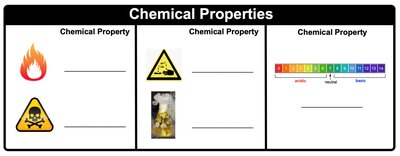
Chemical properties are observed during a chemical reaction and result in the formation of new substances.
Examples: Reactivity with oxygen, toxicity, flammability, acidity/basicity.
Physical Properties
Definition and Examples
Physical properties are measurable and describe the state of a chemical compound without changing its chemical structure.
Examples: Color, density, melting point, boiling point, luster.
Intensive vs. Extensive Properties
Intensive Properties
Intensive properties do not depend on the size or amount of substance present. They are characteristic properties.
Examples: Density, melting point, color, luster.
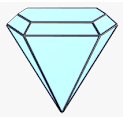
Extensive Properties
Extensive properties depend on the size or amount of substance present. They are additive properties.
Examples: Mass, volume, length, moles.

Conversion Factors
Definition and Application
A conversion factor is a ratio or fraction that relates two different units. It is used to convert from one unit to another.
Example: 1 day = 24 hours; 1 kg = 2.2046 lbs
Dimensional Analysis
Process and Strategies
Dimensional analysis is a systematic method for converting units using conversion factors. The process involves starting with the given amount, identifying the end amount, and applying conversion factors to cancel unwanted units.
Example: Convert 32 inches to centimeters using the conversion factor 1 inch = 2.54 cm.
Density
Definition and Formula
Density is the amount of mass per unit volume. For solids and liquids, units are typically g/cm3 or kg/m3. For gases, units are g/L or kg/m3.
Formula:
Density of Geometric Objects
For geometric objects, density can be calculated using their mass and volume.
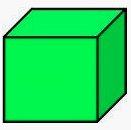
Cube:
Sphere:
Cylinder:
Density of Non-Geometric Objects: Water Displacement
Water displacement is used to determine the volume of irregularly shaped objects by measuring the change in water level when the object is submerged.
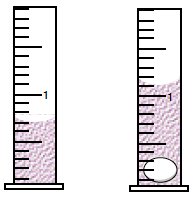
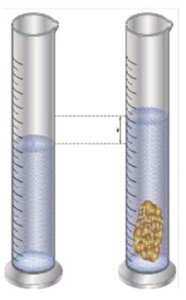
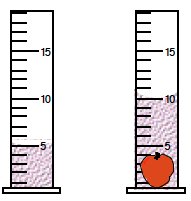
Example: If an object increases the water level from 200 mL to 260 mL, its volume is 60 mL.
Additional info: These notes cover the foundational concepts of Chapter 1 in General Chemistry, including matter classification, measurement, properties, and problem-solving techniques. All images included directly reinforce the educational content and are relevant to the explanations provided.
