 Indietro
Matter, Measurement, and Problem Solving: Physical & Chemical Changes, Properties, and Energy
Guida di studio - Note intelligenti
 Appunti personalizzati basati sui tuoi materiali, ampliati con definizioni chiave, esempi e contesto.
Physical and Chemical Changes and Properties of Matter
Physical and Chemical Changes
Understanding the distinction between physical and chemical changes is fundamental in chemistry. These changes describe how substances transform and help us predict and interpret chemical behavior.
Physical Change: A change that alters only the state or appearance of a substance without changing its chemical composition. The molecules, atoms, or ions retain their identity. Examples include melting, boiling, dissolving, and breaking.
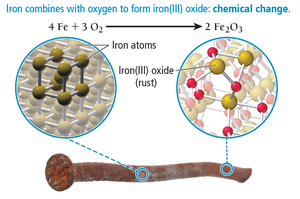
Chemical Change: A change that alters the chemical identity or composition of a substance, resulting in the formation of one or more new substances with different properties. Examples include rusting, burning, and decomposing.
Example of Physical Change: When water boils, it transitions from liquid to gas, but the molecules remain H2O.
Example of Chemical Change: When iron (Fe) reacts with oxygen (O2), it forms iron(III) oxide (Fe2O3), a new substance with different properties.
Physical and Chemical Properties
Properties of matter are classified based on whether they can be observed without changing the substance's identity (physical) or only by changing it (chemical).
Physical Property: A characteristic that can be observed or measured without changing the substance's composition. Examples: odor, taste, color, appearance, melting point, boiling point, density.
Chemical Property: A characteristic that can only be observed by changing the substance's chemical identity. Examples: flammability, corrosiveness, acidity, reactivity, toxicity.
Example: The smell of gasoline is a physical property, while its flammability is a chemical property.
Energy: A Fundamental Part of Physical and Chemical Change
Nature and Forms of Energy
Energy is essential in both physical and chemical changes. It is the capacity to do work or produce heat, and it is always conserved in any process (law of conservation of energy).
Kinetic Energy: Energy associated with motion.
Potential Energy: Energy associated with position or composition.
Mechanical Energy: Energy due to an object's movement or position.
Thermal Energy: Energy related to temperature or heat.
Chemical Energy: Energy stored within the bonds of chemical substances.
Systems with high potential energy tend to change in a way that lowers their potential energy, releasing energy to the surroundings.
Examples of Energy in Chemical Changes
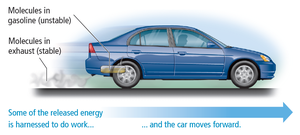
Combustion of Gasoline: Chemical potential energy in gasoline is released during combustion. This energy is transformed into mechanical energy (moving the car), electrical energy (charging the battery), and thermal energy (heat).
Photosynthesis: Plants absorb energy from sunlight to convert carbon dioxide and water into glucose and oxygen.
Mathematical Operations and Significant Figures
Significant Figures in Addition and Subtraction
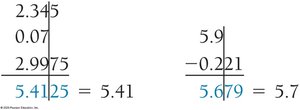
When performing addition or subtraction, the result should be reported with the same number of decimal places as the measurement with the fewest decimal places.
Example 1: (rounded to two decimal places: )
Example 2: (rounded to one decimal place: )
Additional info: The law of conservation of energy is a foundational principle in chemistry, stating that energy cannot be created or destroyed, only transformed. Understanding energy changes is crucial for interpreting chemical reactions and physical processes.
