 Indietro
Matter, Measurement, and Problem Solving: Units and Derived Quantities
Guida di studio - Note intelligenti
 Appunti personalizzati basati sui tuoi materiali, ampliati con definizioni chiave, esempi e contesto.
Chapter One: Matter, Measurement, and Problem Solving
The Units of Measurement
Measurement is fundamental to chemistry, allowing scientists to quantify properties and compare results. Units are standardized quantities used to specify measurements, ensuring consistency and clarity in scientific communication.
Metric System: Used globally, includes units such as centimeters (cm), meters (m), kilograms (kg), grams (g), liters (L), milliliters (mL), kilometers (km).
English System: Used primarily in the United States, includes inches (in), feet (ft), yards (yd), pounds (lb), gallons (gal), miles (mi).
SI System: The International System of Units (Système International d’Unités, SI) was established in 1960 for universal scientific use. It consists of seven base units, with all other units derived from these.
SI Base Units
The SI system is built on seven base units, each corresponding to a fundamental physical quantity. All other units are derived from these base units.
Quantity | SI Base Unit | Symbol |
|---|---|---|
Length | meter | m |
Mass | kilogram | kg |
Time | second | s |
Temperature | kelvin | K |
Amount of substance | mole | mol |
Electric current | ampere | A |
Luminous intensity | candela | cd |
The Meter: A Measure of Length
Length measures the distance between two points. The SI unit is the meter (m).
1 meter = 1.09361 yard
1 meter = 39.37 inches
1 yard = 36 inches
The Kilogram: A Measure of Mass
Mass quantifies the amount of matter in an object. The SI unit is the kilogram (kg).
1 kilogram = 1000 grams
1 kilogram = 2.205 pounds
The Second: A Measure of Time
Time measures the duration of events. The SI unit is the second (s).
1 minute = 60 seconds
1 hour = 60 minutes

The Kelvin: A Measure of Temperature
Temperature quantifies the thermal energy of a substance and determines the direction of heat transfer. The SI unit is the kelvin (K).
The Kelvin scale starts at absolute zero (0 K), where molecular motion ceases.
0 K = -273.15°C = -459°F
Temperature is crucial for understanding energy changes and chemical reactions.
Prefix Multipliers
Prefix multipliers are used in the SI system to represent very large or very small numbers, making measurements easier to communicate.
Example: The prefix "micro" (μ) represents , so 1 μm = m.
Conceptual Connection: For a measurement of m, the most appropriate prefix is "micro" (μ).
Derived Units
Derived units are combinations of two or more base units, used to express quantities such as volume, density, speed, and force.
Volume: Measured in cubic meters (m³), cubic centimeters (cm³), milliliters (mL), liters (L), or gallons (gal).
1 mL = 1 cm³
1 L = 1000 mL = 1000 cm³
1 gal = 3.785 L
1 m³ = 1000 L
Density
Density is a derived quantity defined as mass per unit volume. It is commonly used to identify substances and assess purity.
Formula:
SI unit: kg/m³; commonly used unit: g/mL
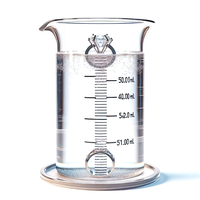
Example: A jeweler examines a 2.50‑g ring. When submerged, the water level rises from 10.00 mL to 11.06 mL. The density is:
Volume displaced:
Density:
Since diamond's density is 3.51 g/mL, the ring is likely not diamond.
Mathematical Operations and Significant Figures
In chemistry, calculations must reflect the precision of measurements. Significant figures indicate the certainty of a value, and rules for addition, subtraction, multiplication, and division ensure proper reporting.
Addition/Subtraction: The result should have the same number of decimal places as the measurement with the fewest decimal places.
Multiplication/Division: The result should have the same number of significant figures as the measurement with the fewest significant figures.
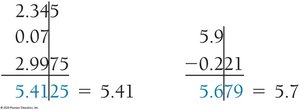
Example: (rounded to two decimal places)
Example: (rounded to one decimal place)
