 Indietro
Measurement and International System of Units (SI) in Chemistry
Guida di studio - Note intelligenti
 Appunti personalizzati basati sui tuoi materiali, ampliati con definizioni chiave, esempi e contesto.
Measurement in Chemistry
Physical Quantities and Units
Measurement is fundamental in chemistry, as it allows scientists to quantify and compare physical properties. Every physical quantity is measured using a specific unit, which provides a standard reference for comparison.
Physical Quantity: Any property of matter that can be measured, such as length, mass, time, temperature, etc.
Unit: A standard quantity used to express a physical measurement (e.g., meter for length, kilogram for mass).
Example: Length can be measured in meters, centimeters, or inches.
Additional info: Consistent units are essential for scientific communication and calculations.
International System of Units (SI Units)
Definition and Importance
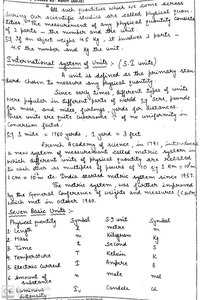
The International System of Units (SI) is the globally accepted standard for measurement in science. It is based on seven fundamental units, each corresponding to a basic physical quantity. The SI system ensures uniformity and consistency in scientific measurements across the world.
SI Unit: Defined as the primary standard for measuring physical quantities.
Importance: Provides a universal language for scientists, enabling accurate and reproducible results.
Example: The meter is the SI unit for length, replacing older units like the yard or mile.
History and Adoption
The SI system was formally adopted in 1960 by the General Conference on Weights and Measures (CGPM). It evolved from earlier metric systems, which were first introduced in France in 1791 and gradually accepted worldwide.
Metric System: The precursor to the SI system, introduced in France in the late 18th century.
CGPM: The international body responsible for maintaining and updating the SI system.
Example: The kilogram was originally defined by a physical prototype, but is now based on fundamental constants.
Seven Basic SI Units
List and Symbols
The SI system is built upon seven basic units, each representing a fundamental physical quantity. These units are used as the foundation for all other derived units in science and engineering.
Physical Quantity | Symbol | SI Unit | Symbol |
|---|---|---|---|
Length | l | meter | m |
Mass | m | kilogram | kg |
Time | t | second | s |
Temperature | T | kelvin | K |
Electric Current | I | ampere | A |
Luminous Intensity | Iv | candela | cd |
Amount of Substance | n | mole | mol |
Additional info: Derived units, such as newton (for force) and joule (for energy), are constructed from these seven basic units.
Examples and Applications
Using SI Units in Chemistry
SI units are used in all chemical calculations, experiments, and reporting. For example, concentrations are measured in moles per liter (mol/L), and reaction rates in moles per second (mol/s).
Example: To calculate the mass of a substance, use the formula .
Example: Temperature in thermochemical equations is always expressed in kelvin (K).
Additional info: Consistent use of SI units prevents errors and ensures clarity in scientific communication.
