 Indietro
Measurements and Units in General Chemistry
Guida di studio - Note intelligenti
 Appunti personalizzati basati sui tuoi materiali, ampliati con definizioni chiave, esempi e contesto.
Measurements and Units
Introduction to Measurement in Chemistry
Measurement is fundamental to all scientific disciplines, including chemistry. Every measured quantity must include both a number and a unit to be meaningful. Units provide context and allow for comparison and calculation.
Measurement: The process of obtaining the magnitude of a quantity relative to a standard unit.
Unit: A standard quantity used to specify measurements (e.g., meter, kilogram, second).
Importance: Measurements without units are ambiguous and cannot be interpreted correctly.
The Scientific Method
Steps of the Scientific Method
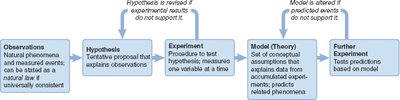
The scientific method is a systematic approach to research and discovery in science. It involves making observations, forming hypotheses, conducting experiments, and developing theories or models.
Observation: Gathering data about natural phenomena.
Hypothesis: A tentative, testable explanation for observations.
Experiment: A controlled procedure to test a hypothesis.
Theory (Model): A well-substantiated explanation of some aspect of the natural world, based on a body of evidence.
Further Experiment: Additional testing to refine or challenge the model.
SI Units and Prefixes
Base SI Units
The International System of Units (SI) is the standard system used in science for consistency and clarity. Each physical quantity has a base unit.
Length: meter (m)
Mass: kilogram (kg)
Time: second (s)
Temperature: kelvin (K)
Amount of substance: mole (mol)
SI Prefixes
Prefixes are used to indicate multiples or fractions of units, making it easier to express very large or small quantities.
Mega (M):
Kilo (k):
Deka (da):
Deci (d):
Centi (c):
Milli (m):
Micro (\mu):
Nano (n):
Pico (p):
Derived Units
Some quantities are measured using combinations of base units, known as derived units.
Area: square meter ()
Volume: cubic meter ()
Force: newton ()
Pressure: pascal ()
Energy: joule ()
Power: watt ()
Accuracy, Precision, and Error
Definitions and Importance
Understanding the quality of measurements is essential in chemistry. Two key concepts are accuracy and precision.
Accuracy: How close a measurement is to the true or accepted value.
Precision: How closely repeated measurements agree with each other.
Random Errors: Affect precision; caused by unpredictable variations.
Systematic Errors: Affect accuracy; caused by consistent bias in measurement (e.g., faulty instrument).
Accuracy can be determined from a single measurement or the average of several. Precision requires multiple measurements.
Significant Digits (Figures)
Rules for Counting Significant Digits
Significant digits reflect the certainty of a measurement. The rules for counting them are:
All nonzero digits are significant.
Leading zeros are not significant (e.g., 0.0025 has 2 significant digits).
Captive zeros (between nonzero digits) are significant (e.g., 402 has 3 significant digits).
Trailing zeros are significant only if there is a decimal point (e.g., 23.50 has 4 significant digits; 2500 has 2 significant digits).
Exact numbers (from counting or defined conversions) have infinite significant digits.
Reporting Measurements
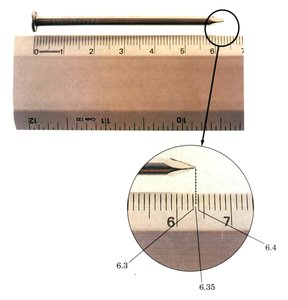
Measurements should be reported with all certain digits plus one estimated digit. The resolution of the measuring device determines the number of significant digits that can be reported.
Calculations with Significant Digits
Multiplication and Division
When multiplying or dividing, the result should have the same number of significant digits as the measurement with the fewest significant digits.
Example: (rounded to 3 significant digits)
Addition and Subtraction
When adding or subtracting, the result should have the same number of decimal places as the measurement with the fewest decimal places.
Example: (rounded to the tenths place)
Rounding Off
If the digit to be dropped is less than 5, leave the preceding digit unchanged (e.g., 1.684 becomes 1.68).
If the digit to be dropped is 5 or greater, increase the preceding digit by 1 (e.g., 1.247 becomes 1.25).
Scientific Notation
Purpose and Format
Scientific notation is used to express very large or very small numbers conveniently and to clearly indicate the number of significant digits.
General format: , where and is an integer.
Example:
Unit Conversion
Conversion Factors and Dimensional Analysis
Unit conversions are performed using conversion factors, which are ratios of equivalent quantities expressed in different units.
Example:
Conversion factor: or
Units must cancel appropriately to yield the desired unit in the answer.
Temperature Scales
Celsius, Kelvin, and Fahrenheit
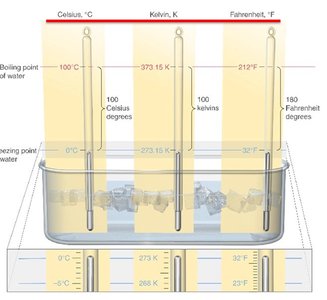
Temperature can be measured in several scales. The Celsius and Kelvin scales are commonly used in science, while Fahrenheit is used in some countries.
Celsius (°C): Water freezes at 0°C and boils at 100°C.
Kelvin (K): Absolute zero is 0 K; water freezes at 273 K and boils at 373 K.
Fahrenheit (°F): Water freezes at 32°F and boils at 212°F.
Conversion formulas:
Summary Table: SI Base Units and Prefixes
Quantity | Base Unit | Symbol |
|---|---|---|
Length | meter | m |
Mass | kilogram | kg |
Time | second | s |
Temperature | kelvin | K |
Amount of substance | mole | mol |
Prefix | Symbol | Value |
|---|---|---|
Mega | M | |
Kilo | k | |
Deka | da | |
Deci | d | |
Centi | c | |
Milli | m | |
Micro | μ | |
Nano | n | |
Pico | p |
