 Indietro
Module 1: Introduction to Matter and Measurement – General Chemistry Study Notes
Guida di studio - Note intelligenti
 Appunti personalizzati basati sui tuoi materiali, ampliati con definizioni chiave, esempi e contesto.
Module 1: Introduction to Matter and Measurement
Topic 1: Classification and Properties of Matter
Chemistry is the study of matter, its properties, and the changes it undergoes. Understanding the classification and properties of matter is foundational for all chemical sciences and their applications in various fields.
Matter: Anything that has mass and occupies space.
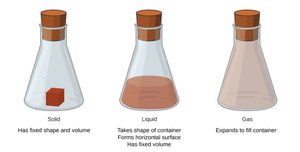
States of Matter: Solid (fixed shape and volume), Liquid (fixed volume, takes shape of container), Gas (expands to fill container).
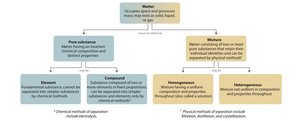
Classification by Composition:
Substances: Have distinct properties and constant composition. Two types: elements (cannot be decomposed) and compounds (can be decomposed into elements).
Mixtures: Combinations of two or more substances. Can be homogeneous (uniform, also called solutions) or heterogeneous (not uniform).
Atoms and Molecules: Atoms are the building blocks of matter. Elements consist of one type of atom; compounds consist of two or more different atoms chemically combined.
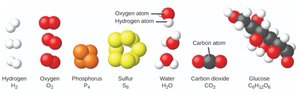
Law of Constant Composition (Law of Definite Proportions): Compounds always have the same relative number of atoms of each element.

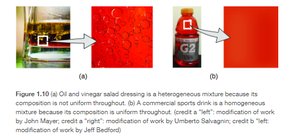
Mixtures: Exhibit properties of their components. Heterogeneous mixtures have visibly different parts; homogeneous mixtures are uniform throughout.
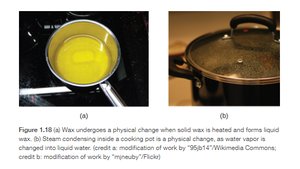
Physical Properties: Can be observed without changing the identity of the substance (e.g., melting point, color, density).
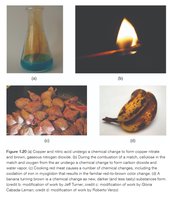
Chemical Properties: Describe a substance's ability to undergo chemical changes (e.g., combustion, oxidation).
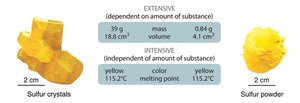
Intensive Properties: Independent of the amount of substance (e.g., density, boiling point).
Extensive Properties: Depend on the amount of substance (e.g., mass, volume).
Topic 2: Measurement in Chemistry
Measurement is essential in chemistry for quantifying matter and its changes. The International System of Units (SI) provides a standardized approach for scientific measurements.
SI Units: The base units include meter (m) for length, kilogram (kg) for mass, second (s) for time, kelvin (K) for temperature, and mole (mol) for amount of substance.
Metric Prefixes: Used to express multiples or fractions of units for convenience.
Prefix | Abbreviation | Multiplier | Prefix | Abbreviation | Multiplier |
|---|---|---|---|---|---|
pico | p | 10-12 | deci | d | 10-1 |
nano | n | 10-9 | centi | c | 10-2 |
micro | μ | 10-6 | milli | m | 10-3 |
milli | m | 10-3 | kilo | k | 103 |
centi | c | 10-2 | mega | M | 106 |
deci | d | 10-1 | giga | G | 109 |

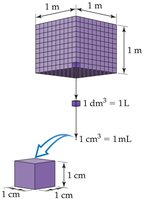
Derived SI Units: Volume is derived from length (). Common units: liter (L), milliliter (mL), cubic centimeter (cm3).
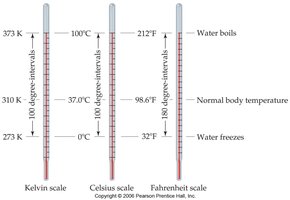
Temperature Scales: Celsius (°C), Kelvin (K), and Fahrenheit (°F). Kelvin is the SI unit; conversions are:
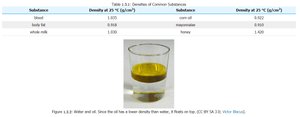
Density: Physical property defined as mass per unit volume. , commonly in g/mL or g/cm3.
Topic 3: Uncertainty in Measurement
All measurements have some degree of uncertainty. Understanding accuracy, precision, and significant figures is crucial for reporting scientific data correctly.
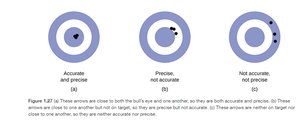
Accuracy: How close a measurement is to the true value.
Precision: How close repeated measurements are to each other.
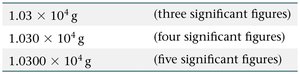
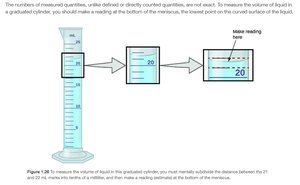
Significant Figures: All digits in a measurement, including the uncertain one. Rules for counting significant figures:
All nonzero digits are significant.
Zeros between nonzero digits are significant.
Leading zeros are not significant.
Trailing zeros are significant if there is a decimal point.
Significant Figures in Calculations:
Addition/Subtraction: Round to the least significant decimal place.
Multiplication/Division: Round to the same number of significant figures as the measurement with the fewest significant figures.
Topic 4: Dimensional Analysis
Dimensional analysis is a systematic approach to problem-solving in chemistry, especially for unit conversions. It uses conversion factors to ensure that calculations are consistent and correct.
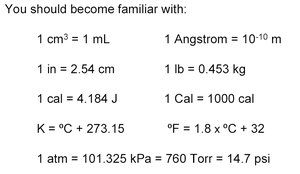
Conversion Factors: Ratios derived from the equality between two different units (e.g., 1 in = 2.54 cm).
Unit Cancellation: Arrange conversion factors so that unwanted units cancel, leaving the desired unit.
Multiple Conversions: Chain conversion factors as needed for complex unit changes.
Equality | Equality |
|---|---|
1 cm3 = 1 mL | 1 Angstrom = 10-10 m |
1 in = 2.54 cm | 1 lb = 0.453 kg |
1 cal = 4.184 J | 1 Cal = 1000 cal |
K = °C + 273.15 | °F = 1.8 × °C + 32 |
1 atm = 101.325 kPa = 760 Torr = 14.7 psi |
Example: Convert 25.0 inches to centimeters using the conversion factor 1 in = 2.54 cm:
Additional info: Dimensional analysis is also called the factor-label method or unit-factor method. It is essential for ensuring that calculated results are physically meaningful and correctly expressed in scientific work.
