 Indietro
Molarity, Solution Preparation, and Dilution in General Chemistry
Guida di studio - Note intelligenti
 Appunti personalizzati basati sui tuoi materiali, ampliati con definizioni chiave, esempi e contesto.
Ch. 4 – Solutions, Molarity, and Dilution
Solution Terminology
Solutions are fundamental in chemistry, providing a medium for most chemical reactions. Understanding their terminology is essential for describing and preparing chemical mixtures accurately.
Solution: A homogeneous mixture of two or more substances in variable proportions, with uniform composition and properties throughout.
Solvent: The component present in the greatest amount; it determines the state of the solution and does the dissolving.
Solute: The component present in a lesser amount; it is dissolved by the solvent.
Concentrated Solution: Contains a relatively large quantity of dissolved solute(s).
Dilute Solution: Contains a small amount of solute dissolved in the solvent.
Properties and Types of Solutions
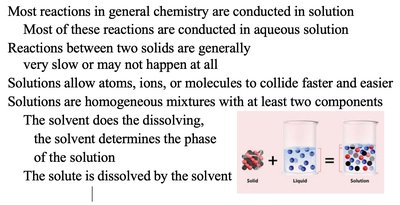
Most reactions in general chemistry occur in solution, especially in aqueous solutions. Solutions allow atoms, ions, or molecules to collide more efficiently, facilitating chemical reactions. Solutions can contain more than one solute, and their composition is described by the concentration of each solute.
Reactions between solids are generally slow or may not occur at all.
Solutions are homogeneous mixtures with at least two components.
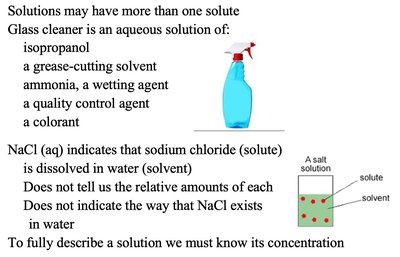
Examples: Glass cleaner is an aqueous solution containing isopropanol, ammonia, a wetting agent, a quality control agent, and a colorant.
Notation: NaCl(aq) indicates sodium chloride dissolved in water, but does not specify the relative amounts or the way NaCl exists in water.
Solution Concentration
Units of Concentration
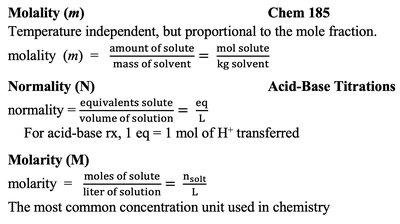
Concentration expresses the amount of solute present in a given quantity of solvent or solution. The most common units are molarity, molality, and normality.
Molarity (M): Moles of solute per liter of solution.
Molality (m): Moles of solute per kilogram of solvent (temperature independent).
Normality (N): Equivalents of solute per liter of solution (used in acid-base titrations).
Key equations:
Molarity:
Molality:
Normality:
Calculating Molarity
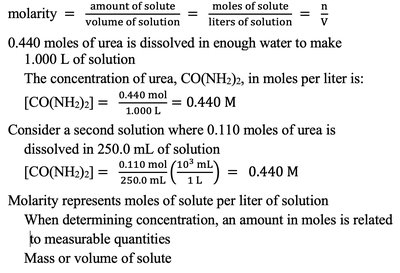
Molarity is the most common concentration unit in chemistry. It is calculated by dividing the moles of solute by the liters of solution. Example calculations:
For 0.440 moles of urea in 1.000 L of solution:
For 0.110 moles of urea in 250.0 mL (0.2500 L):
Preparation of Solutions
Laboratory Techniques and Volumetric Glassware
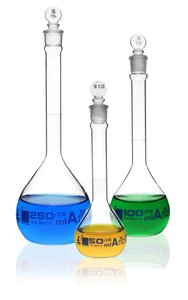
Solutions are prepared by accurately measuring solute and solvent. For solid solutes, precise masses are weighed; for liquids, volumes are measured. Volumetric flasks are used for preparing solutions of precise volume and concentration.
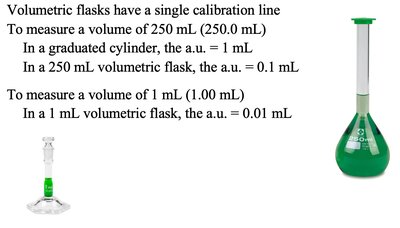
Volumetric flasks have a single calibration line for high accuracy.
Graduated cylinders and pipets are used for less precise measurements.
Common flask sizes: 1.00 mL, 25.00 mL, 250.0 mL, 1000.0 mL, etc.
Accuracy: In a 250 mL flask, the uncertainty is 0.1 mL; in a 1 mL flask, it is 0.01 mL.
Example: Preparation of an Ethanol Solution
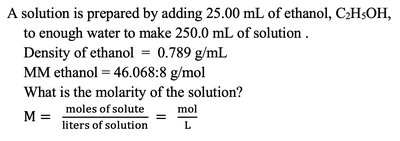
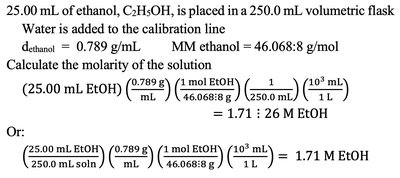
To prepare a solution, a known volume of solute is added to a volumetric flask, and solvent is added up to the calibration line. The molarity is then calculated using the density and molar mass of the solute.
Given: 25.00 mL ethanol (C2H5OH), density = 0.789 g/mL, MM = 46.0688 g/mol, diluted to 250.0 mL.
Calculation:
Calculation of Mass of Solute for a Given Molarity
To prepare a solution of known molarity, calculate the required mass of solute using the formula:
Where is molarity, is volume (in liters), and is molar mass (g/mol).
Examples:
How many grams of NaNO3 are present in 125 mL of 10.8 M NaNO3?
How many grams of sodium sulfate decahydrate are needed to prepare 500.0 mL of 0.445 M Na2SO4·10H2O?
What mass of potassium chromate is required to prepare 250.0 mL of 0.2500 M K2CrO4?
Remember to include waters of hydration in the molar mass for hydrates.
Solution Dilution
Principles of Dilution
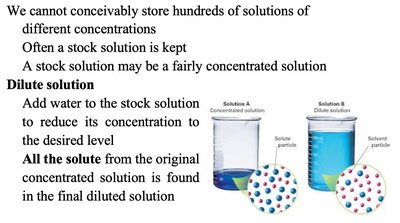
Stock solutions are often prepared at high concentration and diluted as needed. Dilution involves adding solvent to decrease the concentration without changing the amount of solute.
All the solute from the original concentrated solution is found in the final diluted solution.
The dilution equation:
Where and are the molarity and volume of the stock solution, and and are those of the diluted solution.
Example Dilution Problems
If 15.00 mL of 0.450 M K2CrO4 is diluted to 1000.0 mL, the new concentration is:
To make 250.0 mL of 0.1000 M HCl from 12.8 M HCl:
If 200.0 mL of water is added to 100.0 mL of 0.150 M NaCl, the resulting concentration is:
Summary Table: Common Solution Preparation Glassware
Glassware | Typical Volumes | Accuracy (a.u.) |
|---|---|---|
Volumetric Flask | 1.00 mL, 25.00 mL, 250.0 mL, 1000.0 mL | 0.01–0.1 mL |
Graduated Cylinder | Various | 1 mL |
Buret | 10.00 mL, 50.00 mL | 0.01 mL |
Additional info: Accurate solution preparation is essential for quantitative chemical analysis and laboratory experiments.
