 Indietro
Molecular Geometry and Bonding Theories: Study Guide
Guida di studio - Note intelligenti
 Appunti personalizzati basati sui tuoi materiali, ampliati con definizioni chiave, esempi e contesto.
Chapter 9: Molecular Geometry and Bonding Theories
Molecular Shapes
The shape of a molecule is determined by the arrangement of atoms and electron pairs around a central atom. While Lewis structures show bonding and lone pairs, they do not directly indicate the three-dimensional shape. However, they are essential for predicting molecular geometry.
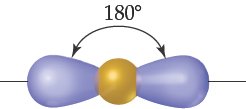
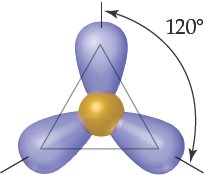
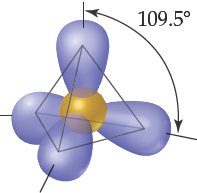
Key Point: Common shapes for molecules with two or three atoms connected to a central atom include linear, trigonal planar, and tetrahedral.
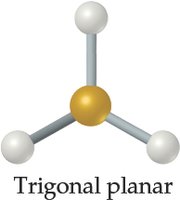
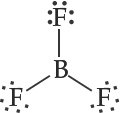
Example: Carbon dioxide (CO2) is linear, while boron trifluoride (BF3) is trigonal planar.
The VSEPR Model
The Valence-Shell Electron-Pair Repulsion (VSEPR) model is used to predict the shape of molecules based on the repulsion between electron pairs. Electron pairs (bonding and nonbonding) arrange themselves as far apart as possible to minimize repulsions, determining the molecular geometry.
Key Point: Electron domains include bonding pairs (single, double, triple bonds) and nonbonding pairs (lone pairs).
Definition: Electron domain refers to regions where electrons are most likely to be found.
Example: Water (H2O) has four electron domains: two bonding and two nonbonding.
Electron-Domain Geometries
Electron-domain geometry is determined by counting the total number of electron domains (bonding and nonbonding) around the central atom. Multiple bonds count as one electron domain. Each geometry corresponds to specific bond angles.
Key Point: The number of electron domains is sometimes called the coordination number.
Table: Electron-domain geometries for two through six electron domains:
Number of Electron Domains | Geometry | Bond Angles |
|---|---|---|
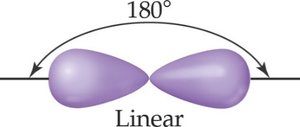
2 | Linear | 180° |
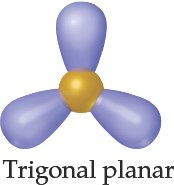
3 | Trigonal planar | 120° |
4 | Tetrahedral | 109.5° |
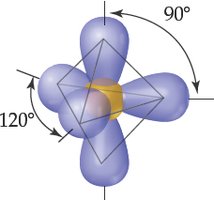
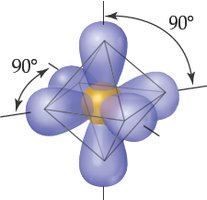
5 | Trigonal bipyramidal | 90°, 120° |
6 | Octahedral | 90° |
Applying VSEPR to Determine Molecular Shapes
To determine the molecular shape:
Draw the best Lewis structure.
Determine the electron-domain geometry.
Use the arrangement of bonded atoms to determine the molecular geometry.
Linear Electron Domain
For two electron domains, the only molecular geometry is linear.
Trigonal Electron Domain
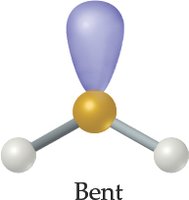
For three electron domains, possible molecular geometries are:
Trigonal planar: All domains are bonding.
Bent: One domain is a lone pair.
Tetrahedral Electron Domain
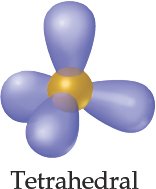
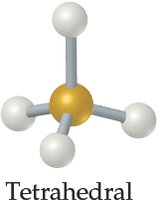
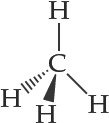
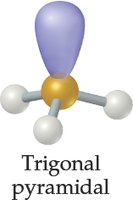
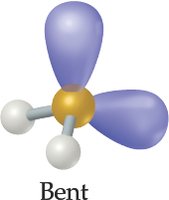
For four electron domains, possible molecular geometries are:
Tetrahedral: All are bonding pairs.
Trigonal pyramidal: One is a lone pair.
Bent: Two are lone pairs.
Nonbonding Pairs and Bond Angles
Nonbonding pairs are physically larger than bonding pairs, resulting in greater repulsions and compression of bond angles.
Multiple Bonds and Bond Angles
Double and triple bonds have larger electron domains than single bonds, exerting greater repulsive force and increasing bond angles.
Molecules with Expanded Valence Shells
Elements in periods 3 through 6 can have more than four bonds due to available d-orbitals, resulting in expanded valence shells. This leads to trigonal bipyramidal (five domains) and octahedral (six domains) geometries.
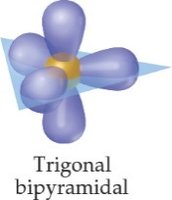
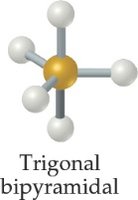
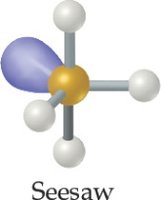
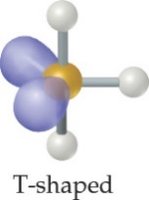
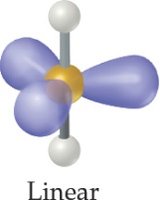
Trigonal Bipyramidal Electron Domain
Possible molecular geometries: Trigonal bipyramidal, seesaw, T-shaped, linear.
Positions: Axial and equatorial; lone pairs occupy equatorial positions.
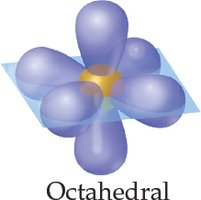
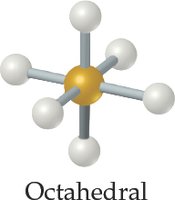
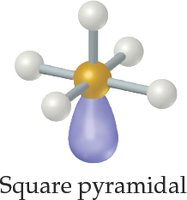
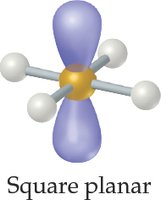
Octahedral Electron Domain
Possible molecular geometries: Octahedral, square pyramidal, square planar.
All positions are equivalent.
Molecular Shape and Polarity
The polarity of a molecule depends on the polarity of individual bonds and their arrangement. If bond dipoles are not symmetrical, the molecule is polar; if they cancel, the molecule is nonpolar.
Key Point: Use vectors (magnitude and direction) to determine dipole moment.
Example: Water (H2O) is polar; carbon dioxide (CO2) is nonpolar.
Covalent Bonding and Orbital Overlap
Valence-bond theory explains why bonds exist: electrons from two atoms occupy the same space, resulting in orbital overlap. The sharing of space between two electrons of opposite spin forms a covalent bond.
Key Point: Increased overlap brings atoms together until a balance is reached between repulsions and attractions.
Bond strength: Minimum energy achieved during overlap.
Bond length: Minimum distance between nuclei.
Hybrid Orbitals
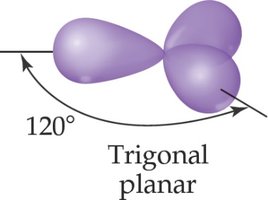
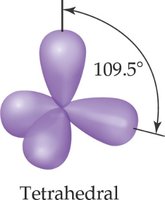
Hybrid orbitals are formed by mixing atomic orbitals to create new orbitals of equal energy (degenerate orbitals). This process is called hybridization and is used to describe bonding in molecules.
Key Point: The shape of hybrid orbitals differs from atomic orbitals.
Example: sp hybridization in beryllium, sp2 in boron, sp3 in carbon.
Hybrid Orbital Description of Water
Water has a tetrahedral molecular geometry with four electron domains (two bonding, two nonbonding). The ideal bond angle for sp3 hybridization is 109.5°, but the measured angle is 104.9° due to repulsion from nonbonding pairs.
Multiple Bonds: Sigma and Pi Bonds
Single covalent bonds (sigma bonds) have electron density concentrated along the internuclear axis. Multiple bonds (double, triple) include pi bonds, which result from sideways overlap of p orbitals perpendicular to the axis.
Key Point: Sigma bonds: head-to-head overlap, cylindrical symmetry.
Pi bonds: sideways overlap, electron density above and below the axis.
Localized and Delocalized Electrons
Bonding electrons shared between two atoms are localized. In molecules with resonance structures, some electrons are delocalized, shared by multiple atoms (e.g., benzene).
Molecular Orbitals
Molecular Orbital (MO) Theory describes bonding as continuous over the whole molecule. Molecular orbitals are formed from atomic orbitals and can be bonding (constructive combination) or antibonding (destructive combination).
Key Point: Each MO can hold two electrons with opposite spin.
Bond order: Indicates bond stability; calculated as .
MO Diagrams and Magnetism
MO diagrams show how atomic orbitals combine. Diamagnetism occurs when all electrons are paired; paramagnetism occurs with unpaired electrons. Oxygen (O2) is paramagnetic, as shown by its MO diagram.
Heteronuclear Diatomic Molecules
MO diagrams for diatomic molecules with different atoms reflect differences in atomic orbital energies. The more electronegative atom's orbitals are lower in energy, so bonding orbitals resemble them more closely.
Additional info: Academic context and explanations have been expanded for clarity and completeness. Images included are directly relevant to the explanation of molecular geometry and hybridization.
