 Indietro
Molecular Geometry and Bonding Theories: Study Notes for General Chemistry
Guida di studio - Note intelligenti
 Appunti personalizzati basati sui tuoi materiali, ampliati con definizioni chiave, esempi e contesto.
Molecular Geometry and Bonding Theories
Introduction
This chapter explores how the arrangement of atoms and electrons in molecules determines their shape, size, and chemical properties. Understanding molecular geometry is essential for predicting reactivity, polarity, and the physical properties of substances.
Molecular Shapes
Lewis Structures and Molecular Shape
Lewis structures illustrate the connectivity of atoms and the distribution of electrons but do not directly show the three-dimensional shape of molecules. However, they are foundational for predicting molecular geometry using models such as VSEPR.
Common Molecular Shapes
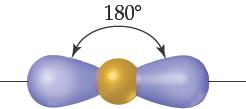
Linear: Two atoms or two electron domains around a central atom. Bond angle is 180°.
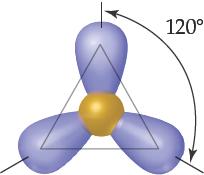
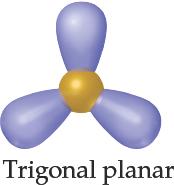
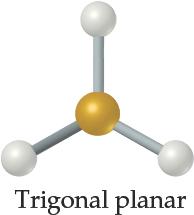
Trigonal planar: Three electron domains around a central atom. Bond angle is 120°.
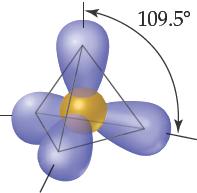
Tetrahedral: Four electron domains around a central atom. Bond angle is 109.5°.
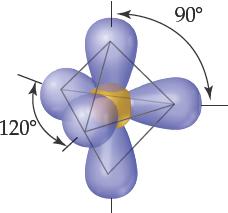
Trigonal bipyramidal: Five electron domains; bond angles are 90°, 120°, and 180°.
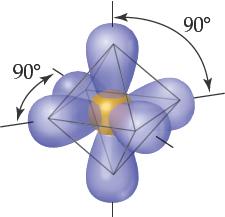
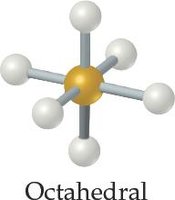
Octahedral: Six electron domains; bond angles are 90°.
The VSEPR Model
Valence-Shell Electron-Pair Repulsion (VSEPR) Theory
The VSEPR model predicts molecular shapes based on the repulsion between electron domains (regions where electrons are most likely to be found) around a central atom. Electron domains include bonding pairs (single, double, triple bonds) and nonbonding pairs (lone pairs).
Key Principle: Electron domains arrange themselves to minimize repulsion, resulting in specific geometries.
Bond Angles: Determined by the number and arrangement of electron domains.
Multiple Bonds: Count as one electron domain.
Electron-Domain Geometries
Electron-domain geometry is determined by counting the total number of electron domains (bonding and nonbonding) around the central atom.
Number of Electron Domains | Electron-Domain Geometry | Bond Angles |
|---|---|---|
2 | Linear | 180° |
3 | Trigonal planar | 120° |
4 | Tetrahedral | 109.5° |
5 | Trigonal bipyramidal | 90°, 120°, 180° |
6 | Octahedral | 90° |
Applying VSEPR to Determine Molecular Shapes
Draw the best Lewis structure.
Determine the electron-domain geometry.
Use the arrangement of bonded atoms to determine the molecular geometry.
Molecular Geometries for Common Electron Domains
Linear Electron Domain
Only one molecular geometry: linear. Example: CO2.
Trigonal Electron Domain
Trigonal planar: All electron domains are bonding.
Bent: One domain is a lone pair.
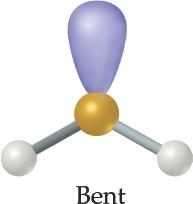
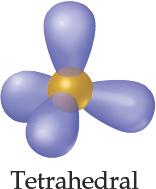
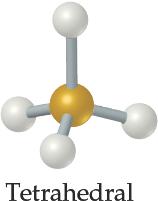
Tetrahedral Electron Domain
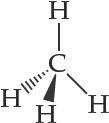
Tetrahedral: All are bonding pairs.
Trigonal pyramidal: One is a lone pair.
Bent: Two are lone pairs.
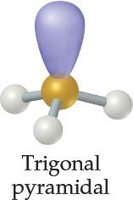
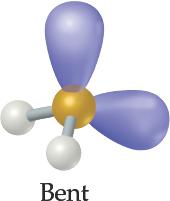
Effects of Nonbonding Pairs and Multiple Bonds
Nonbonding Pairs and Bond Angles
Nonbonding pairs are larger than bonding pairs, causing greater repulsion and compressing bond angles.
Multiple Bonds and Bond Angles
Double and triple bonds have larger electron domains and exert greater repulsive force, increasing bond angles.
Molecules with Expanded Valence Shells
Expanded Valence Shells
Elements in periods 3–6 can have more than four bonds due to available d-orbitals, resulting in trigonal bipyramidal (five domains) and octahedral (six domains) geometries.
Trigonal Bipyramidal Electron Domain
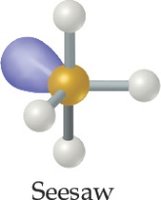
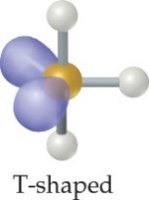
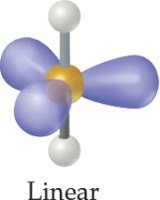
Four distinct molecular geometries: trigonal bipyramidal, seesaw, T-shaped, linear.
Axial and equatorial positions; lone pairs occupy equatorial positions.
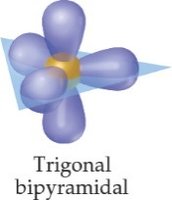
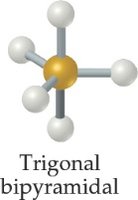
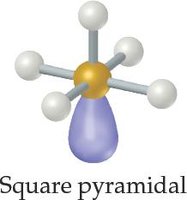
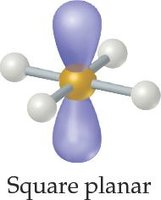
Octahedral Electron Domain
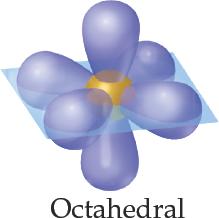
Three molecular geometries: octahedral, square pyramidal, square planar.
All positions are equivalent.
Molecular Shape and Polarity
Polarity of Molecules
The polarity of a molecule depends on the polarity of individual bonds and their arrangement. If bond dipoles are arranged symmetrically, the molecule is nonpolar; if not, it is polar.
Polar molecules: Bond dipoles do not cancel.
Nonpolar molecules: Bond dipoles cancel due to symmetry.
Covalent Bonding and Orbital Overlap
Valence-Bond Theory
Valence-bond theory explains covalent bonding as the overlap of atomic orbitals, allowing electrons of opposite spin to share space and form a bond. The optimal overlap balances repulsion and attraction, defining bond strength and bond length.
Hybrid Orbitals
Hybridization
Hybrid orbitals are formed by mixing atomic orbitals to create new orbitals of equal energy (degenerate orbitals). The type of hybridization depends on the electron-domain geometry:
sp: Linear geometry
sp2: Trigonal planar geometry
sp3: Tetrahedral geometry


Hybrid Orbital Description of Water
Water has a tetrahedral electron-domain geometry (two bonding, two nonbonding pairs). The ideal bond angle for sp3 hybridization is 109.5°, but the measured angle is 104.9° due to repulsion from nonbonding pairs.
Hybrid Orbital Summary
Electron-Domain Geometry | Hybrid Orbitals |
|---|---|
Linear | sp |
Trigonal planar | sp2 |
Tetrahedral | sp3 |
Trigonal bipyramidal | sp3d |
Octahedral | sp3d2 |
Multiple Bonds: Sigma and Pi Bonds
Types of Covalent Bonds
Sigma (σ) bonds: Formed by head-to-head overlap; electron density is along the internuclear axis.
Pi (π) bonds: Formed by sideways overlap; electron density is above and below the internuclear axis.


Localized and Delocalized Electrons
Electron Localization
Localized electrons: Shared between two atoms (single bonds).
Delocalized electrons: Shared among multiple atoms (resonance structures, e.g., benzene).
Molecular Orbital Theory
Molecular Orbitals
Molecular orbital (MO) theory describes bonding as continuous over the whole molecule. When atomic orbitals overlap, they form bonding and antibonding molecular orbitals. Bonding orbitals are constructive combinations; antibonding orbitals are destructive and have nodal planes.
MO Diagrams and Bond Order
MO diagrams show how atomic orbitals combine.
Bond order is calculated as:
Lowest energy orbitals are filled first.

MO Theory for Period 2 Diatomic Molecules
The number of MOs formed equals the number of atomic orbitals combined.
Only atomic orbitals of similar energy combine effectively.
Core electrons are excluded from MO diagrams.
MO Diagrams and Magnetism
Diamagnetism: All electrons are spin-paired; weakly repelled by a magnetic field (e.g., N2).
Paramagnetism: One or more unpaired electrons; attracted to a magnetic field (e.g., O2).
Heteronuclear Diatomic Molecules
MO diagrams for molecules with different atoms reflect differences in atomic orbital energies. The more electronegative atom's orbitals are lower in energy, so bonding orbitals resemble them more closely.
Summary Table: Molecular Geometries and Hybridizations
Electron Domains | Geometry | Hybridization | Example |
|---|---|---|---|
2 | Linear | sp | CO2 |
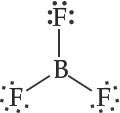
3 | Trigonal planar | sp2 | BF3 |
4 | Tetrahedral | sp3 | CH4 |
5 | Trigonal bipyramidal | sp3d | PCl5 |
6 | Octahedral | sp3d2 | SF6 |
Example: Methane (CH4) is tetrahedral with sp3 hybridization. Boron trifluoride (BF3) is trigonal planar with sp2 hybridization.
Additional info: Academic context was added to clarify hybridization, MO theory, and the effects of electron domains on molecular geometry.
