 Indietro
Molecules and Compounds: Structure, Bonding, and Formulas
Guida di studio - Note intelligenti
 Appunti personalizzati basati sui tuoi materiali, ampliati con definizioni chiave, esempi e contesto.
Molecules and Compounds
Elements to Molecules
When two or more nonmetallic elements combine, they form molecules. These molecules can be composed of the same element (e.g., O2) or different elements (e.g., H2O). The diversity of substances in nature arises from the ability of elements to form a wide variety of compounds.
Hydrogen, Oxygen, and Water
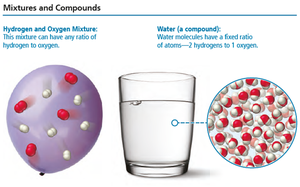
The properties of compounds are often dramatically different from the elements that compose them. For example, hydrogen and oxygen are both gases, but when combined in a 2:1 ratio, they form water, a liquid with unique properties.
Law of Definite Proportion
The Law of Definite Proportion states that a chemical compound always contains its component elements in a fixed ratio by mass. For example, water (H2O) always contains two hydrogen atoms for every one oxygen atom.
Chemical Bonds
Types of Chemical Bonds
Atoms in compounds are held together by chemical bonds, which lower the potential energy of the system. There are two main types of chemical bonds:
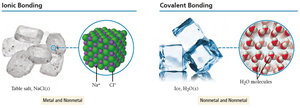
Ionic bonds: Involve the transfer of electrons from a metal to a nonmetal.
Covalent bonds: Involve the sharing of electrons between nonmetals.
Ionic Bonds
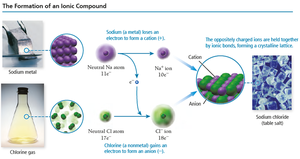
Ionic bonds occur between metals and nonmetals. Metals lose electrons to become cations, while nonmetals gain electrons to become anions. The resulting oppositely charged ions attract each other, forming an ionic compound, which exists as a crystal lattice in the solid state.
Covalent Bonds
Covalent bonds occur between nonmetal atoms. Instead of transferring electrons, the atoms share electrons to achieve stable electron configurations. The resulting compounds are called molecular compounds.
Representing Compounds
Chemical Formulas and Molecular Models
Chemical compounds are represented by chemical formulas, which indicate the type and number of each element present. There are three main types of chemical formulas:
Empirical formula: Shows the simplest whole-number ratio of atoms.
Molecular formula: Shows the actual number of atoms of each element in a molecule.
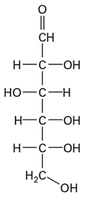
Structural formula: Shows how atoms are bonded together.
Structural Formulas
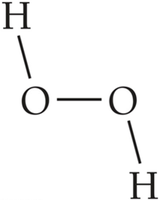
Structural formulas use lines to represent covalent bonds and show the arrangement of atoms in a molecule.
Molecular Models
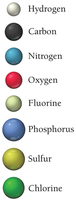
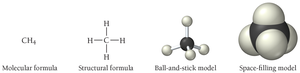
Molecular models provide three-dimensional representations of molecules. The ball-and-stick model shows atoms as balls and bonds as sticks, while the space-filling model shows the relative sizes of atoms and how they fill space.
Ways of Representing a Compound
Compounds can be represented in several ways, including molecular formulas, structural formulas, ball-and-stick models, and space-filling models. Each method provides different levels of information about the molecule's structure and composition.
Representation | Example: CH4 |
|---|---|
Molecular formula | CH4 |
Structural formula |
|
Ball-and-stick model | Shows atoms as balls and bonds as sticks |
Space-filling model | Shows the relative sizes and positions of atoms |
Lewis Structures and the Octet Rule
Lewis Structure Model
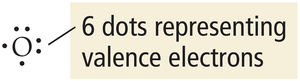
The Lewis model represents valence electrons as dots around the chemical symbol. Lewis structures help visualize the transfer or sharing of electrons in chemical bonding.
The Octet Rule
Atoms tend to gain, lose, or share electrons to achieve a noble gas configuration, usually eight valence electrons (an octet). Hydrogen and helium are exceptions, aiming for two electrons (a duet).
Period 2 nonmetals must obey the octet rule.
Period 3 and heavier nonmetals can have expanded octets when they are the central atom.
Bonding and the Octet Rule
In the Lewis model, a chemical bond is the sharing or transfer of electrons to achieve a stable electron configuration. Ionic bonds result from electron transfer (metal to nonmetal), while covalent bonds result from electron sharing (between nonmetals).
Ionic Compounds: Structure and Properties
Ionic Bonding and the Crystal Lattice
Ionic compounds are composed of cations and anions arranged in a crystal lattice. The lattice maximizes the attraction between oppositely charged ions, resulting in a stable structure. The formula unit represents the simplest ratio of ions in the compound.
Properties of Ionic Compounds
Hard and brittle
Do not conduct electricity as solids, but conduct when melted or dissolved in water
High melting and boiling points due to strong electrostatic forces
Lattice Energy
Lattice energy is the energy released when gaseous ions form an ionic solid. It is always exothermic and depends on the charges and sizes of the ions.
Naming Compounds
Naming Ionic Compounds
Ionic compounds are named based on the cation and anion present. For metals with invariant charge, the name is simply the metal followed by the nonmetal with an -ide ending (e.g., sodium chloride). For metals with variable charge (transition metals), a Roman numeral indicates the charge (e.g., iron(III) chloride).
Naming Molecular Compounds
Molecular compounds (composed of nonmetals) use prefixes to indicate the number of each atom (e.g., carbon dioxide, dinitrogen tetroxide). The first element is named first, and the second element is named with an -ide ending.
Formulas and Calculations
Formula Mass/Molecular Mass
The molecular mass (or formula mass) is the sum of the atomic masses of all atoms in a molecule or formula unit. It is calculated using the chemical formula and atomic masses from the periodic table.
Mole Concept and Conversions
The mole is a counting unit in chemistry. Molar mass (g/mol) and Avogadro's number (6.022 × 10²³ particles/mol) are used to convert between mass, moles, and number of particles.
Percent Composition
The percent composition of a compound is the percentage by mass of each element in the compound. It is calculated using the formula:
Empirical and Molecular Formulas
The empirical formula gives the simplest whole-number ratio of atoms in a compound. The molecular formula is a whole-number multiple of the empirical formula and gives the actual number of atoms in a molecule.
To determine the empirical formula from percent composition or experimental data:
Convert percentages to grams (assume 100 g sample if not given).
Convert grams to moles for each element.
Divide by the smallest number of moles to get the simplest ratio.
Multiply to obtain whole numbers if necessary.
Organic Compounds
Definition and Characteristics
Organic compounds are primarily composed of carbon and hydrogen, often with oxygen, nitrogen, phosphorus, or sulfur. Carbon forms four covalent bonds and can create chains, branches, and rings, leading to a vast diversity of organic molecules.
Common Hydrocarbons
Hydrocarbons are organic compounds containing only carbon and hydrogen. They are classified based on the types of bonds between carbon atoms (alkanes, alkenes, alkynes, and aromatic hydrocarbons).
Summary Table: Types of Chemical Formulas
Type | Description | Example (Glucose) |
|---|---|---|
Empirical formula | Simplest whole-number ratio | CH2O |
Molecular formula | Actual number of atoms | C6H12O6 |
Structural formula | Shows bonding arrangement |
|
Key Terms and Concepts
Molecule: A group of atoms bonded together.
Compound: A substance composed of two or more elements in a fixed ratio.
Ionic bond: Electrostatic attraction between cations and anions.
Covalent bond: Sharing of electrons between atoms.
Empirical formula: Simplest ratio of elements.
Molecular formula: Actual number of atoms in a molecule.
Structural formula: Shows how atoms are connected.
Lewis structure: Diagram showing valence electrons as dots.
Octet rule: Atoms tend to have eight electrons in their valence shell.
Lattice energy: Energy released when ions form a crystal lattice.
Percent composition: Percentage by mass of each element in a compound.
