 Indietro
Nuclear Chemistry: Radioactivity, Nuclear Equations, and Applications
Guida di studio - Note intelligenti
 Appunti personalizzati basati sui tuoi materiali, ampliati con definizioni chiave, esempi e contesto.
Nuclear Chemistry
Introduction to Nuclear Chemistry
Nuclear chemistry focuses on the structure and behavior of atomic nuclei, particularly the processes by which unstable nuclei undergo transformation. The nucleus contains two types of subatomic particles: protons and neutrons, collectively called nucleons. The atomic number (Z) is the number of protons, while the mass number (A) is the total number of protons and neutrons. Atoms with the same atomic number but different mass numbers are called isotopes.
Nuclide Symbols
The nuclide symbol represents a specific isotope of an element. It is written as:
where X is the chemical symbol, A is the mass number, and Z is the atomic number.
Types of Radioactive Decay
Alpha, Beta, and Gamma Radiation
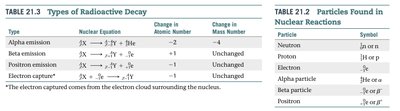
Radioactive decay involves the emission of particles or electromagnetic radiation from unstable nuclei. The main types are:
Alpha (α) decay: Emission of an alpha particle (two protons and two neutrons, identical to a helium-4 nucleus). The atomic number decreases by 2, and the mass number decreases by 4.
Beta (β) decay: Emission of a beta particle (an electron). A neutron is converted into a proton, increasing the atomic number by 1 while the mass number remains unchanged.
Gamma (γ) radiation: Emission of high-energy photons. Gamma emission does not change the atomic number or mass number but often accompanies other types of decay as the nucleus reorganizes into a more stable state.
Common symbols for particles in nuclear reactions are summarized below:
Particle | Symbol |
|---|---|
Neutron | |
Proton | or |
Electron (Beta particle) | or |
Alpha particle | or |
Positron | or |
Nuclear Equations
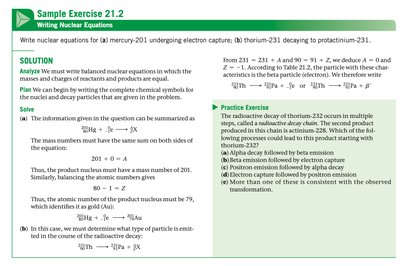
Nuclear equations represent the changes in the nucleus during radioactive decay. They must be balanced in terms of both atomic and mass numbers. For example:
Alpha decay:
Beta decay:
Sample exercises help practice writing and balancing nuclear equations.
Patterns of Nuclear Stability
Neutron-to-Proton Ratio and the Belt of Stability
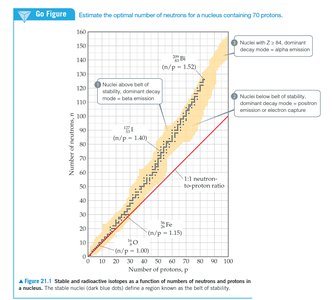
The stability of a nucleus depends largely on its neutron-to-proton (n/p) ratio. Stable isotopes cluster in a region known as the belt of stability. For lighter elements, stability is achieved at an n/p ratio close to 1, but for heavier elements, more neutrons are needed for stability. Nuclei with atomic numbers greater than 83 are all radioactive.
Nuclei above the belt (high n/p): Tend to undergo beta emission.
Nuclei below the belt (low n/p): Tend to undergo positron emission or electron capture.
Nuclei with Z ≥ 84: Undergo alpha emission.
Rates of Radioactive Decay and Half-Life
First-Order Kinetics and Decay Constant
Radioactive decay follows first-order kinetics, where the rate depends on the number of radioactive nuclei present:
The decay constant (k) is related to the half-life () by:
The number of nuclei remaining after time t is given by:
where is the initial number of nuclei and is the number remaining at time t.
Stability of Isotopes and Predicting Stable Nuclei
Magic Numbers and Even/Odd Nucleon Numbers
Two key observations help predict nuclear stability:
Nuclei with magic numbers of protons (2, 8, 20, 28, 50, 82) or neutrons (2, 8, 20, 28, 50, 82, 126) are especially stable.
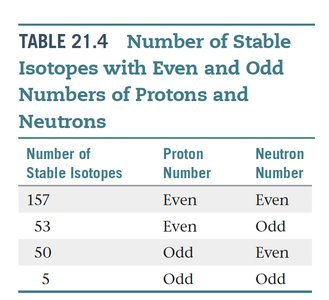
Nuclei with even numbers of protons and/or neutrons are more likely to be stable. About 60% of stable nuclei have even numbers of both protons and neutrons.
Number of Stable Isotopes | Proton Number | Neutron Number |
|---|---|---|
157 | Even | Even |
53 | Even | Odd |
50 | Odd | Even |
5 | Odd | Odd |
Radiocarbon Dating
Principle and Application
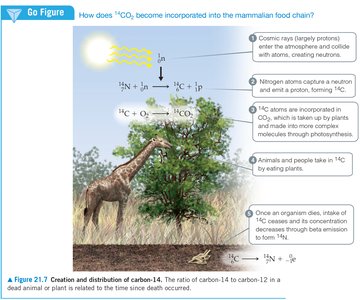
Radiocarbon dating uses the predictable decay of carbon-14 () to estimate the age of formerly living materials. Carbon-14 is produced in the atmosphere and incorporated into living organisms. After death, the intake of $ ^{14}C $ stops, and its ratio to decreases as $ ^{14}C $ decays with a half-life of about 5700 years. By measuring the remaining $ ^{14}C $ in a sample, the time since death can be estimated.
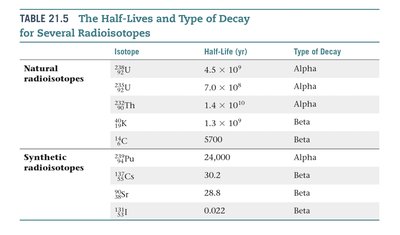
Summary Table: Half-Lives and Types of Decay
Isotope | Half-Life (yr) | Type of Decay |
|---|---|---|
Alpha | ||
Alpha | ||
Alpha | ||
5700 | Beta | |
24,000 | Alpha | |
30.2 | Beta | |
28.8 | Beta | |
0.022 | Beta |
Additional info: The above tables and figures reinforce the key concepts of nuclear chemistry, including the types of radioactive decay, the importance of neutron-to-proton ratios, and the practical application of radiocarbon dating in archaeology and geology.
