 Indietro
Nuclear Chemistry: Structure, Decay, and Applications
Guida di studio - Note intelligenti
 Appunti personalizzati basati sui tuoi materiali, ampliati con definizioni chiave, esempi e contesto.
Nuclear Chemistry
Introduction to Nuclear Chemistry
Nuclear chemistry is a specialized branch of chemistry that examines the chemical and physical properties of elements as influenced by changes in the atomic nucleus. It encompasses the study of radioactive elements, nuclear reactions, and the interaction of radiation with matter. Nuclear chemistry is fundamental to understanding both natural and artificial processes involving atomic nuclei.
Key Concepts in Atomic Theory
Atomic theory provides the foundation for understanding nuclear chemistry. The nucleus contains protons and neutrons, and the arrangement of these particles determines the element and its isotopes.
Mass Number (A): The total number of protons and neutrons in the nucleus.
Atomic Number (Z): The number of protons in the nucleus, which defines the element.
Isotopes: Variants of elements with the same number of protons but different numbers of neutrons. For example, Uranium-234, Uranium-235, and Uranium-238 are isotopes of uranium.
Example: Copper-65 is an isotope of copper with 29 protons and 36 neutrons.
Isotopes Explained
Isotopes of an element share the same number of protons but differ in their number of neutrons. This difference affects their nuclear stability and radioactive properties.
Similarity: Isotopes have identical chemical behavior due to the same number of protons and electrons.
Difference: Isotopes differ in mass and nuclear stability due to varying numbers of neutrons.
Example: Carbon-12 and Carbon-14 both have 6 protons, but Carbon-14 has 8 neutrons while Carbon-12 has 6.
Information from the Periodic Table
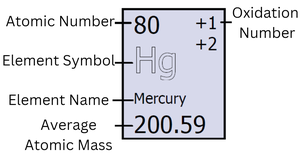
The periodic table provides essential information about each element, including atomic number, element symbol, name, and average atomic mass. Some tables also list oxidation states.
Nuclear Stability
Factors Affecting Nuclear Stability
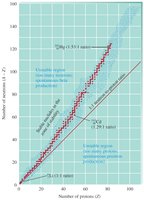
Nuclear stability refers to the ability of an atomic nucleus to remain intact without undergoing spontaneous changes, such as radioactive decay. Three main factors influence nuclear stability:
Size of the Nucleus: Larger nuclei tend to be less stable due to increased repulsive forces between protons.
Type of Decay: The mode of radioactive decay (alpha, beta, gamma) affects stability.
Odd vs. Even Nucleons: Nuclei with even numbers of protons and neutrons are generally more stable.
Radioactivity
Discovery and Nature of Radioactivity
Some nuclides are unstable and undergo radioactive decay, transforming into other elements or isotopes. These unstable isotopes are called radionuclides. The phenomenon of radioactivity was discovered by Marie Curie, who identified polonium and radium as radioactive elements.

Symbols Used in Nuclear Chemistry
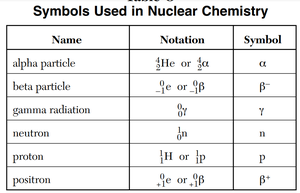
Nuclear chemistry uses specific symbols to represent particles and radiation involved in nuclear reactions.
Name | Notation | Symbol |
|---|---|---|
Alpha particle | or | \(\alpha\) |
Beta particle | or | \(\beta^-\) |
Gamma radiation | \(\gamma\) | |
Neutron | \(\text{n}\) | |
Proton | or | \(\text{p}^+\) |
Positron | or | \(\beta^+\) |
Types of Radioactive Decay
Radioactive decay occurs in several forms, each involving the emission of different particles or energy:
Alpha Decay: Emission of an alpha particle (), reducing the atomic number by 2 and mass number by 4.
Beta Decay: Emission of a beta particle (), converting a neutron to a proton.
Gamma Decay: Emission of gamma rays (), which are high-energy photons.
Positron Emission: Emission of a positron (), converting a proton to a neutron.
Electron Capture: Absorption of an electron by the nucleus, converting a proton to a neutron.
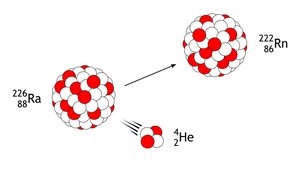
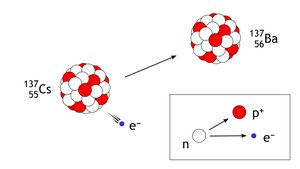
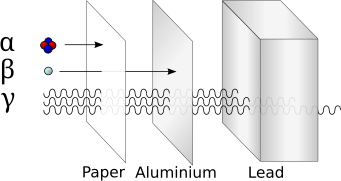
Radioactive Decay Series
Decay Series and Nuclear Transformations
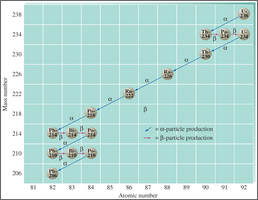
Large radioactive nuclei often undergo a series of decays, known as a radioactive decay series, until they form a stable nuclide, typically lead. Each step involves a specific type of decay.
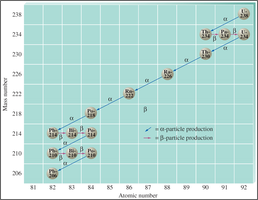
Half-Life
Definition and Importance of Half-Life
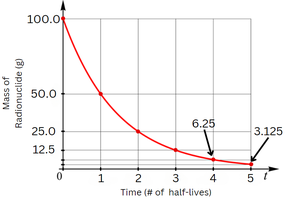
The half-life () is the time required for half the atoms in a radioactive sample to decay. It is a key measure of the speed of nuclear decay and is used to estimate the age of materials and the persistence of radioactivity.
Examples of Half-Life
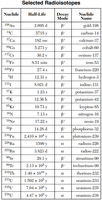
Different isotopes have widely varying half-lives, from fractions of a second to billions of years. For example:
Francium-223: Half-life of about 22 minutes.
Uranium-238: Half-life of 4.5 billion years.
Half-Life Equation:
The amount of radioactive material remaining after time can be calculated using: where is the initial amount, is the half-life, and is the elapsed time.
Nuclear Transformations
Nuclear Transformations and Equations
Nuclear transformations involve changes in the nucleus, such as transmutation of elements or the creation of new isotopes. These processes are fundamental to nuclear chemistry and are often studied in particle accelerators.

Nuclear Fission
Process and Applications of Nuclear Fission
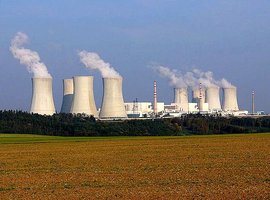
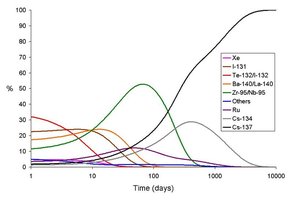
Nuclear fission is the splitting of a heavy nucleus into smaller nuclei, releasing energy, neutrons, and gamma radiation. This process is used in nuclear power generation, medical isotope production, and research.
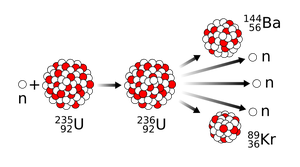
Nuclear Power: Fission generates electricity in nuclear reactors.
Nuclear Weapons: Uncontrolled fission reactions are the basis for atomic bombs.
Medical Isotope Production: Fission produces isotopes for medical imaging and treatment.
Research: Used to study fundamental physics and produce new elements.
Advantages and Disadvantages of Nuclear Fission
Advantages: High energy yield, no greenhouse gas emissions, long-lasting fuel supply.
Disadvantages: Radioactive waste, risk of accidents, potential for weapon development.
Nuclear Fusion
Process and Applications of Nuclear Fusion
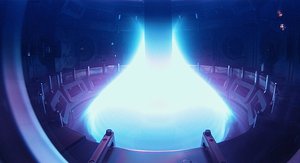
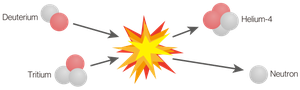
Nuclear fusion is the combination of two light nuclei to form a heavier nucleus, releasing enormous energy. Fusion powers stars and is a focus of research for clean energy.
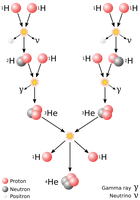
Energy Production: Fusion is researched for sustainable energy (e.g., ITER reactor).
Powering Stars: Fusion reactions are the primary energy source for stars.
Nuclear Weapons: Fusion reactions are used in hydrogen bombs.
Advantages and Disadvantages of Nuclear Fusion
Advantages: Abundant fuel, clean energy, high energy yield.
Disadvantages: Extreme conditions required, technological hurdles, high cost.
Detection and Uses of Radioactivity
Detection of Radioactivity
Radioactivity is detected using instruments such as the Geiger counter, which measures ionizing radiation. These devices are essential in nuclear research, medical applications, and environmental monitoring.

Applications of Radioactivity
Carbon Dating: Used to determine the age of organic materials by measuring radioactive carbon-14.
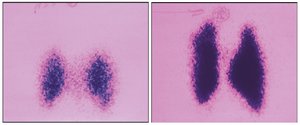
Medical Applications: Radioactive isotopes are used for diagnosis and treatment, such as imaging and cancer therapy.

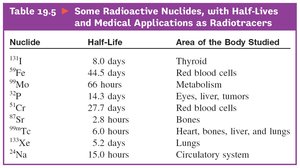
Nuclide | Half-Life | Area of the Body Studied |
|---|---|---|
\(^{131}\text{I}\) | 8.0 days | Thyroid |
\(^{59}\text{Fe}\) | 44.5 days | Red blood cells |
\(^{99}\text{Mo}\) | 66 hours | Metabolism |
\(^{99m}\text{Tc}\) | 14.3 days | Eyes, liver, tumors |
\(^{51}\text{Cr}\) | 27.7 days | Red blood cells |
\(^{85}\text{Sr}\) | 2.8 hours | Bones |
\(^{99m}\text{Tc}\) | 6.0 hours | Heart, bones, liver, lungs |
\(^{133}\text{Xe}\) | 5.2 days | Lung |
\(^{22}\text{Na}\) | 15.0 hours | Circulatory system |
Summary
Nuclear chemistry explores the structure and behavior of atomic nuclei, the mechanisms of radioactive decay, and the practical applications of radioactivity in energy, medicine, and research. Understanding these concepts is essential for further study in chemistry, physics, and related fields.
