Indietro
2: Numerical Side of Chemistry: Measurement, Units, and Problem Solving
Guida di studio - Note intelligenti
 Appunti personalizzati basati sui tuoi materiali, ampliati con definizioni chiave, esempi e contesto.
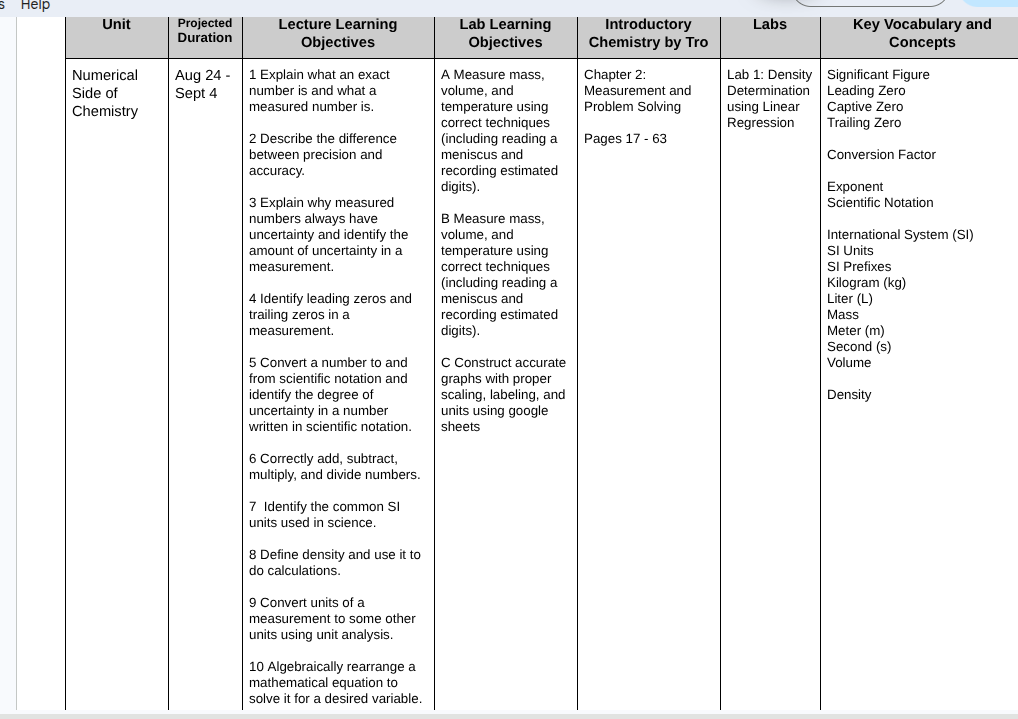
Numerical Side of Chemistry
Measurement and Problem Solving
This section introduces foundational concepts in measurement, numerical operations, and unit analysis, which are essential for accurate scientific work in General Chemistry. Understanding these principles allows students to interpret data, perform calculations, and communicate results effectively.
Exact vs. Measured Numbers
Exact Numbers: Values known with complete certainty, often from counting or defined quantities (e.g., 12 eggs in a dozen).
Measured Numbers: Values obtained using instruments, always subject to some uncertainty (e.g., mass measured with a balance).
Example: Counting atoms in a molecule (exact); measuring the mass of a sample (measured).
Precision and Accuracy
Precision: The consistency of repeated measurements.
Accuracy: How close a measurement is to the true or accepted value.
Example: A balance consistently gives similar mass readings (precise), but if those readings are close to the actual mass, they are also accurate.
Uncertainty in Measurements
All measured numbers have uncertainty due to instrument limitations.
The uncertainty is indicated by the number of significant figures recorded.
Example: Reading a meniscus in a graduated cylinder and estimating the last digit.
Significant Figures and Zeros
Significant Figures: Digits in a measurement that are known with certainty plus one estimated digit.
Leading Zeros: Zeros before nonzero digits; not significant (e.g., 0.0025).
Captive Zeros: Zeros between nonzero digits; always significant (e.g., 205).
Trailing Zeros: Zeros at the end of a number; significant if after a decimal point (e.g., 2.50).
Scientific Notation
Used to express very large or small numbers concisely.
Format: where a is a number between 1 and 10, and n is an integer.
Example: 0.00045 =
Mathematical Operations with Significant Figures
Addition/Subtraction: Result should have the same decimal places as the measurement with the fewest decimal places.
Multiplication/Division: Result should have the same number of significant figures as the measurement with the fewest significant figures.
SI Units and Prefixes
The International System of Units (SI) is used in science for consistency.
Common SI Units:
Mass: kilogram (kg)
Length: meter (m)
Time: second (s)
Volume: liter (L)
SI Prefixes: Used to indicate multiples or fractions of units (e.g., milli-, centi-, kilo-).
Density
Definition: Density is mass per unit volume.
Formula:
Example: If a sample has a mass of 10 g and a volume of 2 mL, its density is .
Unit Conversion and Analysis
Unit analysis (dimensional analysis) is used to convert between units using conversion factors.
Example: To convert 5.0 cm to meters:
Algebraic Rearrangement of Equations
Solving for a desired variable by rearranging equations.
Example: Rearranging the density formula to solve for mass:
Laboratory Techniques
Measuring mass, volume, and temperature accurately, including reading a meniscus and recording estimated digits.
Constructing accurate graphs with proper scaling, labeling, and units.
Key Vocabulary
Significant Figure
Leading Zero
Captive Zero
Trailing Zero
Conversion Factor
Exponent
Scientific Notation
International System (SI)
SI Units
SI Prefixes
Kilogram (kg)
Liter (L)
Mass
Meter (m)
Second (s)
Volume
Density
Lab Example
Lab 1: Density Determination using Linear Regression
Students measure mass and volume, plot data, and use linear regression to determine density.
Table: SI Units and Prefixes
Quantity | SI Unit | Symbol |
|---|---|---|
Mass | Kilogram | kg |
Length | Meter | m |
Time | Second | s |
Volume | Liter | L |
Prefix | Symbol | Factor |
|---|---|---|
Kilo | k | 1,000 |
Centi | c | 0.01 |
Milli | m | 0.001 |