 Indietro
Periodic Properties and Electron Configuration: Structure and Trends in the Periodic Table
Guida di studio - Note intelligenti
 Appunti personalizzati basati sui tuoi materiali, ampliati con definizioni chiave, esempi e contesto.
Periodic Properties of the Elements
Organization of the Periodic Table
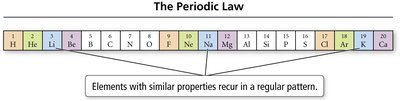
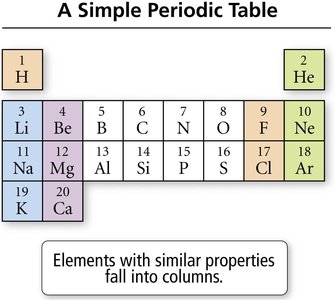
The periodic table is a systematic arrangement of elements based on their atomic number, electron configuration, and recurring chemical properties. Elements with similar properties are grouped in columns called groups or families, while rows are called periods. The periodic law states that when elements are arranged by increasing atomic number, certain sets of properties recur periodically.
Groups/Families: Vertical columns; elements share similar chemical and physical properties.
Periods: Horizontal rows; properties change progressively across a period.
Blocks: The table is divided into s, p, d, and f blocks, corresponding to the type of atomic orbital being filled.
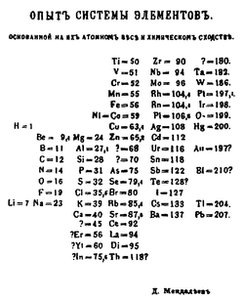
Historical Note: Dmitri Mendeleev organized the first periodic table by atomic mass and predicted the existence and properties of undiscovered elements.
Classification of Elements
Metals: Solids at room temperature (except Hg), reflective, conduct heat and electricity, malleable, ductile, tend to lose electrons and form cations.
Nonmetals: Found in all three states, brittle as solids, poor conductors, tend to gain electrons and form anions.
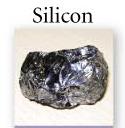
Metalloids: Exhibit properties intermediate between metals and nonmetals; often semiconductors.
Electron Configuration and the Periodic Table
Rules for Electron Filling
Electron configuration describes the arrangement of electrons in an atom's orbitals. The filling order is governed by three main principles:
Aufbau Principle: Electrons fill orbitals of lowest energy first (order: s → p → d → f).
Pauli Exclusion Principle: Each orbital can hold two electrons with opposite spins.
Hund’s Rule: Electrons occupy degenerate orbitals singly before pairing up, maximizing the number of unpaired electrons.
The periodic table structure reflects the order of orbital filling:
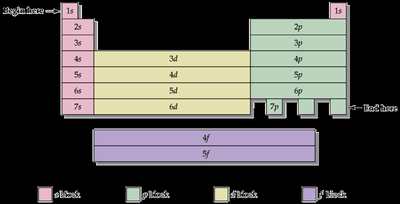
s-block: Groups 1 and 2, plus helium
p-block: Groups 13–18
d-block: Transition metals (Groups 3–12)
f-block: Lanthanides and actinides
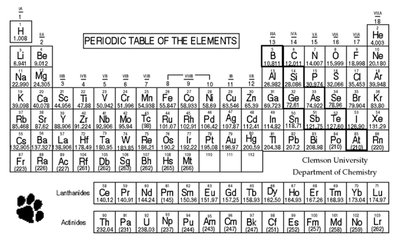
Example: The ground state electron configuration for manganese (Mn, Z=25) is or [Ar] .
Valence and Core Electrons
Valence electrons: Electrons in the outermost shell (highest n); involved in bonding and determine chemical properties.
Core electrons: Inner electrons; provide shielding and are not involved in bonding.
Electron Configurations of Ions
Cations (metals): Lose electrons from the highest energy orbital, becoming isoelectronic with the nearest noble gas.
Anions (nonmetals): Gain electrons to fill the valence shell, also becoming isoelectronic with a noble gas.
Transition metals: Lose s electrons before d electrons when forming cations.
Example:
Example:
Isoelectronic Species
Isoelectronic species are atoms or ions with the same electron configuration. For example, , , , and are all isoelectronic with .
Effective Nuclear Charge (Zeff)
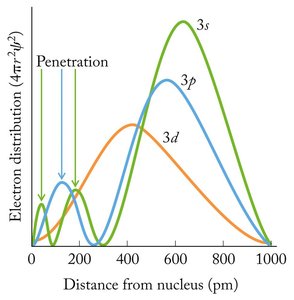
Shielding and Penetration
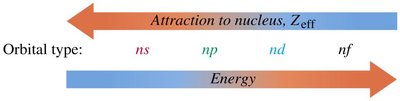
In multi-electron atoms, electrons are attracted to the nucleus but repelled by other electrons. Core electrons shield valence electrons from the full nuclear charge, resulting in an effective nuclear charge () that is less than the actual nuclear charge ().
Shielding: Core electrons shield outer electrons from the nucleus.
Penetration: Orbitals with greater penetration (e.g., s orbitals) experience less shielding and higher .
The effective nuclear charge is calculated as:
Trends in Effective Nuclear Charge
increases across a period (left to right) due to increasing nuclear charge with similar shielding.
changes little down a group, but valence electrons are farther from the nucleus and less tightly held.
Periodic Trends
Atomic Radius
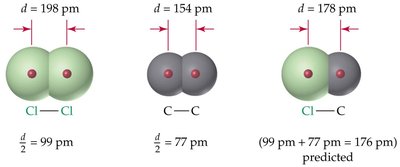
The atomic radius is defined as half the distance between the nuclei of two identical atoms bonded together. It is influenced by and the principal quantum number (n).
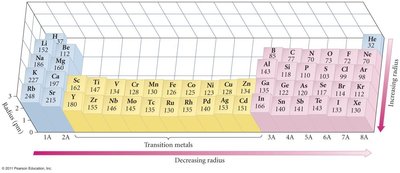
Atomic radius increases down a group (due to increasing n).
Atomic radius decreases across a period (due to increasing ).
Ionic Radius
The ionic radius is the distance from the nucleus to the outermost electron in an ion.
Cations are smaller than their parent atoms (loss of electrons, increased ).
Anions are larger than their parent atoms (gain of electrons, decreased ).
For isoelectronic species, the more negative the charge, the larger the ion.
Ionization Energy (IE)
Ionization energy is the energy required to remove an electron from a gaseous atom. It is a measure of how strongly an atom holds its electrons.
IE increases across a period (increasing ).
IE decreases down a group (electrons are farther from the nucleus).
Successive ionization energies increase, with a large jump when core electrons are removed.
Electron Affinity (EA)
Electron affinity is the energy change when a neutral atom gains an electron. A more negative EA means a greater tendency to accept an electron.
EA generally becomes more negative across a period (except for noble gases and some exceptions).
EA becomes less negative down a group.
Halogens have the most negative EA; noble gases and alkaline earth metals have positive or small EA values.
Summary Table: Periodic Trends
Property | Across a Period (→) | Down a Group (↓) |
|---|---|---|
Atomic Radius | Decreases | Increases |
Ionic Radius | Cations decrease, anions increase | Increases |
Ionization Energy | Increases | Decreases |
Electron Affinity | More negative | Less negative |
Effective Nuclear Charge () | Increases | Little change |
Key Equations and Constants
Energy of a photon:
Speed of light:
Avogadro's number:
Planck's constant:
Speed of light:
