 Indietro
Periodic Properties of Elements and Quantum Mechanical Model: Study Notes
Guida di studio - Note intelligenti
 Appunti personalizzati basati sui tuoi materiali, ampliati con definizioni chiave, esempi e contesto.
Periodic Properties of Elements
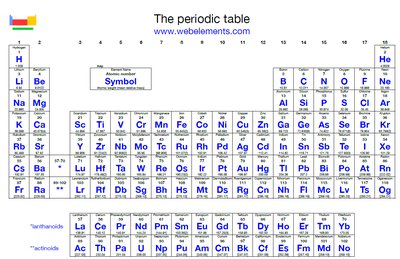
Periodic Law and the Periodic Table
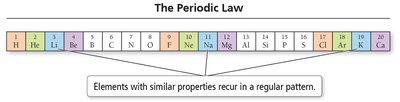
The Periodic Law states that when elements are arranged in order of increasing atomic number, certain sets of properties recur periodically. This law forms the basis for the modern periodic table, which organizes elements into rows (periods) and columns (groups or families) based on their atomic structure and recurring chemical properties.
Groups (Columns): Elements in the same group have similar chemical properties due to similar valence electron configurations.
Periods (Rows): Elements in the same period have the same principal quantum number (n).
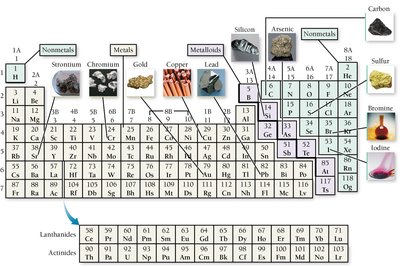
Classification: Elements are classified as metals (shiny, malleable, good conductors), nonmetals (dull, poor conductors), and metalloids (intermediate properties, semiconductors).
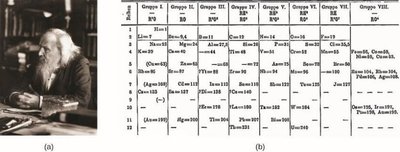
Mendeleev's Periodic Table: Mendeleev arranged elements by increasing atomic mass, predicting the existence and properties of undiscovered elements by leaving gaps in his table.

Quantum Mechanical Model of the Atom
Quantum Numbers and Orbitals
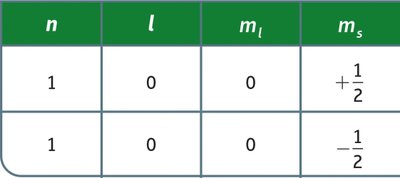
Each electron in an atom is described by a unique set of four quantum numbers:
Principal quantum number (n): Indicates the energy level and size of the orbital. Values: 1, 2, 3, ...
Angular momentum quantum number (l): Defines the shape of the orbital. Values: 0 (s), 1 (p), 2 (d), 3 (f), up to (n-1).
Magnetic quantum number (ml): Specifies the orientation of the orbital in space. Values: -l to +l.
Spin quantum number (ms): Indicates the direction of electron spin. Values: +1/2 or -1/2.
Quantum mechanics provides the probability of finding an electron in a three-dimensional space around the nucleus, based on solutions to the Schrödinger equation.
Shapes of Atomic Orbitals
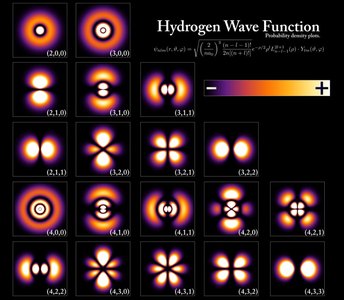
Atomic orbitals have distinct shapes depending on their quantum numbers:
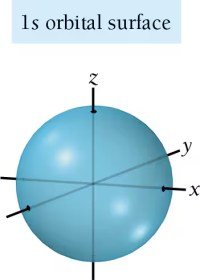
s orbitals: Spherical shape.
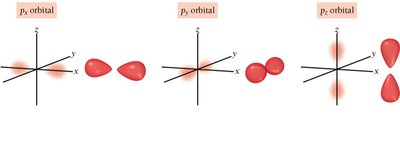
p orbitals: Dumbbell-shaped, oriented along x, y, and z axes.
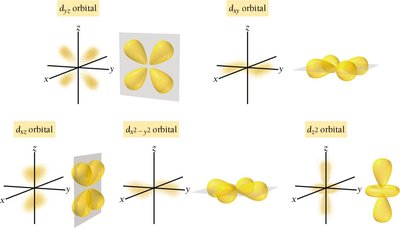
d orbitals: Four-lobed shapes, with various orientations.
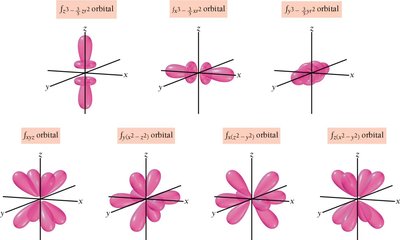
f orbitals: Complex shapes with multiple lobes.
Electron Configuration and Orbital Diagrams
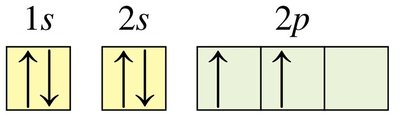
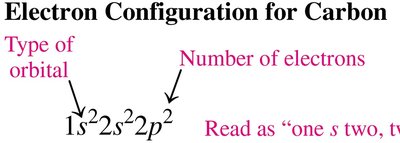
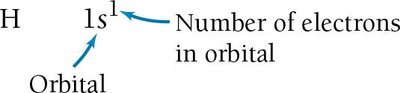
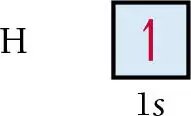
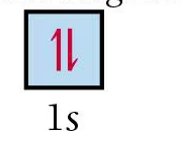
Electron configuration describes the arrangement of electrons in an atom's orbitals. Orbital diagrams use boxes and arrows to show electron placement and spin.
Aufbau Principle: Electrons fill the lowest energy orbitals first.
Pauli Exclusion Principle: No two electrons in an atom can have the same set of four quantum numbers.
Hund's Rule: When filling degenerate orbitals, each orbital is singly occupied before any is doubly occupied, and electrons have parallel spins.

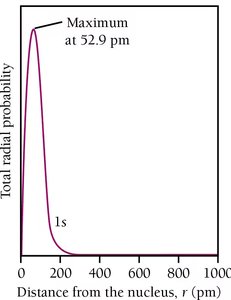
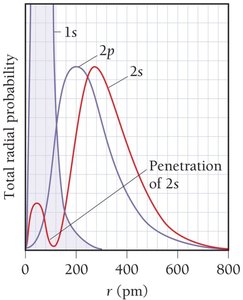
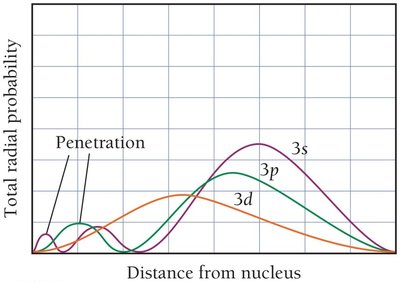
Radial Probability and Penetration
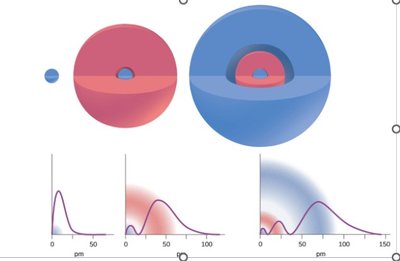
The radial probability describes the likelihood of finding an electron at a certain distance from the nucleus. Penetration refers to how close an orbital can get to the nucleus, affecting its energy and shielding.
Radial nodes: Spherical regions where the probability of finding an electron is zero. Number of radial nodes = (n - l - 1).
Penetration order: For a given energy level, s > p > d > f in terms of penetration and energy (s is lowest).



Sublevel Energy Splitting in Multi-electron Atoms
Energy Ordering and Degeneracy
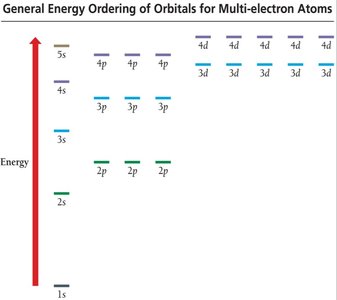
In multi-electron atoms, sublevels with the same principal quantum number (n) have different energies due to electron-electron interactions, shielding, and penetration. Orbitals with the same energy are called degenerate.
Energy order:
Sublevel splitting: Caused by charge interaction, shielding, and penetration.
Coulomb's Law and Effective Nuclear Charge (Zeff)
Coulomb's Law describes the attractive and repulsive forces between charged particles:
Like charges repel (positive potential energy).
Opposite charges attract (negative potential energy).
Potential energy increases with charge magnitude and decreases with distance.
Effective Nuclear Charge (Zeff): The net positive charge experienced by an electron after accounting for shielding by inner electrons.
Electron Configuration Using the Periodic Table
Determining Electron Configuration
The periodic table can be used to determine electron configurations. The d sublevels are one less (n-1) than the period number, and the f sublevels are two less (n-2).
Abbreviated Electron Configuration (Noble Gas Notation)
Electron configurations can be abbreviated by using the noble gas preceding the element in brackets, followed by the remaining orbitals.
Example: Sulfur: [Ne] 3s2 3p4
Valence Electrons and Chemical Properties
Valence Electrons
Valence electrons are the electrons in the highest principal energy shell. They determine the chemical and physical properties of an element and participate in bonding.
For main group elements, the group number equals the number of valence electrons.
Inner electrons are called core electrons.
Electron Configuration of Ions
Formation of Ions
Atoms form ions to achieve an electron configuration similar to the nearest noble gas (octet rule):
Cations: Metals lose electrons to form positively charged ions.
Anions: Nonmetals gain electrons to form negatively charged ions.
For transition metal ions, remove ns electrons before (n-1)d electrons.
Summary Table: Quantum Numbers
Quantum Number | Symbol | Represents | Values Permitted |
|---|---|---|---|
Principal quantum number | n | Shell, energy level, size | 1, 2, 3, ... (n ≠ 0) |
Angular momentum quantum number | l | Sub-shell, shape | 0, 1, 2, 3 to (n-1) |
Magnetic quantum number | ml | 3D orientation | -l to +l |
Spin quantum number | ms | Spin direction | +1/2, -1/2 |
Key Equations
Radial nodes:
Effective nuclear charge:
Coulomb's Law:
