Indietro
Periodic Properties of the Elements: Ionization Energy, Electron Affinity, and Metallic Character
Guida di studio - Note intelligenti
 Appunti personalizzati basati sui tuoi materiali, ampliati con definizioni chiave, esempi e contesto.
Periodic Properties of the Elements
Ions: Electron Configurations, Magnetic Properties, Ionic Radii, and Ionization Energy
The periodic table reveals distinct patterns in the properties of elements, including ionization energy, electron affinity, and metallic character. These trends are governed by the electronic structure and effective nuclear charge experienced by electrons.
Ionization Energy (IE)
Ionization energy is the energy required to remove an electron from an atom in the gaseous state. It is always positive, as removing an electron requires energy input.
First Ionization Energy (IE1): Energy needed to remove the first electron.
Second Ionization Energy (IE2): Energy needed to remove the second electron after the first has been removed.
IE1 for Li: 520 kJ/mol (endothermic)
IE2 for Li: 7298 kJ/mol (endothermic)
Trends in Ionization Energy:
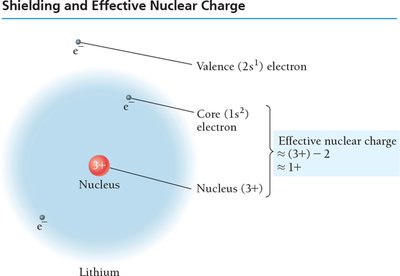
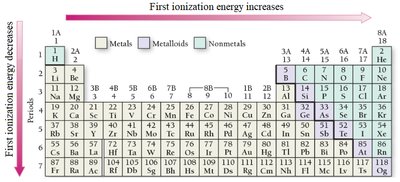
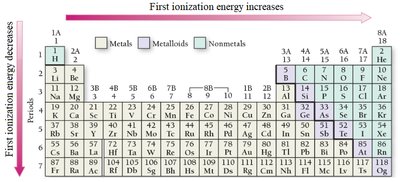
IE1 increases from left to right across a period due to increasing effective nuclear charge (Zeff).
IE1 decreases down a group as atomic size increases and electrons are farther from the nucleus.
Inverse relationship between atomic size and IE1.
Exceptions to Ionization Energy Trends
Some elements deviate from the general trend due to electron configuration and pairing energy:
Transition from s to p block (e.g., Be vs. B): IE1 for B is lower than for Be because the 2p1 electron in B is easier to remove than the 2s2 electron in Be.
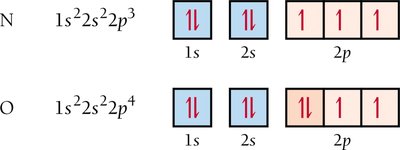
Pairing energy in p orbitals (e.g., N vs. O): IE1 for N is higher than for O due to electron-electron repulsion in O's 2p orbital.
Example: IE1 for N = 1402 kJ/mol; IE1 for O = 1314 kJ/mol.
Trends in Second and Successive Ionization Energies
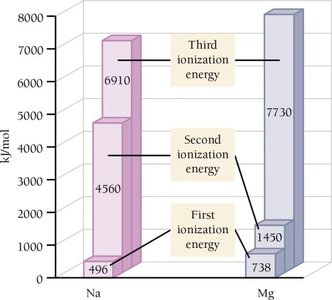
Removing valence electrons requires less energy than removing core electrons. Successive ionization energies increase, with a large jump when a core electron is removed.
Na: IE1 = 496 kJ/mol, IE2 = 4560 kJ/mol, IE3 = 6910 kJ/mol
Mg: IE1 = 738 kJ/mol, IE2 = 1450 kJ/mol, IE3 = 7730 kJ/mol
Element | IE1 | IE2 | IE3 | IE4 | IE5 | IE6 | IE7 |
|---|---|---|---|---|---|---|---|
Na | 496 | 4560 | 6910 | ||||
Mg | 738 | 1450 | 7730 | ||||
Al | 578 | 1820 | 2750 | 11,600 | |||
Si | 786 | 1580 | 2300 | 4360 | 16,100 | ||
P | 1012 | 1900 | 2910 | 4960 | 6270 | 22,200 | |
S | 1000 | 2250 | 3360 | 4560 | 7010 | 8500 | 27,100 |
Cl | 1251 | 2300 | 3820 | 5160 | 6540 | 9460 | 11,000 |
Ar | 1521 | 2670 | 3930 | 5770 | 7240 | 8780 | 12,000 |
Electron Affinities and Metallic Character
Electron Affinity (EA)
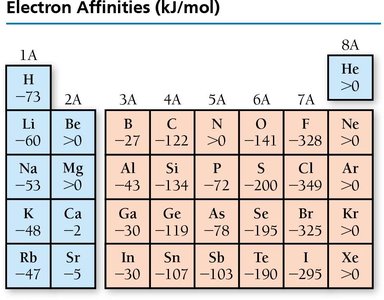
Electron affinity is the energy change when an atom or ion in the gaseous state gains an electron. It is usually negative, indicating energy release.
EA for Cl: −349 kJ/mol
EA for F: −328 kJ/mol
EA for Na: −53 kJ/mol
Trends in Electron Affinity:
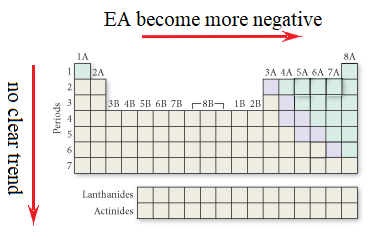
EA becomes more negative across a period (left to right) for main group elements due to increasing Zeff.
Trend is not regular down a group; Group 1A follows the trend, but others do not.
Exceptions occur for Group 5A elements (e.g., N) due to electron repulsion in half-filled p orbitals.
Example: Cl gains a noble gas configuration when it adds an electron, resulting in a more negative EA than Na.
Metallic Character
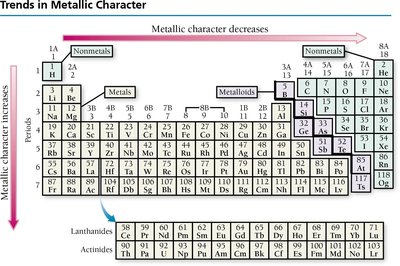
Metallic character refers to the tendency of an element to lose electrons in chemical reactions. Metals are good conductors, malleable, ductile, and shiny, while nonmetals are poor conductors and tend to gain electrons.
Metallic character decreases across a period (left to right).
Metallic character increases down a group.
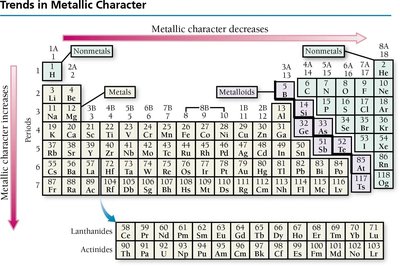
Example: Arrange Si, Cl, Na, Rb in increasing metallic character: Cl < Si < Na < Rb.
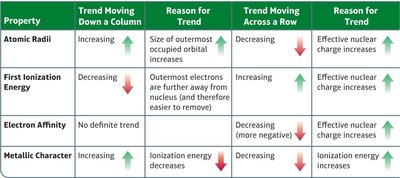
Periodic Trends Summary
The electronic configuration of elements explains the observed periodic trends in atomic size, ionization energy, electron affinity, and metallic character. These properties are determined by the effective nuclear charge and the arrangement of electrons.
Property | Trend Moving Down a Column | Reason for Trend | Trend Moving Across a Row | Reason for Trend |
|---|---|---|---|---|
Atomic Radii | Increasing | Size of outermost occupied orbital increases | Decreasing | Effective nuclear charge increases |
First Ionization Energy | Decreasing | Outermost electrons are further away from nucleus | Increasing | Effective nuclear charge increases |
Electron Affinity | No definite trend | Decreasing (more negative) | Effective nuclear charge increases | |
Metallic Character | Increasing | Ionization energy decreases | Decreasing | Ionization energy increases |