 Indietro
Periodic Properties of the Elements: Structure, Electron Configuration, and Trends
Guida di studio - Note intelligenti
 Appunti personalizzati basati sui tuoi materiali, ampliati con definizioni chiave, esempi e contesto.
Periodic Properties of the Elements
Elemental Patterns and the Periodic Law
The periodic table organizes elements based on recurring patterns in their physical and chemical properties. These patterns, known as periodic properties, allow scientists to predict the behavior of elements and the existence of undiscovered ones. The periodic law states that when elements are arranged in order of increasing atomic number, certain sets of properties recur periodically.
Periodic property: A property predictable based on an element’s position in the periodic table.
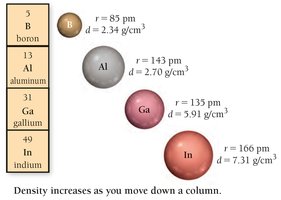
Example: Density increases as you move down a column in the periodic table.

Mendeleev’s Periodic Table and the Modern Periodic Table
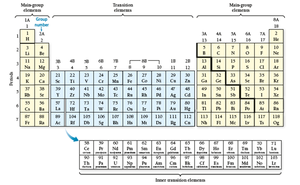
Mendeleev organized elements by increasing mass, placing those with similar properties in the same columns. He predicted the existence and properties of undiscovered elements by leaving gaps in his table. The modern periodic table arranges elements by increasing atomic number, which better explains recurring properties.
Rows: Called periods.
Columns: Called groups or families; elements in a group have similar properties.
Classification: Metals, nonmetals, metalloids; main-group elements (predictable properties), transition and inner transition metals (less predictable properties).
Electron Configuration and Quantum Theory
Quantum-mechanical theory describes the arrangement of electrons in atoms. Electrons occupy orbitals, and their configuration determines elemental properties. The solution to Schrödinger’s equation for hydrogen shows its electron occupies the lowest energy orbital. For multi-electron atoms, electron–electron interactions cause energy splitting of sublevels.
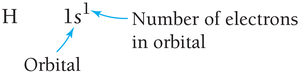
Electron configuration: The arrangement of electrons in orbitals.
Orbitals: Regions where electrons are likely to be found; described by quantum numbers.
Electron Spin and the Pauli Exclusion Principle
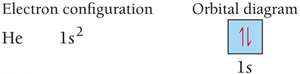
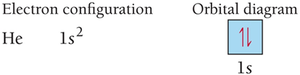
Electron spin is a fundamental property, quantized in two directions (up or down). The Pauli exclusion principle states that no two electrons in an atom can have the same set of four quantum numbers, so each orbital can hold a maximum of two electrons with opposite spins.
Spin quantum number (ms): +1/2 or -1/2.
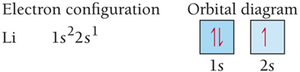
Orbital diagrams: Use boxes and arrows to represent orbitals and electron spins.
Sublevel Energy Splitting, Shielding, and Penetration
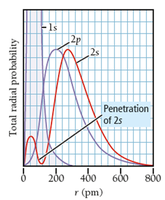
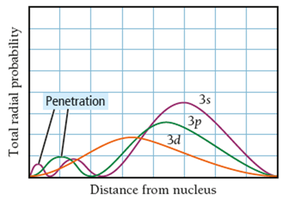
In multi-electron atoms, sublevels split in energy due to charge interactions, shielding, and penetration. Shielding occurs when inner electrons block the attraction between the nucleus and outer electrons. Penetration refers to how close an electron can get to the nucleus, affecting its energy and shielding.
Degenerate orbitals: Orbitals with the same energy.
Penetration: s orbitals penetrate more than p or d orbitals, leading to lower energy.
General Energy Ordering of Orbitals
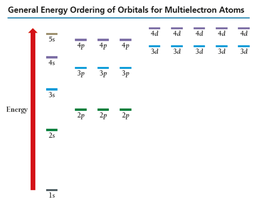
Electrons fill atomic orbitals from lowest to highest energy, following the order: 1s, 2s, 2p, 3s, 3p, 4s, 3d, 4p, 5s, 4d, 5p, 6s, 4f, 5d, 6p. This is known as the aufbau principle.
Electron Configuration Rules: Pauli Exclusion Principle and Hund’s Rule
Orbitals in the same sublevel are degenerate. The Pauli exclusion principle limits each orbital to two electrons with opposite spins. Hund’s rule states that electrons fill degenerate orbitals singly with parallel spins before pairing.

Valence Electrons and the Periodic Table
Valence electrons are those in the outermost principal energy level and are crucial for chemical bonding and reactivity. The group number of a main-group element equals its number of valence electrons, and the row number equals the highest principal quantum number.
Writing Electron Configurations from the Periodic Table
To write an electron configuration, locate the element and its atomic number, use the order of filling, and assign electrons to orbitals. Noble gas notation uses the symbol of the preceding noble gas in brackets for inner electrons.
Transition Metals and Electron Configuration Anomalies
Transition and inner transition metals (d and f blocks) often have irregular electron configurations due to small energy differences between s and d orbitals. Some elements have experimentally determined configurations that differ from expected patterns.
Periodic Trends: Atomic Radii
Atomic radius is the average distance from the nucleus to the outermost electrons. It increases down a group (due to higher principal energy levels) and decreases across a period (due to increased effective nuclear charge).
Van der Waals radius: Nonbonding radius.
Covalent radius: Bonding radius.
Effective Nuclear Charge and Periodic Trends
The effective nuclear charge (Zeff) is the net positive charge experienced by an electron. Core electrons shield outer electrons efficiently, while valence electrons do not shield each other well. Zeff increases across a period and decreases down a group.
Magnetic Properties of Ions
Atoms or ions with unpaired electrons are paramagnetic (attracted to a magnetic field), while those with all paired electrons are diamagnetic (slightly repelled by a magnetic field).
Radii of Atoms and Their Ions
Cations are smaller than their neutral atoms due to increased effective nuclear charge after electron loss. Anions are larger than their neutral atoms because added electrons experience less effective nuclear charge. Ion size increases down a group and decreases across a period for isoelectronic ions.
Periodic Trend: Ionization Energy
Ionization energy is the minimum energy required to remove an electron from an atom in the gas phase. It decreases down a group (outer electrons farther from nucleus) and increases across a period (greater effective nuclear charge).
Periodic Trend: Electron Affinity
Electron affinity is the energy change when an electron is added to an atom. It is generally exothermic (energy released), but can be endothermic for some elements. Electron affinity becomes more negative across a period, with halogens having the highest values.
Periodic Trend: Metallic Character
Metallic character describes how closely an element’s properties match those of a metal. It decreases across a period and increases down a group. Metals are malleable, ductile, conduct heat and electricity, and tend to lose electrons in reactions.
Summary Table: Periodic Properties
The periodic table summarizes trends in atomic radius, ionization energy, electron affinity, and metallic character, helping predict elemental behavior and reactivity.
*Additional info: Academic context was added to clarify definitions, rules, and examples for each topic, and to ensure completeness for exam preparation.*
