 Indietro
Periodic Properties of the Elements: Structure, Electron Configuration, and Trends
Guida di studio - Note intelligenti
 Appunti personalizzati basati sui tuoi materiali, ampliati con definizioni chiave, esempi e contesto.
Periodic Properties of the Elements
Elemental Patterns and the Periodic Law
The periodic table organizes elements based on recurring patterns in their physical and chemical properties. These patterns, known as periodic properties, allow scientists to predict the behavior of elements and even the existence of undiscovered ones.
Periodic property: A property predictable based on an element’s position in the periodic table.
Example: Density increases as you move down a column due to increasing mass-to-volume ratio.
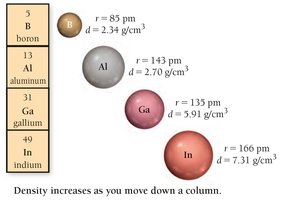
Mendeleev’s Periodic Law: When elements are arranged in order of increasing mass, certain sets of properties recur periodically.

Mendeleev’s table organized elements so that those with similar properties fell into the same columns, allowing predictions of undiscovered elements.

The Modern Periodic Table
Today, elements are arranged by increasing atomic number rather than mass. Rows are called periods, and columns are called groups or families. Elements in a group share similar properties.
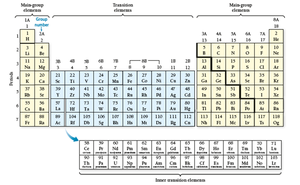
Main-group elements: Properties are predictable based on position (labeled with A).
Transition and inner transition elements: Properties are less predictable (labeled with B).
Electron Configuration and Quantum Theory
Electron Configuration: How Electrons Occupy Orbitals
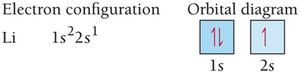
Quantum-mechanical theory describes the arrangement of electrons in atoms. Electrons occupy orbitals, and their arrangement is called the electron configuration.
Orbitals: Regions of space where electrons are likely to be found.
Electron configuration: Notation showing which orbitals electrons occupy.
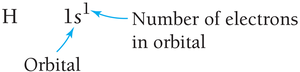
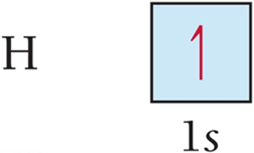
For multi-electron atoms, electron–electron interactions complicate the arrangement, but orbitals remain hydrogen-like. Two key concepts are electron spin and energy splitting of sublevels.
Electron Spin and the Pauli Exclusion Principle
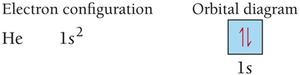
Electrons possess a property called spin, which is quantized and can be either up or down. The spin quantum number () describes this property.
Paired spins: Two electrons in an orbital must have opposite spins.
Pauli Exclusion Principle: No two electrons in an atom can have the same set of four quantum numbers; thus, each orbital holds a maximum of two electrons with opposite spins.
Sublevel Energy Splitting, Shielding, and Penetration
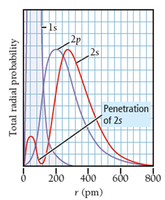
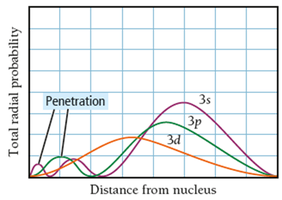
In multi-electron atoms, sublevels (s, p, d, f) within a principal energy level are not degenerate due to charge interaction, shielding, and penetration.
Shielding: Electrons block the attraction between other electrons and the nucleus.
Penetration: Electrons in orbitals closer to the nucleus experience greater attraction.
General Energy Ordering of Orbitals
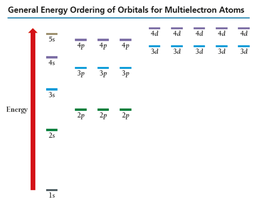
Electrons fill orbitals from lowest to highest energy, following the aufbau principle. The order is:
1s → 2s → 2p → 3s → 3p → 4s → 3d → 4p → 5s → 4d → 5p → 6s → 4f → 5d → 6p
Rules for Electron Configuration
Aufbau Principle: Fill lowest energy orbitals first.
Pauli Exclusion Principle: Maximum two electrons per orbital, with opposite spins.
Hund’s Rule: When filling degenerate orbitals, place one electron in each before pairing.

Valence Electrons and the Periodic Table
Core vs. Valence Electrons
Core electrons are in lower-energy shells, while valence electrons are in the outermost shell and participate in bonding and ion formation.
Valence electrons determine chemical and physical behavior.
Periodic Table Organization: Orbital Blocks
The periodic table is divided into four blocks (s, p, d, f) based on the filling of quantum sublevels. The group number of a main-group element equals its number of valence electrons; the row number equals its highest principal quantum number.
Writing Electron Configurations from the Periodic Table
Locate the element and its atomic number.
Use the order of filling to distribute electrons in orbitals.
Use noble gas notation for inner electron configuration.
Periodic Trends and Properties
Atomic Radii
Atomic radius is the average distance from the nucleus to the outermost electrons. It increases down a group and decreases across a period.
Down a group: Valence shell farther from nucleus, larger radius.
Across a period: Effective nuclear charge increases, valence shell held closer, smaller radius.
Effective Nuclear Charge ()
The effective nuclear charge is the net positive charge attracting an electron, accounting for shielding by core electrons. It increases across a period and decreases down a group.
Ionization Energy
Ionization energy (IE) is the minimum energy required to remove an electron from an atom in the gas phase. It decreases down a group and increases across a period.
First ionization energy: Energy to remove the first electron.
Successive ionization energies: Each removal costs more energy, especially when removing core electrons.
Electron Affinity (EA)
Electron affinity is the energy change when an atom gains an electron. It is generally exothermic and becomes more negative across a period. Halogens have the highest electron affinity.
Metallic Character
Metallic character describes how closely an element’s properties match those of a metal. It increases down a group and decreases across a period.
Metals: Malleable, ductile, conduct heat/electricity, form cations.
Nonmetals: Brittle, insulators, form anions.
Summary Table: Periodic Properties
Property | Trend Down a Group | Trend Across a Period |
|---|---|---|
Atomic Radius | Increases | Decreases |
Ionization Energy | Decreases | Increases |
Electron Affinity | Irregular | Becomes more negative |
Metallic Character | Increases | Decreases |
Effective Nuclear Charge | Decreases | Increases |
Key Equations
Coulomb’s Law:
Effective Nuclear Charge:
Practice and Application
Write electron configurations for elements using the periodic table.
Predict atomic and ionic radii, ionization energies, and metallic character based on periodic trends.
Identify valence and core electrons for main-group elements.
Additional info: These notes expand on brief points with academic context, definitions, and examples to ensure completeness and clarity for exam preparation.
