 Indietro
Periodic Properties of the Elements: Structure, Electron Configuration, and Trends
Guida di studio - Note intelligenti
 Appunti personalizzati basati sui tuoi materiali, ampliati con definizioni chiave, esempi e contesto.
Periodic Properties of the Elements
The Modern Periodic Table
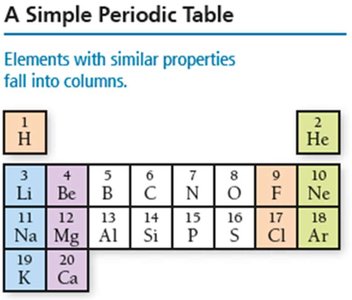
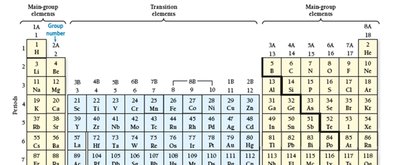
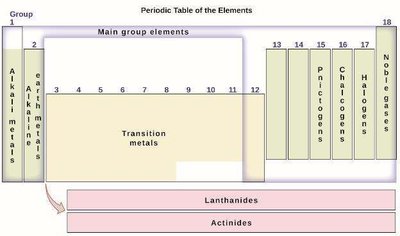
The periodic table is a fundamental tool in chemistry, organizing elements by increasing atomic number and grouping them according to similar properties. Rows are called periods, and columns are called groups or families. Elements in the same group exhibit similar chemical behaviors, explained by quantum theory.
Main-group elements: Properties are predictable based on position (labeled with a number and 'A').
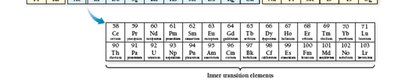
Transition and inner transition elements: Properties are less predictable (labeled with a number and 'B').
Classification: Metals, nonmetals, and metalloids.
Electron Configuration and Quantum Theory
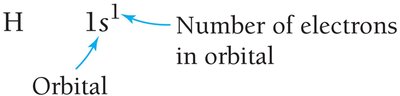
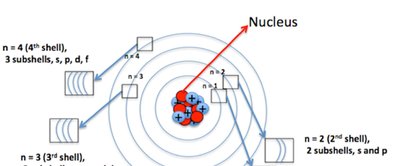
Quantum-mechanical theory describes how electrons occupy orbitals in atoms. The arrangement of electrons is called the electron configuration, which determines chemical properties.
Electrons fill orbitals from lowest to highest energy (Aufbau principle).
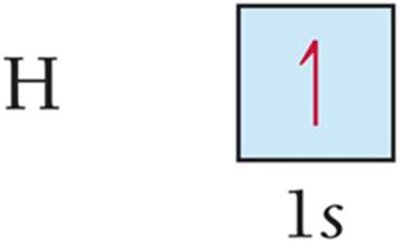
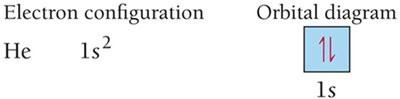
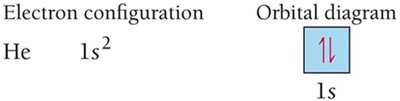
Each orbital can hold a maximum of two electrons with opposite spins (Pauli exclusion principle).
Hund's rule: Electrons occupy degenerate orbitals singly before pairing.
Quantum Numbers
Principal quantum number (n): Energy level.
Angular momentum quantum number (l): Sublevel (s, p, d, f).
Magnetic quantum number (ml): Orbital orientation.
Spin quantum number (ms): Electron spin (+½ or -½).
Sublevel Energy Splitting and Penetration
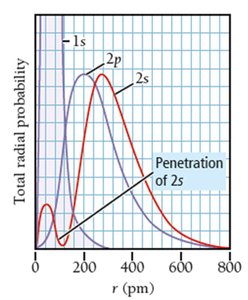
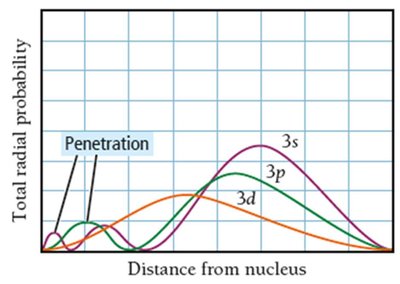
In multi-electron atoms, sublevels split in energy due to charge interaction, shielding, and penetration. Lower l values correspond to lower energy.
Energy order:
Penetration: s orbitals penetrate closer to the nucleus than p or d orbitals.
Coulomb’s Law and Effective Nuclear Charge
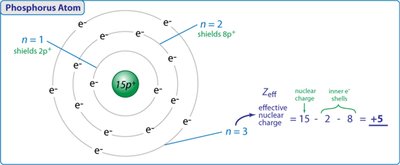
Coulomb’s law describes the forces between charged particles. In atoms, electrons experience both attraction to the nucleus and repulsion from other electrons, leading to shielding and a reduced effective nuclear charge (Z_{eff}).
Formula:
Shielding reduces the attraction felt by outer electrons.
Penetration increases the attraction for electrons in orbitals closer to the nucleus.
General Energy Ordering of Orbitals
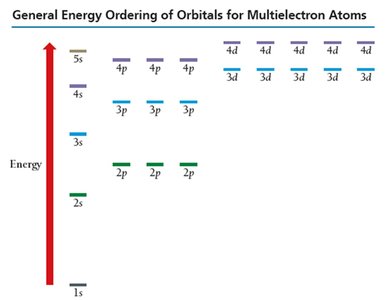
Electrons fill orbitals in a specific order to minimize energy:
Order: 1s, 2s, 2p, 3s, 3p, 4s, 3d, 4p, 5s, 4d, 5p, 6s, 4f, 5d, 6p
Writing Electron Configurations
To write electron configurations:
Find the atomic number (number of electrons).
Distribute electrons according to the filling order.
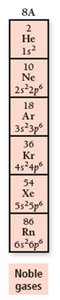
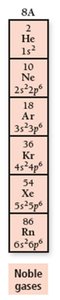
Use noble gas notation for inner electrons.
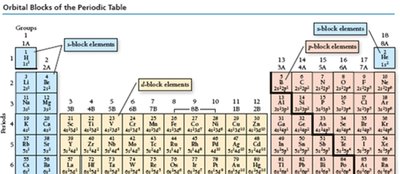
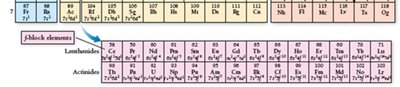
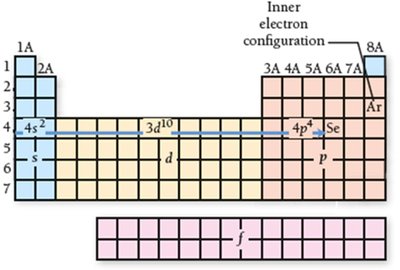
Orbital Diagrams and Valence Electrons
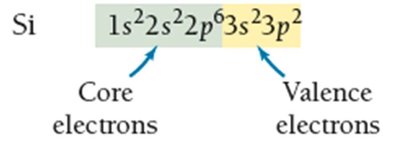
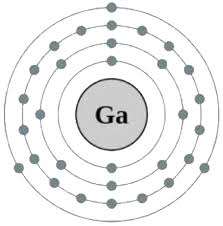
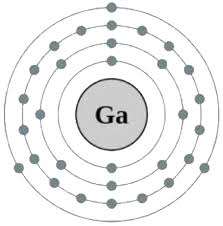
Orbital diagrams visually represent electron configurations. Valence electrons are those in the outermost shell and are crucial for chemical bonding.
Core electrons: Lower energy shells.
Valence electrons: Highest principal energy shell.



Transition Metals and Electron Configuration Anomalies
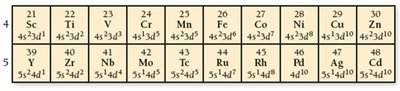
Transition and inner transition metals may have irregular electron configurations due to stability of half-filled or fully-filled d sublevels.
Example: Cr expected [Ar]4s23d4, found [Ar]4s13d5
Cu expected [Ar]4s23d9, found [Ar]4s13d10
Periodic Trends: Atomic Radii
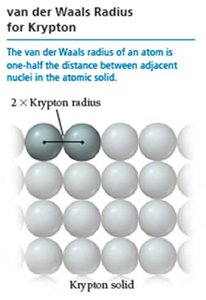
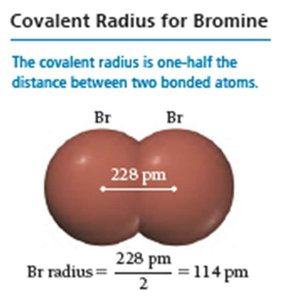
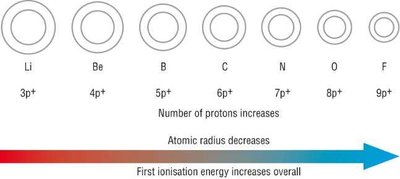
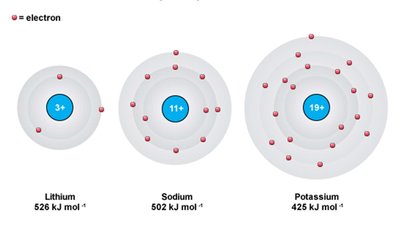
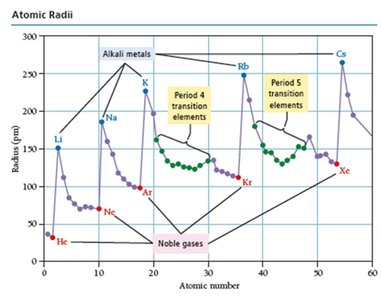
Atomic radius is the average distance from the nucleus to the outermost electrons. It varies across the periodic table:
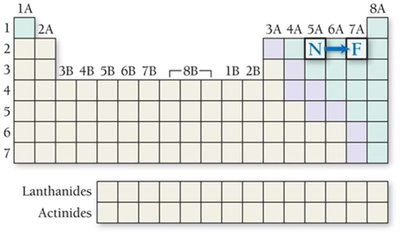
Decreases across a period (left to right) due to increased effective nuclear charge.
Increases down a group due to higher principal quantum number.

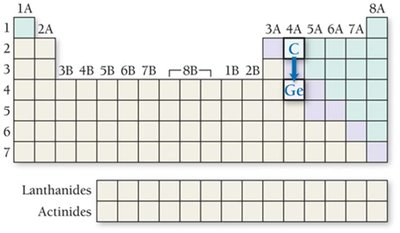
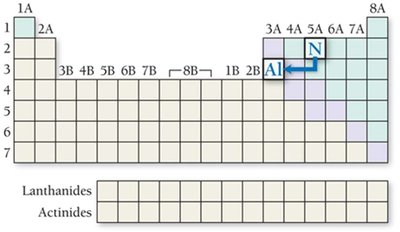
Radii of Atoms and Ions
Cations are smaller than their neutral atoms due to loss of electrons and increased effective nuclear charge. Anions are larger due to added electrons and increased repulsion.
Isoelectronic species: Higher nuclear charge means smaller radius.
Periodic Trend: Ionization Energy
Ionization energy is the energy required to remove an electron from an atom in the gas phase. It is always endothermic.
Decreases down a group (outer electrons farther from nucleus).
Increases across a period (higher effective nuclear charge).
Exceptions occur due to sublevel stability and electron repulsion.
Periodic Trend: Electron Affinity
Electron affinity is the energy change when an electron is added to an atom. It is usually exothermic, but can be endothermic for some elements.
Becomes more negative across a period (left to right).
Halogens have the highest electron affinity.
No clear trend down a group.
Periodic Trend: Metallic Character
Metallic character describes how closely an element's properties match those of a metal.
Decreases across a period (left to right).
Increases down a group.
Summary Table: Periodic Properties
Property | Trend Across Row | Trend Down Column |
|---|---|---|
Atomic Radii | Decreases | Increases |
First Ionization Energy | Increases | Decreases |
Electron Affinity | Becomes more negative | No definite trend |
Metallic Character | Decreases | Increases |
Magnetic Properties of Ions
Atoms or ions with unpaired electrons are paramagnetic (attracted to a magnetic field). Those with all paired electrons are diamagnetic (slightly repelled).
Key Equations
Coulomb’s Law:
Effective Nuclear Charge:
Examples and Applications
Writing electron configurations for main-group and transition elements.
Predicting atomic and ionic radii based on periodic trends.
Determining ionization energy and electron affinity for elements.
Classifying elements as metals, nonmetals, or metalloids based on their properties and position in the periodic table.
Additional info:
Periodic properties are explained by quantum mechanics and electron configuration.
Valence electrons are most important for chemical reactivity and bonding.
