 Indietro
Periodic Properties of the Elements: Structure, Trends, and Electron Configuration
Guida di studio - Note intelligenti
 Appunti personalizzati basati sui tuoi materiali, ampliati con definizioni chiave, esempi e contesto.
Periodic Properties of the Elements
Introduction to Periodic Properties
The periodic table organizes elements according to recurring patterns in their physical and chemical properties. These patterns, known as periodic properties, allow scientists to predict the behavior of elements and the existence of undiscovered elements. Periodic properties are closely related to the arrangement of electrons in atoms and the structure of the periodic table.
The Periodic Law and the Development of the Periodic Table
The Periodic Law
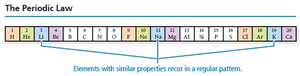
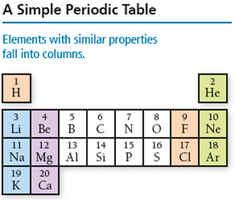
The periodic law states: "When the elements are arranged in order of increasing mass, certain sets of properties recur periodically." This law was first formulated by Dmitri Mendeleev in 1869, who organized the known elements into a table so that elements with similar properties fell into the same columns. Mendeleev's table contained gaps, which allowed him to predict the existence and properties of undiscovered elements.

The Modern Periodic Table
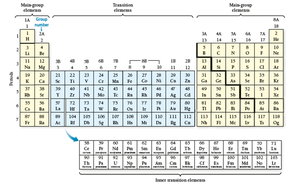
Today, the periodic table is organized by increasing atomic number (number of protons), not atomic mass. The table is divided into rows called periods and columns called groups or families. Elements in the same group have similar chemical properties. The periodic table is further divided into main-group elements, transition elements, and inner transition elements.
Classification of Elements
Metals, Nonmetals, and Metalloids
Elements are classified as metals, nonmetals, or metalloids based on their properties:
Metals: Good conductors of heat and electricity, malleable, ductile, and lustrous. Tend to lose electrons in chemical reactions.
Nonmetals: Poor conductors, brittle in solid state, and tend to gain electrons in reactions.
Metalloids: Exhibit properties intermediate between metals and nonmetals.
Main-Group, Transition, and Inner Transition Elements
Main-group elements (s and p blocks) have predictable properties. Transition elements (d block) and inner transition elements (f block) have less predictable properties due to their electron configurations.
Electron Configuration and Quantum Theory
Quantum-Mechanical Model of the Atom
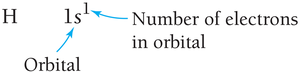
Quantum mechanics describes electrons as occupying orbitals—regions of space where the probability of finding an electron is high. The arrangement of electrons in these orbitals is called the electron configuration.
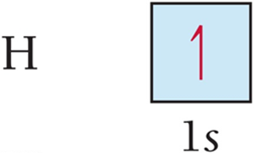
Electron Spin and the Pauli Exclusion Principle
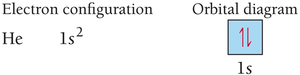
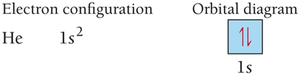
Each electron has a property called spin, which can be either up or down. The Pauli exclusion principle states that no two electrons in an atom can have the same set of four quantum numbers, so each orbital can hold a maximum of two electrons with opposite spins.
Sublevel Energy Splitting, Shielding, and Penetration
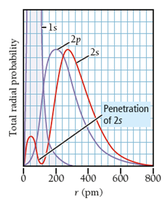
In multi-electron atoms, sublevels (s, p, d, f) have different energies due to electron-electron repulsions, shielding, and penetration effects. Shielding occurs when inner electrons block the attraction between the nucleus and outer electrons. Penetration refers to how close an electron in a given orbital can get to the nucleus, affecting its energy.
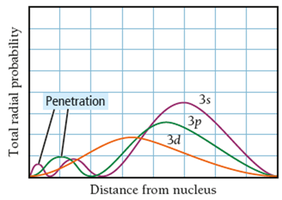
Energy Ordering of Orbitals
Electrons fill orbitals in order of increasing energy, following the aufbau principle. The general order is:
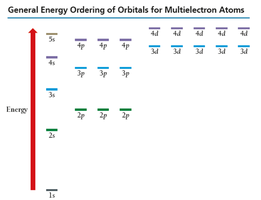
Hund's Rule
When filling orbitals of equal energy (degenerate orbitals), electrons fill them singly first, with parallel spins, before pairing up. This minimizes electron repulsion and stabilizes the atom.

Electron Configuration and the Periodic Table
Writing Electron Configurations
To write the electron configuration for an element:
Locate the element and determine its atomic number (number of electrons).
Fill orbitals in order of increasing energy, following the aufbau principle, Pauli exclusion principle, and Hund's rule.
Use noble gas notation for inner electrons when appropriate.
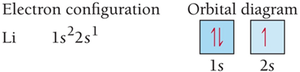

Valence and Core Electrons
Valence electrons are those in the outermost principal energy level and are responsible for chemical bonding. Core electrons are in inner shells and do not participate in bonding.
Periodic Table Blocks
The periodic table is divided into s, p, d, and f blocks, corresponding to the sublevel being filled. The group number of a main-group element equals its number of valence electrons; the period number equals the highest principal quantum number in its electron configuration.
Periodic Trends in Elemental Properties
Atomic Radius
The atomic radius is the average distance from the nucleus to the outermost electrons. Atomic radius increases down a group (due to added energy levels) and decreases across a period (due to increasing effective nuclear charge).
Effective Nuclear Charge ()
Effective nuclear charge is the net positive charge experienced by valence electrons. It increases across a period and decreases down a group, influencing atomic size and other properties.
Ionization Energy
Ionization energy (IE) is the energy required to remove an electron from an atom in the gas phase. First ionization energy decreases down a group and increases across a period. Exceptions occur due to sublevel energies and electron repulsions.
Electron Affinity
Electron affinity (EA) is the energy change when an atom gains an electron. EA generally becomes more negative (more exothermic) across a period, with halogens having the highest (most negative) values. Trends down groups are less regular.
Metallic Character
Metallic character refers to how closely an element's properties match those of metals. Metallic character increases down a group and decreases across a period.
Summary Table: Periodic Trends
Property | Down a Group | Across a Period |
|---|---|---|
Atomic Radius | Increases | Decreases |
Ionization Energy | Decreases | Increases |
Electron Affinity | Generally less negative | More negative |
Metallic Character | Increases | Decreases |
Conclusion
The periodic table is a powerful tool for understanding and predicting the properties of elements. The arrangement of electrons in atoms, as described by quantum mechanics, underlies the periodic trends in atomic radius, ionization energy, electron affinity, and metallic character. Mastery of these concepts is essential for further study in chemistry.
