Indietro
Periodic Trends and Ionic Bonding: Lecture 10
Guida di studio - Note intelligenti
 Appunti personalizzati basati sui tuoi materiali, ampliati con definizioni chiave, esempi e contesto.
Periodic Trends
Overview of Periodic Trends
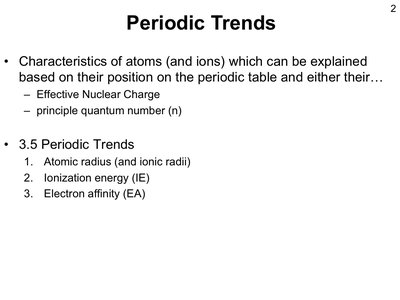
Periodic trends describe the predictable variations in atomic and ionic properties as one moves across or down the periodic table. These trends are primarily governed by effective nuclear charge and the principal quantum number (n), which influence the behavior of electrons in atoms and ions.
Effective Nuclear Charge (Zeff): The net positive charge experienced by valence electrons, accounting for shielding by inner electrons.
Principal Quantum Number (n): Indicates the energy level and relative distance of electrons from the nucleus.
Key periodic trends include atomic radius, ionization energy, and electron affinity.
Atomic Radius
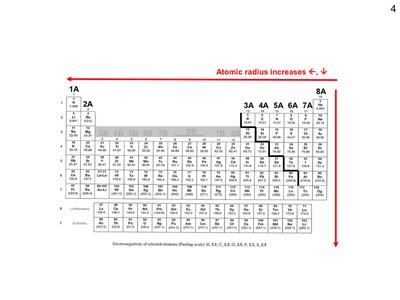
The atomic radius is the distance from the nucleus to the outermost electron shell. It varies systematically across the periodic table:
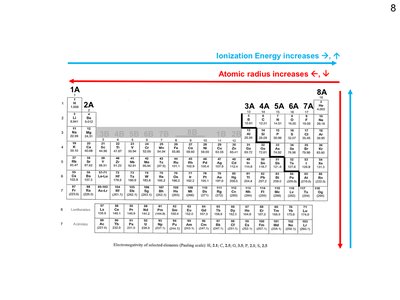
Atomic radius increases as you move down a group (due to increasing n).
Atomic radius decreases as you move across a period (due to increasing Zeff).
Ionic radius follows similar trends, but cations are smaller and anions are larger than their parent atoms.
Ionization Energy (IE)
Ionization energy is the energy required to remove an electron from an atom in its gaseous state. It reflects how strongly an atom holds onto its electrons.
IE increases across a period (left to right).
IE decreases down a group (top to bottom).
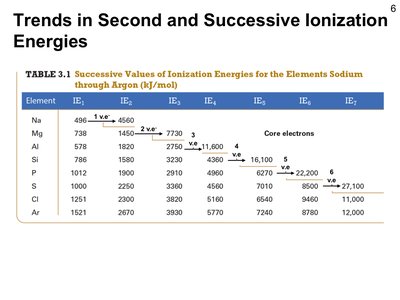
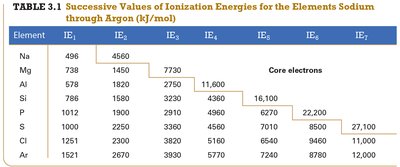
Successive ionization energies (IE1, IE2, etc.) increase as more electrons are removed, especially after all valence electrons are gone.
Equation for first ionization energy:
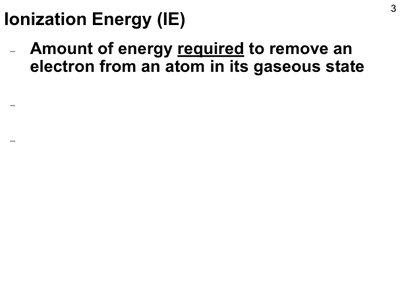

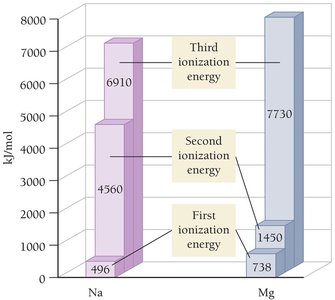
Table: Successive Ionization Energies
Element | IE1 | IE2 | IE3 | IE4 | IE5 | IE6 | IE7 |
|---|---|---|---|---|---|---|---|
Na | 496 | 4560 | 6910 | ||||
Mg | 738 | 1450 | 7730 | 10500 | |||
Al | 578 | 1820 | 2750 | 11500 | |||
Si | 786 | 1580 | 3230 | 4360 | 16100 | ||
P | 1012 | 1900 | 2910 | 4950 | 6270 | 22200 | |
S | 1000 | 2250 | 3820 | 5160 | 6540 | 9460 | 11100 |
Cl | 1251 | 2300 | 3820 | 5160 | 6540 | 9460 | 11100 |
Ar | 1521 | 2670 | 3930 | 5770 | 7240 | 9780 | 12000 |
Electron Affinity (EA)
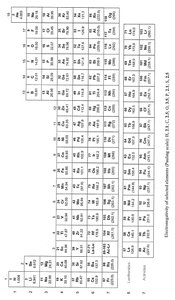
Electron affinity is the energy change when an electron is added to an atom in its gaseous state. It is a measure of an atom's tendency to accept an electron.
EA becomes more negative across a period (left to right), indicating a greater tendency to accept electrons.
EA is less negative down a group (top to bottom).
Noble gases are exceptions; their EA values are positive or near zero due to their stable electron configurations.
Equation for electron affinity:




Ionic Bonding
Introduction to Ionic Bonding
Ionic bonding occurs when atoms transfer electrons to achieve stable electron configurations, resulting in the formation of ions. The electrostatic attraction between oppositely charged ions forms an ionic compound.
Typically occurs between metals (which lose electrons) and nonmetals (which gain electrons).
Results in the formation of a crystalline lattice structure.

Properties and Examples of Ionic Bonding
Atoms react to form molecules to achieve lower energy and greater stability, often by completing their valence shell.
Sodium (Na) and Chlorine (Cl): Na loses one electron to become Na+, Cl gains one electron to become Cl-, forming NaCl.
Calcium (Ca) and Oxygen (O): Ca loses two electrons to become Ca2+, O gains two electrons to become O2-, forming CaO.
Sodium (Na) and Nitrogen (N): Na loses electrons, N gains three electrons, forming Na3N.
These reactions are driven by the tendency of atoms to achieve noble gas configurations.
Energetics of Ionic Bonding
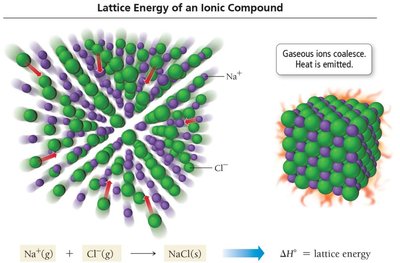
The formation of ionic compounds is accompanied by the release of energy, known as lattice energy. Lattice energy is the energy released when gaseous ions coalesce to form an ionic solid.
Lattice energy is a measure of the strength of the ionic bond.
It is influenced by the charge and size of the ions involved.
Equation for lattice energy:
Additional Information
Recommended readings and practice problems are provided to reinforce understanding of periodic trends and ionic bonding. Refer to textbook sections 3.2, 3.4, 10.2–10.5 and practice problems 3.31, 3.35, 10.35, 10.41, 10.43, 10.45, 10.47, 10.51.