 Indietro
Periodic Trends: Lecture 9
Guida di studio - Note intelligenti
 Appunti personalizzati basati sui tuoi materiali, ampliati con definizioni chiave, esempi e contesto.
Periodic Trends
Overview of Periodic Trends
Periodic trends are recurring patterns in the properties of elements that can be explained by their position on the periodic table. These trends are influenced by factors such as effective nuclear charge and the principal quantum number (n). Understanding these trends is essential for predicting the behavior of atoms and ions in chemical reactions.
Effective Nuclear Charge (Zeff): The net positive charge experienced by an electron in a multi-electron atom.
Atomic Radius: The size of an atom, typically measured from the nucleus to the outermost electron shell.
Ionic Radius: The size of an ion, which changes depending on whether the atom loses or gains electrons.
Ionization Energy (IE): The energy required to remove an electron from an atom in the gas phase.
Electron Affinity (EA): The energy change when an electron is added to a neutral atom.
Effective Nuclear Charge
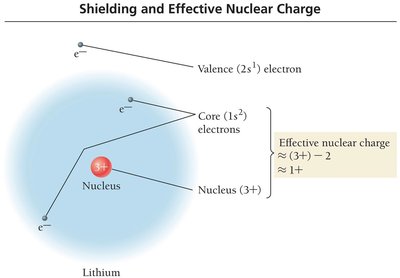
The effective nuclear charge is a key concept in understanding periodic trends. It is calculated as the difference between the actual nuclear charge (Z) and the shielding effect (S) caused by inner electrons. Electrons in the same energy level contribute minimally to shielding.
Formula:
Z: Number of protons in the nucleus (atomic number).
S: Number of electrons in lower energy levels (core electrons).
Example: For lithium, the effective nuclear charge for the valence electron is approximately .
Calculating Effective Nuclear Charge
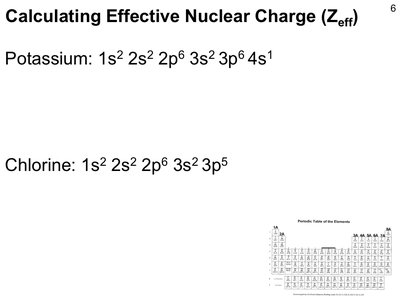
To calculate Zeff for specific elements, use their electron configurations to determine Z and S.
Potassium (K): Electron configuration: 1s2 2s2 2p6 3s2 3p6 4s1
Chlorine (Cl): Electron configuration: 1s2 2s2 2p6 3s2 3p5
Periodic Table Reference
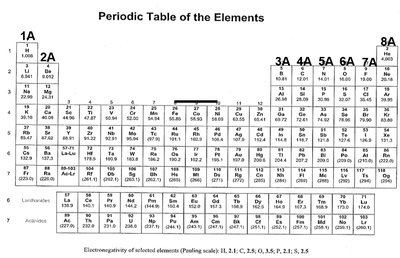
The periodic table is a fundamental tool for understanding periodic trends. It organizes elements by increasing atomic number and groups elements with similar properties together.
Atomic Radius
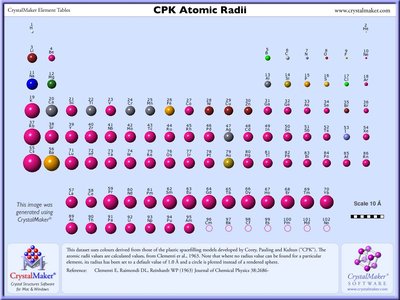
The atomic radius decreases across a period (left to right) due to increasing effective nuclear charge, which pulls electrons closer to the nucleus. It increases down a group (top to bottom) as the principal quantum number increases, adding more electron shells.
Trend: Decreases across a period, increases down a group.
Reason: Higher Zeff across a period; more electron shells down a group.
Ionic Radius
Cations
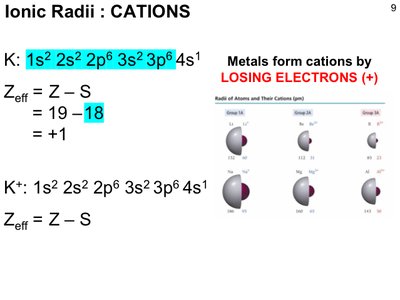
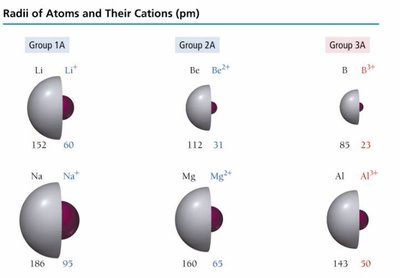
Metals form cations by losing electrons, resulting in a smaller ionic radius compared to the neutral atom. The loss of electrons reduces electron-electron repulsion and increases Zeff.
Example: K: ; K+: (but fewer electrons, smaller radius)
Trend: Cations are smaller than their parent atoms.
Anions
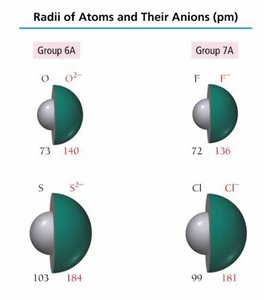
Nonmetals form anions by gaining electrons, resulting in a larger ionic radius compared to the neutral atom. The addition of electrons increases electron-electron repulsion and decreases Zeff per electron.
Example: Cl: ; Cl-: (but more electrons, larger radius)
Trend: Anions are larger than their parent atoms.
Isoelectronic Species
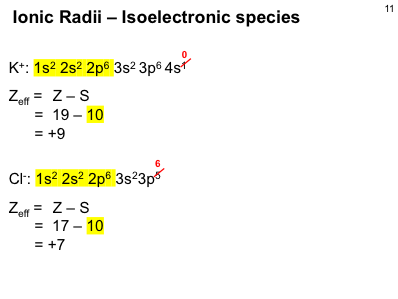
Isoelectronic species are ions or atoms with the same number of electrons but different nuclear charges. Their radii differ due to varying Zeff.
Example: K+ and Cl- both have 18 electrons, but K+ has a higher Zeff and thus a smaller radius.
Formula:
Ionization Energy (IE)
Ionization energy is the energy required to remove an electron from an atom in the gas phase. It increases across a period due to higher Zeff and decreases down a group due to increased distance from the nucleus.
Trend: Increases across a period, decreases down a group.
Reason: Higher Zeff makes electrons harder to remove; more shells make electrons easier to remove.
Electron Affinity (EA)
Electron affinity is the energy change when an electron is added to a neutral atom. Elements with high electron affinity tend to gain electrons easily, forming anions. EA generally becomes more negative across a period.
Trend: Becomes more negative across a period, less negative down a group.
Reason: Higher Zeff attracts added electrons more strongly.
Summary Table: Periodic Trends
Trend | Across Period | Down Group |
|---|---|---|
Atomic Radius | Decreases | Increases |
Ionic Radius (Cations) | Decreases | Increases |
Ionic Radius (Anions) | Decreases | Increases |
Ionization Energy | Increases | Decreases |
Electron Affinity | Becomes more negative | Becomes less negative |
Practice and Further Study
Recommended practice problems: 9.63, 9.65, 9.67, 9.73, 9.75, 9.77, 9.79, 9.81, 9.85, 9.95, 9.97, 9.99, 9.101, 9.107. Refer to textbook sections 9.6–9.9 for detailed explanations and examples.
Additional info:
Periodic trends are foundational for understanding chemical bonding, reactivity, and the properties of elements.
Isoelectronic species provide insight into how nuclear charge affects ionic size.
