 Indietro
Phase Chemistry and Colligative Properties: Study Notes for General Chemistry
Guida di studio - Note intelligenti
 Appunti personalizzati basati sui tuoi materiali, ampliati con definizioni chiave, esempi e contesto.
Phase Chemistry and Colligative Properties
Phase Changes
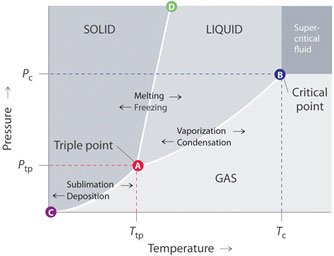
Phase changes refer to the conversion of a substance from one physical state to another, such as solid, liquid, or gas. These transitions involve energy changes but do not alter the chemical identity of the substance.
Melting/Fusion: Solid to liquid
Freezing: Liquid to solid
Vaporization: Liquid to gas
Condensation: Gas to liquid
Sublimation: Solid to gas
Deposition: Gas to solid
Energy is absorbed in melting, vaporization, and sublimation (endothermic processes).
Energy is released in freezing, condensation, and deposition (exothermic processes).
Everyday examples: Ice melting, water boiling, water vapor condensing, dry ice subliming.
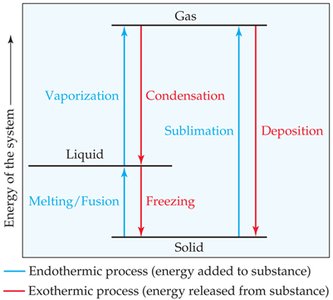
Energy Change & Change of State
Energy is required for phase changes, and the amount depends on the strength of intermolecular forces. The stronger the forces, the more energy is needed to separate particles.
Heat of fusion (ΔHfus): Energy required for solid to liquid transition.
Heat of vaporization (ΔHvap): Energy required for liquid to gas transition.
Heat of sublimation (ΔHsub): Energy required for solid to gas transition.
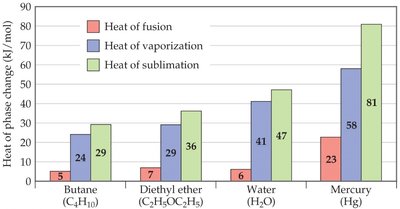
Phase Diagrams
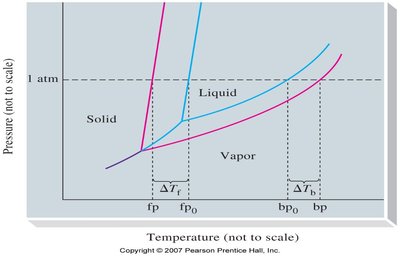
A phase diagram shows which physical state of a substance is stable at different combinations of temperature and pressure. It includes boundaries between solid, liquid, and gas phases, as well as special points:
Triple point: All three phases coexist in equilibrium.
Critical point: The liquid–vapor boundary ends; above this, the substance is a supercritical fluid.
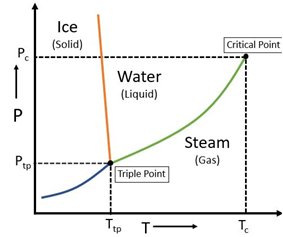
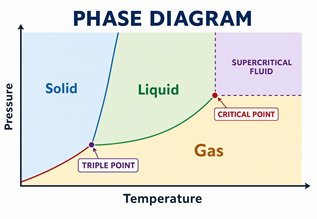
Critical Temperature & Supercritical Fluids
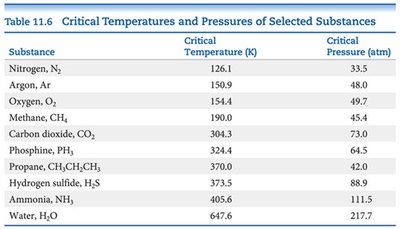
The critical temperature (Tc) is the highest temperature at which a gas can be liquefied by applying pressure. The critical pressure (Pc) is the pressure required to reach the critical point at Tc. Above these values, the substance exists as a supercritical fluid, exhibiting properties of both liquids and gases.
Supercritical CO2: Used in decaffeination and industrial extraction processes.
Solutions and Solubility
What are Solutions?
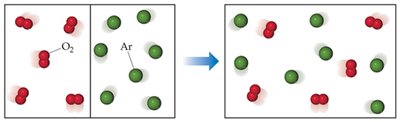
Solutions are homogeneous mixtures of two or more pure substances. The solute is dispersed uniformly throughout the solvent. The formation of solutions is favored by increased entropy (randomness) and depends on intermolecular forces.
Intermolecular Forces of Attraction
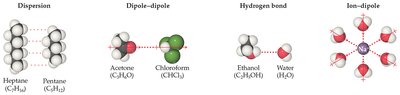
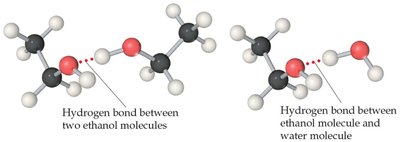
Intermolecular forces drive the interaction between solute and solvent. Types include dispersion, dipole-dipole, hydrogen bonding, and ion-dipole interactions.
Solute–solute interactions: Must be overcome to disperse solute particles.
Solvent–solvent interactions: Must be overcome to make room for solute.
Solvent–solute interactions: Occur as particles mix (solvation/hydration).
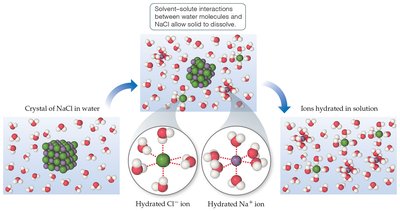
Energetics of Solution Formation
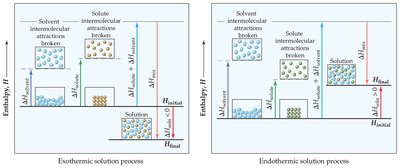
The enthalpy change of solution formation is a balance between the energy required to separate particles and the energy released when new interactions form. Entropy also plays a role.
Exothermic solutions: ΔHsoln < 0, spontaneous.
Endothermic solutions: ΔHsoln ≥ 0, may still occur if entropy increases.
Gibbs free energy: ΔG = ΔH - TΔS
Aqueous Solution vs. Chemical Reaction
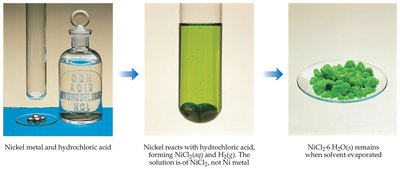
Dissolving is a physical process where the solute's chemical identity remains unchanged. A chemical reaction produces new substances.
Example: Nickel reacts with hydrochloric acid to form nickel(II) chloride and hydrogen gas.
Solubility
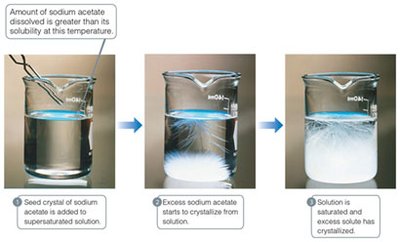
Solubility is the maximum amount of solute that can dissolve in a given amount of solvent at a specific temperature. Solutions can be saturated, unsaturated, or supersaturated.
Saturated: Maximum solute dissolved; at equilibrium.
Unsaturated: Less than maximum solute dissolved.
Supersaturated: More than equilibrium solubility; unstable.
Factors Affecting Solubility
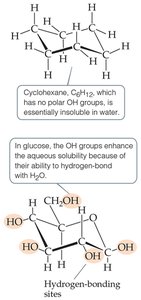
Solubility depends on solute–solvent interactions, pressure (for gases), and temperature. "Like dissolves like" is a useful guideline: polar solutes dissolve in polar solvents, nonpolar in nonpolar.
Hydrogen bonding: Increases solubility for organic molecules.
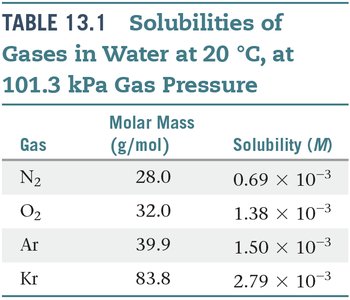
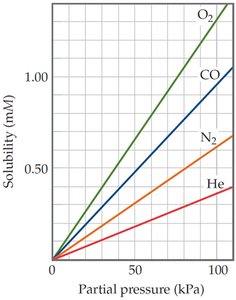
Molecular size and polarizability: Affect solubility, especially for gases.
Liquid/Liquid Solubility
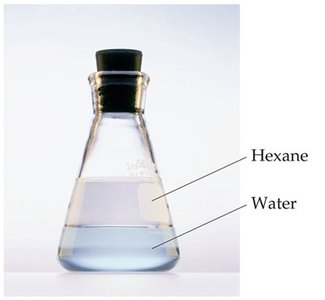
Liquids that mix in all proportions are miscible; those that do not are immiscible. Miscibility depends on the similarity of intermolecular interactions.
Example: Hexane (nonpolar) and water (polar) are immiscible.
Partially miscible: Some pairs mix to a limited extent.
Solubility and Biological Importance
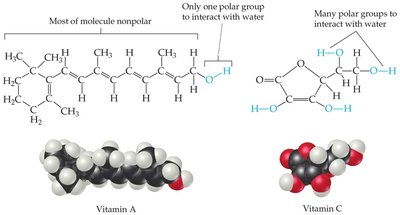
Fat-soluble vitamins (e.g., vitamin A) are nonpolar and stored in fatty tissue. Water-soluble vitamins (e.g., vitamin C) must be consumed regularly.
Pressure Effects on Solubility
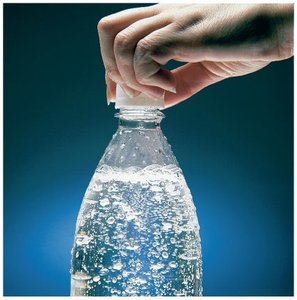
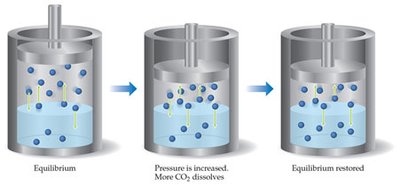
Pressure affects the solubility of gases but not solids or liquids. The solubility of a gas is proportional to its partial pressure above the solution (Henry’s Law).
Henry’s Law:
Temperature Effects on Solubility
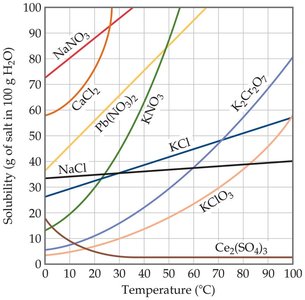
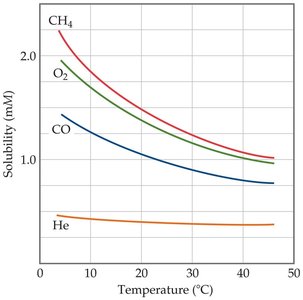
For most solids, solubility increases with temperature, but not always. For all gases, solubility decreases as temperature increases.
Solution Concentration and Units
Mass Percent
Mass percent is the ratio of the mass of solute to the total mass of solution, multiplied by 100.
Formula:
Parts per Million (ppm) and Parts per Billion (ppb)
ppm and ppb are used for very dilute solutions.
Formula for ppm:
Formula for ppb:
Mole Fraction (χ)
Mole fraction is the ratio of moles of a substance to the total number of moles in a solution.
Formula:
Molarity (M) and Molality (m)
Molarity is moles of solute per liter of solution; molality is moles of solute per kilogram of solvent.
Molarity:
Molality:
Molality does not vary with temperature (mass is constant), but molarity does (volume changes).
Colligative Properties
Definition and Types
Colligative properties depend on the number of dissolved solute particles, not their chemical identity. The main colligative properties are:
Vapour pressure lowering
Boiling point elevation
Freezing point depression
Osmotic pressure
Vapour Pressure Lowering
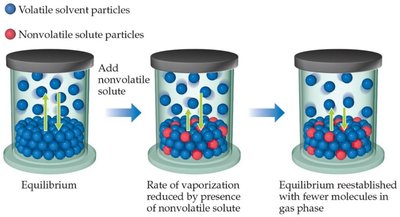
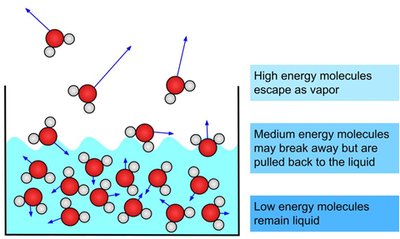
Adding a non-volatile solute to a solvent lowers the vapor pressure of the solution. This is described by Raoult’s Law:
Raoult’s Law:
Vapor pressure lowering:
Boiling Point Elevation
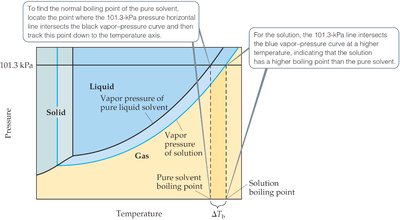
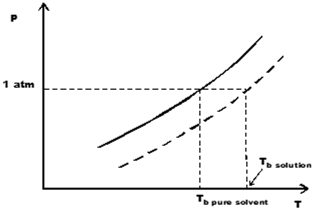
Adding solute raises the boiling point of a solution. The increase is quantified by:
Formula:
Kb: Molal boiling point elevation constant (depends on solvent).
m: Molality of solute.
i: Van't Hoff factor (number of particles produced per formula unit).
Freezing Point Depression
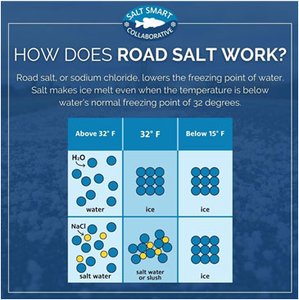
Adding solute lowers the freezing point of a solution. The decrease is quantified by:
Formula:
Kf: Molal freezing point depression constant (depends on solvent).
m: Molality of solute.
i: Van't Hoff factor.
Osmotic Pressure
Osmotic pressure is the external pressure required to stop osmosis, the net movement of solvent molecules through a semipermeable membrane toward higher solute concentration.
Formula:
Π: Osmotic pressure
M: Molarity of solution
R: Gas constant ()
T: Temperature in Kelvin
i: Van't Hoff factor
Summary Table: Colligative Properties
Property | Equation | Key Variables |
|---|---|---|
Vapour Pressure Lowering | Mole fraction, vapor pressure | |
Boiling Point Elevation | Molality, Kb, Van't Hoff factor | |
Freezing Point Depression | Molality, Kf, Van't Hoff factor | |
Osmotic Pressure | Molarity, R, T, Van't Hoff factor |
Example: Road salt lowers the freezing point of water, allowing ice to melt at temperatures below 0°C.
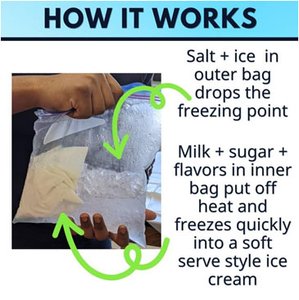
Example: Making ice cream by adding salt to ice lowers the freezing point, enabling the mixture to freeze quickly.
Example: Osmosis is critical in biological systems, such as plant cells and red blood cells.
